
NOC - Partial Differential Equations for Engineers - Solution
Explore advanced techniques for solving partial differential equations in engineering, covering various coordinate systems and problem types across multiple dimensions.
Non Linear Programming
Explore advanced optimization techniques including convex, quadratic, separable, geometric, and dynamic programming, as well as search methods and numerical integration.

Complex Integration, Cauchy and Residue Theorems - Essence of Complex Analysis
Explore complex integration, Cauchy's theorem, and the residue theorem in this intuitive explanation using Pólya vector field. Gain insights into key concepts of complex analysis.
Machine Learning Analysis of Chaos and Vice Versa - Edward Ott, University of Maryland
Exploring machine learning's effectiveness in analyzing chaotic systems and vice versa. Covers short-term forecasting, ergodic properties, Lyapunov exponents, and the interplay between chaos theory and ML in understanding complex dynamical systems.
Best Practice From Julia - Impact Through Efficient Research Code
Explore Julia's impact on efficient research code, from self-driving cars to astronomy. Learn about cutting-edge tools for mathematical modeling and machine learning in various fields.
Continuity and Rational Functions - Michaël Cadilhac, University of Oxford
Explore continuity in word-to-word functions and its connection to language classes. Delve into transducers and their role in computing continuous functions, with applications in automata theory.
Matrix Multiplication, Signals, and Convolutions
Explore matrix multiplication, natural signals, and convolutions in deep learning. Includes practical demonstrations using IPython and PyTorch.
Theory and Methods Challenges in Counterfactual Prediction - Karla Diaz-Ordaz
Explore causal inference in AI prediction, enhancing algorithms with 'what if' capabilities for decision-making and fairness. Learn about counterfactual prediction challenges and methodologies.
Enriching Latent Class Models With Counterfactual Prediction - Mark Gilthorpe
Exploring counterfactual prediction in AI: enhancing prediction algorithms with 'what if' capabilities for improved decision-making and fairness in healthcare, insurance, and beyond.

Learning From Ranks, Learning to Rank - Jean-Philippe Vert, Google Brain
Explore differentiable approaches to integrate permutations, sorting, and ranking in machine learning, focusing on embedding techniques and relaxation of ranking operators.
Can Learning Theory Resist Deep Learning? - Francis Bach, INRIA
Exploring global convergence of gradient descent in non-convex optimization for deep learning, highlighting challenges in bridging theory and practice in machine learning algorithms.
Pendulum Simulation: In Search of Chaos - Part 6
Explore chaos in double pendulum systems through simulation, analyzing different initial conditions and observing complex behavior patterns.
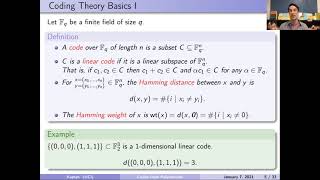
Codes from Polynomials Over Finite Fields
Explore polynomial-based coding theory, focusing on Reed-Solomon and Reed-Muller codes, their properties, and applications in error correction for reliable data transmission over noisy channels.
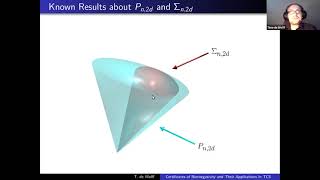
Certificates of Nonnegativity and Their Applications in Theoretical Computer Science
Explore nonnegativity certificates in real algebraic geometry, focusing on sums of squares and sums of nonnegative circuit polynomials, with applications to polynomial optimization and theoretical computer science.
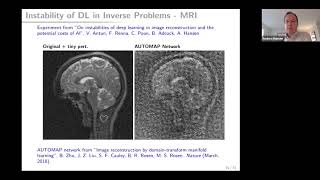
Foundations of Deep Learning and AI: Instabilities, Limitations, and Potential
Exploring deep learning's instability, AI limitations, and potential impacts on scientific computing and medical imaging. Compares AI's current state to early 20th-century mathematics, predicting similar foundational challenges.
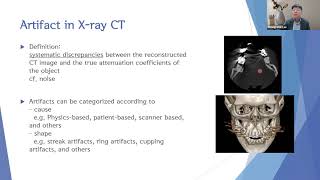
Artifact Suppression in X-ray CT Images - SIAM-IS Virtual Seminar
Explore X-ray CT imaging, artifact suppression techniques, and recent advancements in metal and scattering artifact reduction for improved medical and industrial applications.

Mathematics in Computer Animation - Pixar's Approach
Pixar engineer explores mathematical techniques behind computer-animated effects, including dynamic simulations for clothing, hair, and 3D interactive animation, showcasing real-world applications in film production.
Factorization-based Sparse Solvers and Preconditioners - Lecture 3
Explore factorization-based sparse solvers and preconditioners, covering topics like minimum degree ordering, numerical pivoting, and sparse Gaussian elimination techniques.
Functions of Matrices - Lecture 5
Explore matrix functions with Nick Higham, covering algorithms, analysis, nonnormality bounds, and practical coding experiments for advanced mathematical understanding.
Matrix Equations and Model Reduction - Lecture 3
Explore matrix equations and model reduction techniques with Peter Benner, covering enrichment, polar residual form, transfer functions, and moment matching for efficient system analysis.
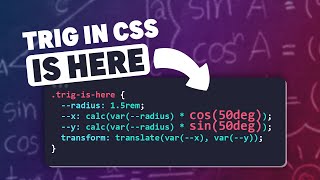
CSS Trigonometry
Explore CSS trigonometry functions sin() and cos() for creative layouts and animations. Learn practical applications and optimize with Sass loops and custom properties.