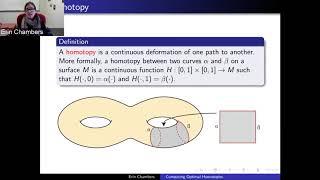
Computing Optimal Homotopies
Explore curve similarity measures and homotopy-based deformations in GIS, medical imaging, and graphics. Survey geometric and topological metrics, algorithms, and open questions in optimal homotopy computation.
Solving Equations and Optimization Problems with Uncertainty
Explore algorithms for detecting zeros of imprecise continuous functions and approximating worst-case optima in optimization problems with uncertain feasible domains.
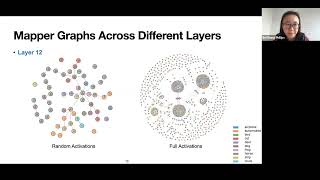
Topology of Artificial Neuron Activations in Deep Learning
Explore the topology of artificial neuron activations in deep learning, from image classification to natural language processing, with insights on convolutional neural networks and transformer-based models.
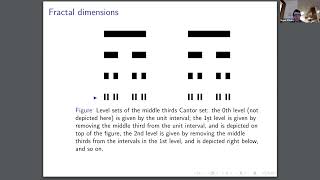
Alpha Magnitude
Explores alpha magnitude, a new metric space invariant, its properties, and potential for estimating fractal dimensions in real-world datasets, offering computational advantages over existing methods.
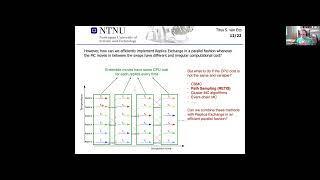
Exchanging Replicas with Unequal Cost, Infinitely and Permanently
Innovative replica exchange method for parallel simulations with varying computational costs, enhancing efficiency in Monte Carlo algorithms and path sampling techniques.
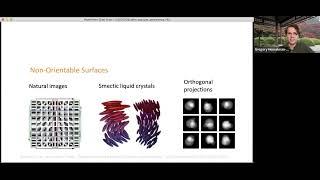
Saecular Persistence
Explore saecular persistence, a method to decompose persistence modules with non-field coefficients. Learn about applications in topology, generalized persistence diagrams, and scientific data analysis.
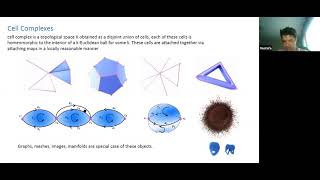
Cell Complex Neural Networks
Exploring neural network computations on cell complexes, generalizing graph neural networks and introducing inter-cellular message passing schemes that consider underlying topology.
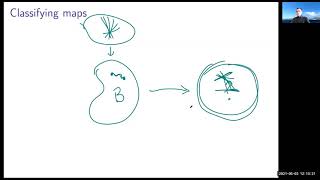
Approximate and Discrete Vector Bundles
Explore synchronization problems and dimensionality reduction through vector bundles. Learn how characteristic classes provide insights into global synchronization and data analysis challenges.

Configurations Spaces of Particles - Homological Solid, Liquid, and Gas
Exploring configuration spaces of particles with thickness, examining topological aspects of phase transitions in hard-sphere systems, and their implications for physics and mathematics.
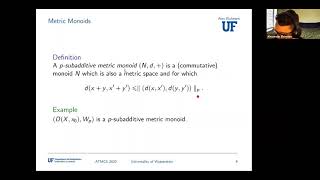
Universality of Persistence Diagrams and Bottleneck & Wasserstein Distances
Explore the mathematical foundations of persistence diagrams and their associated metrics, focusing on universality properties and distance calculations in topological data analysis.
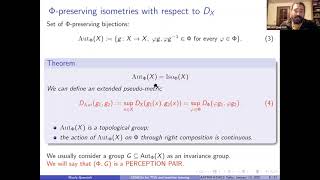
Group Equivariant Non-Expansive Operators and Their Use in Deep Learning
Explore group equivariant non-expansive operators and their applications in deep learning, focusing on topological and geometrical properties.
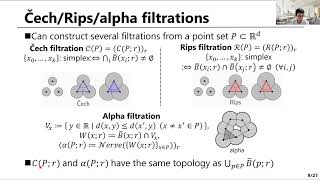
RipsNet- Fast and Robust Estimation of Persistent Homology for Point Clouds
Estimating persistence diagrams of point clouds using neural networks for faster, more robust topological analysis. Overcomes computational complexity and sensitivity to outliers in practical applications.
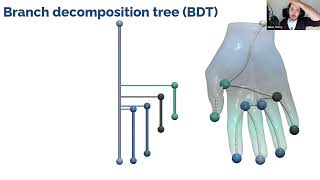
Wasserstein Distances, Geodesics and Barycenters of Merge Trees
Explore computational frameworks for merge trees, including Wasserstein distances, geodesics, and barycenters. Learn efficient algorithms and applications in visualization, feature tracking, and ensemble clustering.
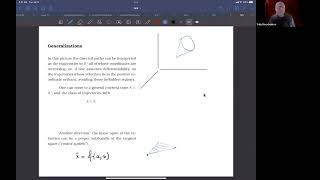
Linear Obstacles in Linear Systems and Ways to Avoid Them
Explore topology in control theory, focusing on obstacle-avoiding paths and cohomology rings using homotopy limits. Gain insights into theoretical computer science applications.
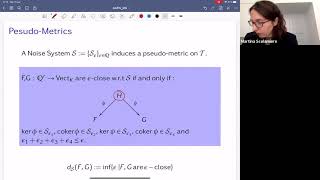
Extracting Persistence Features with Hierarchical Stabilisation
Explore hierarchical stabilisation for extracting stable invariants from persistence modules, focusing on the stable rank and its applications in data analysis and classification tasks.
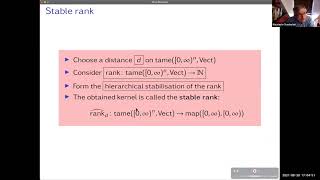
Enabling a Machine to Sense Geometry
Explore how to construct a reach space of kernels on persistent modules, enabling machine intelligence to sense geometry, with applications in synthetic and real scenarios.
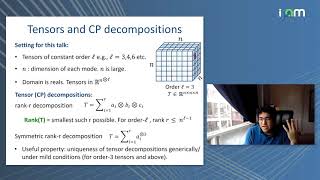
Smoothed Analysis for Tensor Decompositions and Unsupervised Learning
Explore smoothed analysis for tensor decompositions and unsupervised learning, focusing on polynomial time guarantees and robust decompositions of symmetric overcomplete tensors.
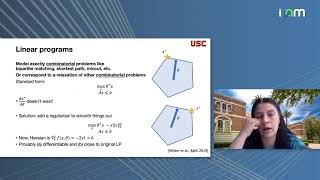
Decision-Focused Learning - Integrating Downstream Combinatorics in ML
Explore the integration of machine learning and discrete optimization to enhance problem-solving in real-world scenarios, focusing on decision-focused learning and tailored solution strategies.
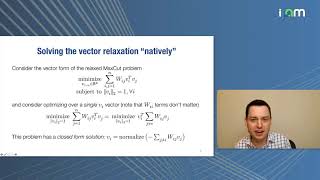
Fast Semidefinite Programming for Differentiable Combinatorial Optimization
Explore advanced techniques in semidefinite programming for combinatorial optimization, focusing on fast and differentiable methods presented by Carnegie Mellon expert Zico Kolter.
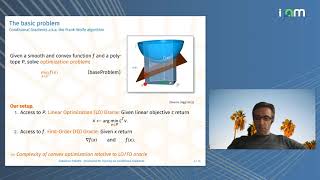
Structured ML Training via Conditional Gradients
Explore conditional gradient methods for structured optimization in machine learning, covering applications in traditional and deep learning, with a focus on incorporating polyhedral structures into solutions.

Transportation Engineering for Connected and Automated Vehicles
Explore the impact of connected and automated vehicles on transportation engineering, focusing on mathematical challenges and opportunities in this emerging field.