Spacetime, Quantum Mechanics and Positive Geometry by Nima Arkani Hamed
Explore the intersection of spacetime, quantum mechanics, and positive geometry, delving into scattering amplitudes, the mystery of time, and emergent phenomena in theoretical physics.
Quantum Field Theory as the Language of Physics by Nathan Seiberg
Explore quantum field theory's role as the universal language of physics, its applications, limitations, and potential reformulation in this insightful talk by Nathan Seiberg.
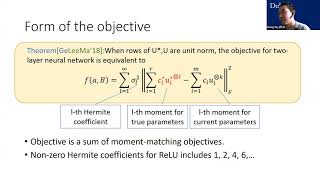
Beyond Lazy Training for Over-parameterized Tensor Decomposition
Explore over-parameterization in tensor decomposition, comparing lazy training and gradient descent approaches. Discover how gradient descent can leverage low-rank data structure beyond lazy training regimes.
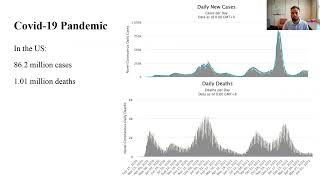
Mathematical Modeling of Diseases Spread - The Dextrous Use of Simple Machine-Learning Tools
Explore machine learning techniques for modeling disease spread, focusing on data preparation, model training, and interpreting results to inform public health policies.
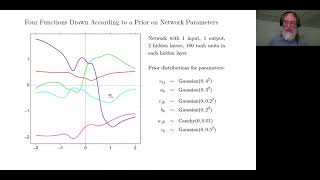
MCMC Training of Bayesian Neural Networks
Explore Bayesian Neural Networks, MCMC methods, and their applications in machine learning with Prof. Radford Neal. Gain insights into flexible modeling and practical implementations.
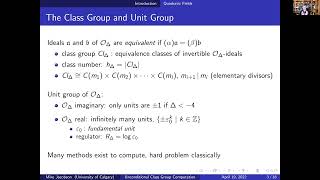
Unconditional Class Group Computation and Applications
Explore unconditional class group computation methods, their applications in cryptography, and potential quantum improvements in this advanced mathematics lecture.
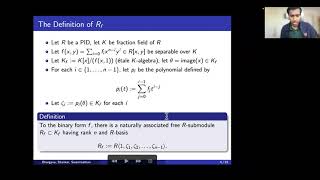
2-Selmer Groups, 2-Class Groups, and the Arithmetic of Binary Forms
Explore Selmer groups, class groups, and binary forms in number theory. Gain insights into elliptic curves, hyperelliptic Jacobians, and superelliptic equations in this advanced mathematics seminar.
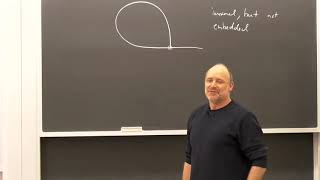
Hilbert's 16th Problem and O-Minimality - Lecture 1
Explore the topology of cycles, limit cycles, and related mathematical concepts in this advanced graduate-level lecture on Hilbert's 16th problem and o-minimality.
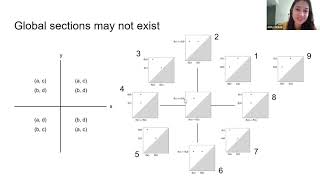
Persistence Diagram Bundles- A Multidimensional Generalization of Vineyards
Explore persistence diagram bundles, a multidimensional generalization of vineyards for analyzing topological changes in data sets with multiple parameters, including computation methods and potential applications.
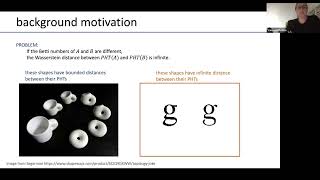
Vanessa Robins - The Extended Persistent Homology Transform for Manifolds with Boundary
Explore extended persistent homology transform for shape analysis, offering finite distances between shapes with different Betti numbers and applications in shape clustering.
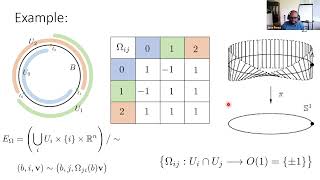
Vector Bundles for Data Alignment and Dimensionality Reduction
Explore vector bundles in data science, focusing on synchronization problems and topology-preserving dimensionality reduction. Applications in computational chemistry and dynamical systems are presented.
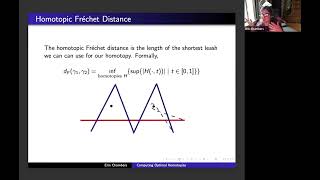
Computing Optimal Homotopies
Explore optimal curve similarity measures using homotopy-based approaches, examining structural properties, algorithms, and open questions in topology and computational geometry.
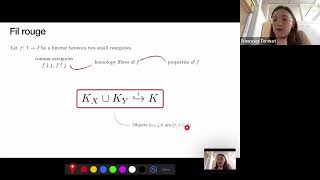
What's Behind the Homotopical Decomposition of a Simplicial Complex
Explore homotopical decomposition of simplicial complexes, focusing on conditions for homotopy type preservation and the mathematics behind decomposability results.
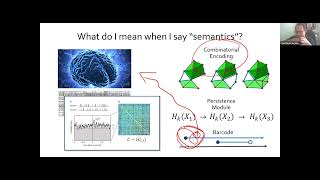
An Approach to Assigning Semantics to Persistent Homology Classes
Explore a novel approach to interpreting persistent homology classes in applied settings, overcoming traditional limitations by leveraging comparative measurements against known models.
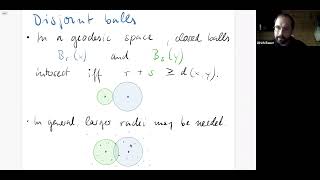
Ulrich Bauer - Gromov Hyperbolicity, Geodesic Defect, and Apparent Pairs in Rips Filtrations
Explore Gromov hyperbolicity, geodesic defect, and apparent pairs in Rips filtrations, extending Rips' results on contractibility and examining computational implications for persistent homology.
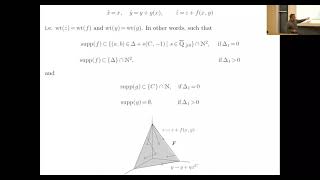
New Techniques for the Resolution of Singularities of Vector Fields and Differential Operators
Explore advanced techniques for resolving singularities in vector fields and differential operators, covering adapted charts, stable systems, and transformation methods.
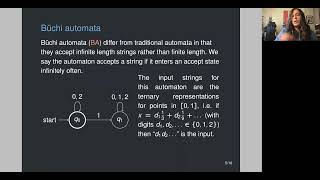
Buchi Automata and Fractals on R
Explore Buchi automata and fractals on R, covering regular languages, model theory, and first-order logic. Gain insights into sparse sets and omega languages in this mathematical journey.
Hyperbolic Geometry, the Modular Group and Diophantine Approximation - Lecture 1
Explore hyperbolic geometry, modular groups, and Diophantine approximation in this advanced lecture. Delve into fundamental concepts, geodesic flows, and subgroups of SL(2,R), with proofs and examples.
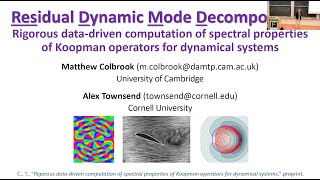
Residual Dynamic Mode Decomposition- Rigorous Data-Driven Computation of Spectral Properties of Koopman Operators for Dynamical Systems
Explore rigorous data-driven methods for computing spectral properties of Koopman operators in dynamical systems, focusing on Residual Dynamic Mode Decomposition and its applications.
Data Augmentation MCMC for Bayesian Inference from Privatized Data
Explore data augmentation MCMC for Bayesian inference from privatized data, focusing on differential privacy challenges and solutions in statistical analysis.
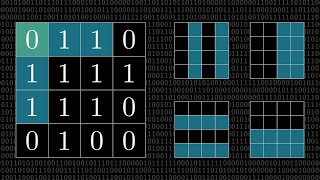
How to Send a Self-Correcting Message - Hamming Codes
Discover error correction codes through an engaging exploration of Hamming codes, learning how to create self-correcting messages for reliable data transmission.