
Math for Game Devs - Abstract Algebra, Procedural Animation & Splines
Explore advanced math concepts for game development, including abstract algebra, procedural animation, and splines. Learn about complex numbers, quaternions, and geometric algebra for enhanced game design and animation techniques.

The Beauty of Bézier Curves
Explore the mathematics and applications of Bézier curves, from basic concepts to advanced topics like derivatives, curvature, and arc length parameterization, with visual demonstrations.
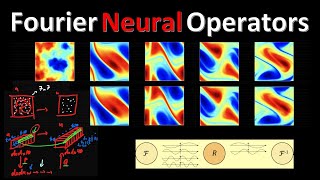
Fourier Neural Operator for Parametric Partial Differential Equations - Paper Explained
Explore a novel neural network architecture for solving partial differential equations efficiently. Learn about Fourier Neural Operators and their potential to revolutionize scientific computing and engineering simulations.

A Friendly Introduction to Linear Algebra for ML
Explore key linear algebra concepts for machine learning, including data representations, vector embeddings, and dimensionality reduction, with insights from a postdoc at X.
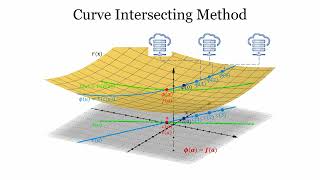
Multi-Server Verifiable Computation of Low-Degree Polynomials
Explore efficient multi-server verifiable computation techniques for low-degree polynomials, including interpolation, curve intersecting, and surface translating methods, with performance analysis and experimental results.

From Causal Inference to Autoencoders, Memorization & Gene Regulation - Caroline Uhler, MIT
Exploring causal inference, autoencoders, and gene regulation through genomics and 3D genome organization. Integrates data modalities, analyzes overparameterized autoencoders, and links memorization to real-valued data retrieval.

Fast and Optimal Low-Rank Tensor Regression via Importance - Garvesh Raskutti, UW-Madison
Explore low-rank tensor regression using importance sketching for efficient high-dimensional data analysis, with theoretical guarantees and practical applications in neuroimaging.
Sequential Design Based on Mutual Information for Computer Experiments - Joakim Beck, KAUST
Explore uncertainty quantification using Gaussian Process emulators for complex systems. Learn about sequential design methods, mutual information criteria, and applications in climate, tsunami, and earthquake modeling.

Pragmatically Ambitious Multiscale Global Temperature Reconstruction - Finn Lindgren, Edinburgh
Explore pragmatic approaches to global temperature reconstruction using multiscale models, data sources, and statistical techniques for uncertainty quantification and bias correction.
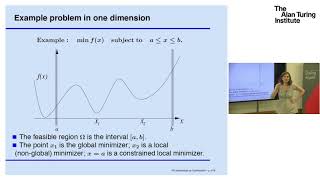
Optimisation - An Introduction: Professor Coralia Cartis, University of Oxford
Explore optimization techniques, from basic concepts to advanced methods, covering minimizers, derivatives, quadratic functions, and gradient methods for solving complex mathematical problems.

Complex Numbers for Audio Signal Processing
Explore complex numbers visually for audio signal processing, covering Cartesian and polar representations, Euler's formula, and their application in Fourier transforms.
Understanding Audio Signals for Machine Learning
Explore audio digital signals, analog-to-digital conversion, and key concepts like sampling, quantization, and aliasing for machine learning applications.
Why Does Maths Give Humans the Edge Over Machines? - With Junaid Mubeen
Exploring human mathematical intelligence and its advantages over machines, highlighting reasoning, imagination, and questioning as key principles that give humans an edge in problem-solving.

Thinking Better with Mathematics – With Marcus du Sautoy
Explore how calculus, geometry, and probability can simplify problem-solving in various fields. Learn about neural networks, efficient packing, and innovative shortcuts that have driven human progress throughout history.

A Solution to the Stable Marriage Problem - Emily Riehl Public Lecture
Explore the mathematics behind the stable marriage problem, its sexist implications, and real-world applications in this engaging lecture by mathematician Emily Riehl.
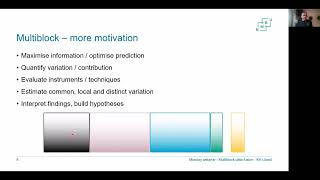
Multiblock Data Fusion
Explore multiblock data analysis techniques for integrating diverse data sources in natural and life sciences, covering key methods, applications, and interpretation strategies.
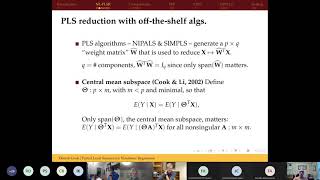
Partial Least Squares for Nonlinear Regression
Explore dimension reduction in PLS regression for nonlinear relationships, challenging traditional views and proposing new insights into PLS-like methods for predictive modeling.
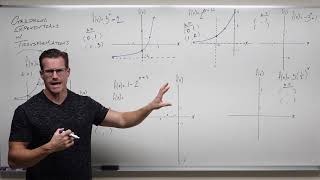
Graphing Exponential Functions with Transformations - Precalculus College Algebra
Learn to graph exponential functions using transformations, focusing on identifying key points and asymptotes in shifted locations on coordinate systems for enhanced mathematical understanding.
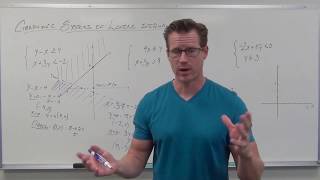
Graphing Systems of Linear Inequalities
Learn to graph and interpret systems of linear inequalities, including shading techniques and solution interpretation using the slope-intercept method.

How to Solve a Rubik's Cube in 8 Steps - The Math of Games and Puzzles
Learn an 8-step method to solve a Rubik's Cube quickly and accurately. Explore the mathematics behind the puzzle and master a world-champion algorithm to solve any cube in under three minutes.

Rays and Spheres- The Math! - Ray Tracing Series
Explore the mathematics behind ray tracing, focusing on rays, spheres, and their intersections. Learn key concepts and equations essential for implementing realistic 3D graphics rendering.