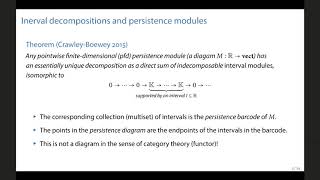
Ulrich Bauer - Persistence Diagrams as Diagrams
Explore persistence diagrams as categorical functors, examining their structure, stability, and relationships to matchings. Learn about new constructions and theorems in this advanced algebraic topology lecture.
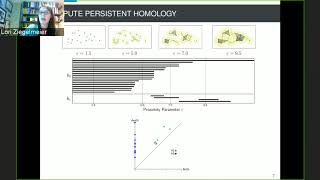
Persistence Images
Explore persistent homology and persistence images for topological data analysis. Learn to convert persistence diagrams into vector representations for machine learning applications.
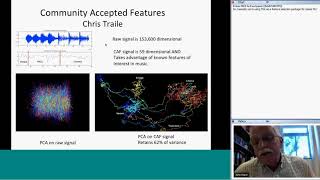
John Harer - Topological Data Analysis and Machine Learning
Explore topological data analysis and machine learning, covering methodology, examples, dimension reduction, and advanced techniques for feature extraction and classification.
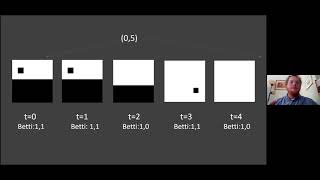
A Canonical Framework for Summarizing Persistence Diagrams
Explore a canonical framework for summarizing persistence diagrams in topological data analysis, including theoretical foundations, applications, and future developments.
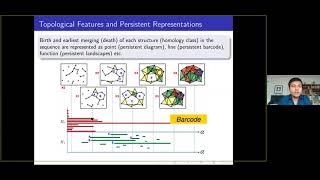
Epsilon-Net Induced Lazy Witness Complex for Topological Data Analysis
Efficient topological data analysis using epsilon-net induced lazy witness complex. Improves scalability and approximation in persistent homology computation with theoretical guarantees and algorithmic implementations.
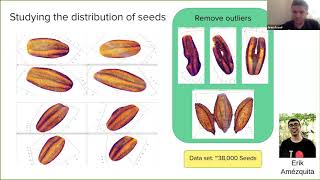
Topological Data Analysis for Quantifying Plant Morphology
Explore topological data analysis for plant morphology using persistent homology and Euclidean Distance Transform. Learn applications in hurricane video data and XRay CT scans of plants.
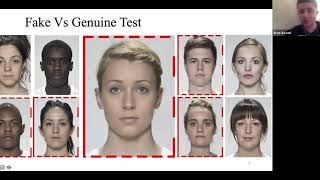
Topological Data Analysis to Detect Fake Faces From Images and Videos
Explore topological data analysis for detecting fake faces in images and videos. Learn about image landmarks, texture descriptors, and performance testing on passport photos and DeepFake videos.
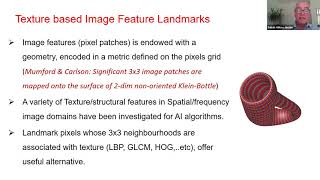
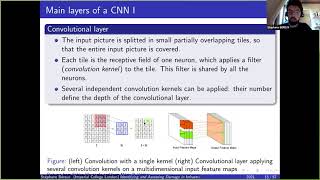
Topological Analysis of Convolutional Neural Network Layers for Image Analysis
Explore the impact of CNN layers on image topological texture features, examining their effectiveness in detecting subtle changes and understanding decision-making processes in image analysis.
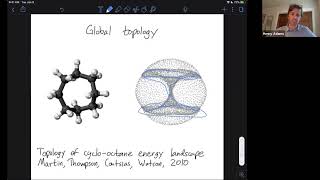
From Persistent Homology to Machine Learning
Overview of persistent homology's applications in machine learning, exploring its use in analyzing global topology and local geometry of datasets, with examples from various fields and discussions on stability and interpretability.
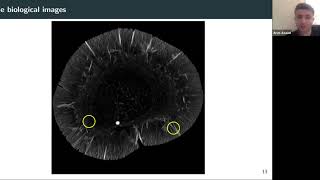
Peter Bubenik - Topological Data Analysis for Biological Images
Explore topological data analysis for biological images, combining persistent homology with machine learning to classify cell structures and analyze various image types.
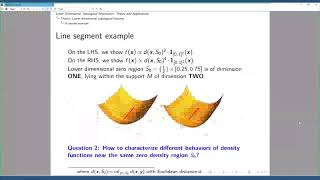
Lower Dimensional Topological Information: Theory and Applications
Explore lower dimensional topological features in data analysis, covering detection methods, theoretical foundations, and applications in image segmentation using topological and statistical approaches.
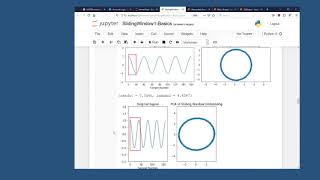
TDALabs - Some of TDA's Greatest Hits in Interactive Python
Interactive exploration of TDA's key applications using Python, covering time series analysis, image processing, 3D shape clustering, and more. Hands-on examples showcase TDA's versatility and practical uses.
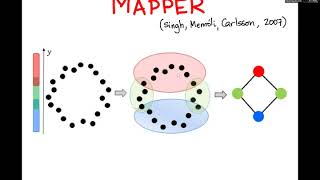
An Introduction to Mapper
Explore Mapper, a topological data analysis technique for visualizing complex datasets. Learn its principles, applications, and how it reveals hidden structures through clustering and graph representation.
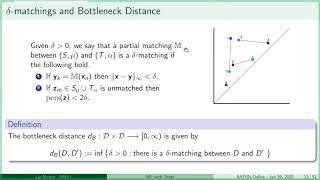
Liz Munch - Featurization of Persistence Diagrams Using Template Functions for ML Tasks
Explore topological data analysis and persistence diagrams for machine learning, focusing on featurization techniques using template functions to map complex data into Euclidean space.
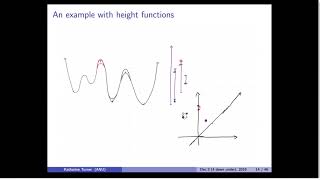
Why Should Q=P in the Wasserstein Distance Between Persistence Diagrams?
Explore Wasserstein distance in persistence diagrams, focusing on q=p choice. Covers geometric implications, stability results, algebraic versions, and computational advantages for central tendencies.
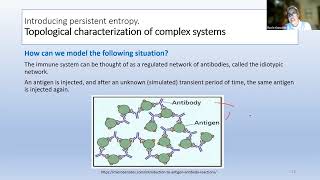
Persistent Entropy, a Tool for Topologically Summarizing Data
Explore persistent entropy as a tool for data summarization, covering its properties, stability, and diverse applications in emotion recognition, cell organization, and literary analysis.
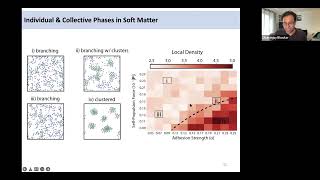
Data-Driven Modeling & TDA of Self-Organized Multicellular Architectures
Explore data-driven modeling and topological data analysis for classifying multicellular structures in cancer and embryonic development, focusing on cell motility and adhesion patterns.
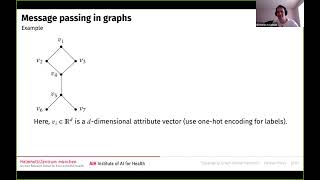
Bastian Rieck - Topological Graph Neural Networks
Explore topological data analysis in graph representation learning, focusing on novel techniques that incorporate topological features to enhance graph neural networks' expressivity and performance.
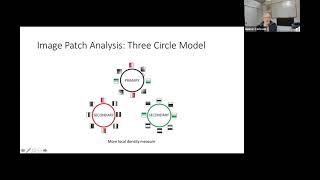
Gunnar Carlsson - Topological Deep Learning
Explore TDA-inspired approaches to deep learning, addressing issues like data hunger and generalization. Discover topological methods for building neural networks and analyzing weight spaces across various datasets.
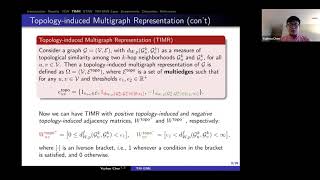
Topological Relational Learning on Graphs
Explore topological relational learning on graphs, enhancing graph neural networks with higher-order information and local structure learning for improved classification and robustness to perturbations.
Identifying and Assessing Damage in Infrastructure Using Topological Data Analysis and Machine Learning
Innovative approach using topological data analysis and machine learning for low-cost, imaging-based concrete damage assessment in infrastructure, offering a potential alternative to expensive laboratory diagnostics.