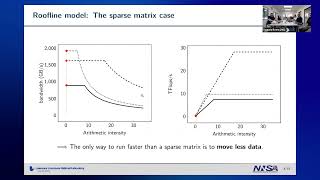
Empowering MFEM Using libCEED - MFEM Workshop 2023
Explore MFEM's enhanced capabilities through libCEED integration, including support for simplices, mixed meshes, and p-adaptivity. Discover performance gains across various HPC architectures.
MFEM Workshop 2023 - Student Lightning Talks Part 2
Explore cutting-edge research in high-order mathematical calculations for scientific simulations through student presentations on neural networks, GPU acceleration, and Monte Carlo methods.
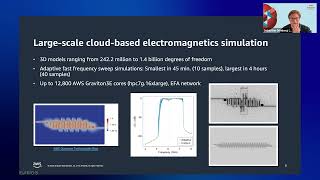
Palace: Parallel Large-scale Computational Electromagnetics - MFEM Workshop 2023
Explore Palace, a parallel finite element code for full-wave electromagnetics simulations, and its capabilities for large-scale 3D modeling in quantum computing hardware design.
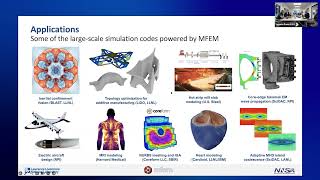
The State of MFEM - Workshop 2023
Explore MFEM's key capabilities, recent developments, and future directions in high-order finite element methods for scientific simulations.
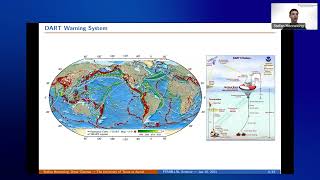
Bayesian Inversion of an Acoustic-Gravity Model for Predictive Tsunami Simulation
Explore Bayesian inversion of acoustic-gravity models for predictive tsunami simulation, focusing on real-time monitoring and early-alert systems using near-field data observation.
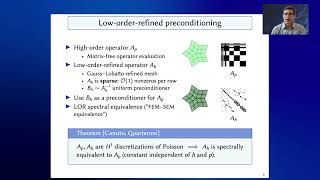
High-Order Solvers and GPU Acceleration for MFEM - Workshop 2022
Explore high-order finite element methods, GPU acceleration, and matrix-free solvers for scientific simulations using MFEM. Learn about low-order-refined preconditioning and adaptive mesh refinement.
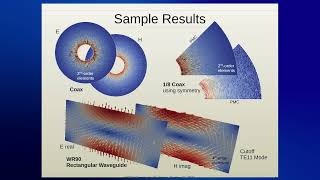
OpenParEM2D: A Free, Open-Source Electromagnetic Simulator for 2D Waveguides and Transmission Lines
Explore OpenParEM2D, a free 2D electromagnetic simulator for guided waves and transmission lines. Learn its capabilities, methodology, and applications in this insightful presentation.
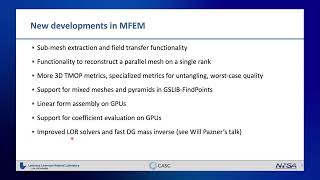
Recent Developments in MFEM - Workshop 2022
Explore recent developments in MFEM, including sub-mesh extraction, GPU-based calculations, and integrations with scientific software libraries for high-order finite element simulations.
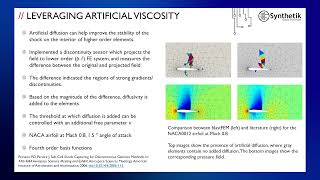
BlastFEM: GPU-Accelerated, High-Performance, Energy-Efficient Solver for Highly Compressible Flows
Explore GPU-accelerated solver for highly compressible flows, enhancing efficiency in scientific simulations across various applications. Learn about blastFEM's capabilities for next-generation computational modeling.
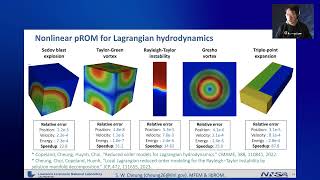
Reduced Order Modeling for Finite Element Simulations with MFEM and libROM
Explore reduced order modeling techniques for finite element simulations using MFEM and libROM. Learn to lower computational complexity while maintaining accuracy in various scientific applications.
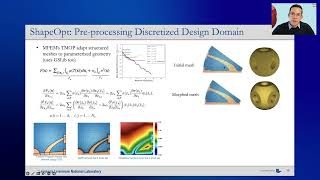
Shape and Topology Optimization Powered by MFEM - Workshop 2022
Explore shape and topology optimization using MFEM and LiDO for high-order calculations in scientific simulations, featuring multi-material geometries and HPC-powered design tools.
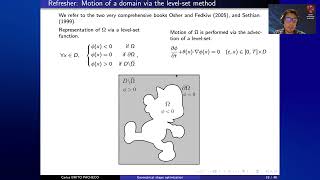
Rodin: Density and Topology Optimization Framework - MFEM Workshop 2022
Explore Rodin, a C++17 framework for shape, density, and topology optimization. Learn its functionalities, from refining shapes to solving variational problems in scientific simulations.
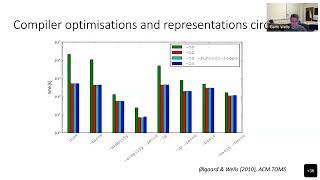
FEniCSx: Design of the Next Generation FEniCS Libraries for Finite Element Methods
Explore FEniCSx, the next-gen finite element library. Learn design improvements, high-performance kernels, and flexible solver creation in C++ or Python for partial differential equations.
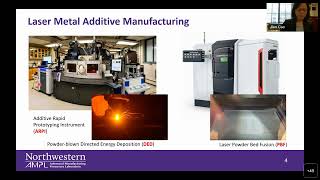
Physics-based AI-assisted Design and Control in Flexible Manufacturing
Explore physics-based AI for flexible manufacturing, focusing on metal powder additive and rapid dieless forming. Learn to integrate process mechanics, control, and machine learning for effective material behavior prediction and in-situ control.
Forging a Secure and Observable DevOps Frontier
Explore AI-driven observability and ML-enhanced security in DevOps. Learn best practices for integrating AI into the DevSecOps lifecycle to balance speed and safety in digital transformation.
人間と計算機が共存する未来
ロボット開発の最前線から、人間と技術の共生の可能性を探る。未来社会のビジョンと、若き開発者の挑戦を通じて、テクノロジーと人類の調和を考察する。
Работа с материалами ДЗЗ из космоса - Часть 3
Освойте передовые методы обработки и анализа космических снимков для решения задач дистанционного зондирования Земли.
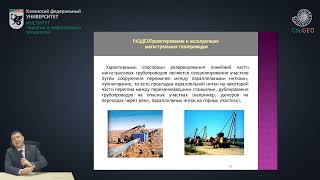
Ремонт магистральных трубопроводов
Изучите методы ремонта магистральных трубопроводов от эксперта ПАО "Транснефть". Получите практические знания для повышения квалификации в нефтегазовой отрасли.
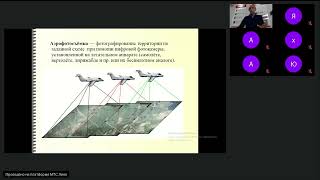
Дистанционное зондирование - 12.10.2023
Изучите основы дистанционного зондирования и его применение в геологии и нефтегазовых технологиях. Повысьте свою квалификацию в этой перспективной области.
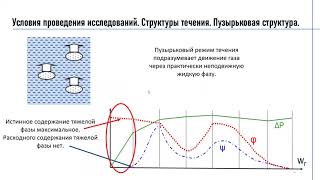
Роль информационных систем ГИС контроля при разработке месторождения - Задачи, объекты и классификация
Изучите роль, задачи и классификацию информационных систем ГИС-контроля в разработке месторождений.
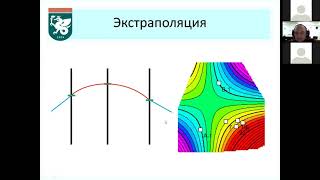
Основы прикладной геостатистики: Интерполяция, экстраполяция, аппроксимация и вариограммный анализ - Часть 2
Изучите основы прикладной геостатистики, включая интерполяцию, экстраполяцию, аппроксимацию и вариограммный анализ.