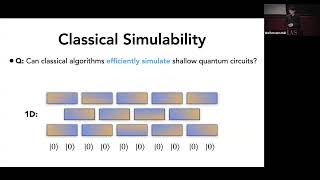
Shallow Quantum Circuits
Explore the potential of shallow quantum circuits in quantum information processing, focusing on their applications and limitations in various computational tasks.
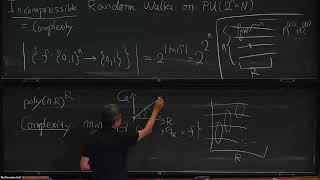
Incompressibility of Random Walks on Unitary Group
Explore the mathematical intricacies of random walks on unitary groups, delving into their incompressibility properties and implications for quantum information theory.
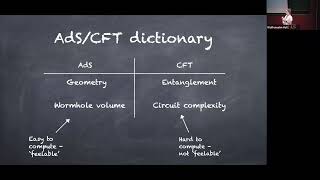
Complexity and Gravity
Explore the intricate relationship between complexity theory and gravitational physics in this advanced workshop, delving into cutting-edge research at the intersection of quantum information and theoretical physics.
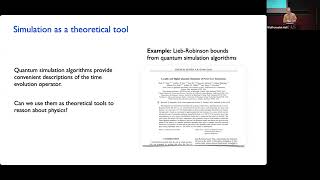
Digital Quantum Simulation Algorithms
Explore cutting-edge digital quantum simulation algorithms with expert Andrew Childs, delving into advanced techniques for modeling complex quantum systems.
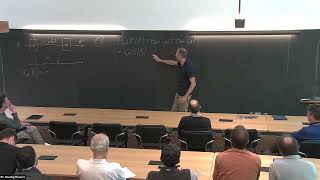
How QIT Arguments Rely on Symmetry
Explore quantum de Finetti theorem's role in deriving stochastic independence from symmetry principles, with applications to quantum information theory and black hole information puzzle.
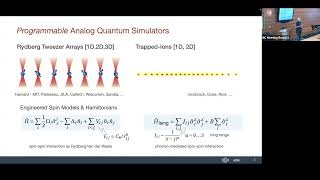
Exploring Large-Scale Entanglement in Quantum Simulation
Dive into quantum simulation's frontier, exploring large-scale entanglement with Peter Zoller. Uncover cutting-edge research and insights on this complex quantum phenomenon.
Discussion on Possible Quantum Simulation of Black Holes
Explore quantum simulation of black holes with Juan Maldacena, delving into cutting-edge physics research and its potential implications for our understanding of the universe.
Discussion on MIP* = RE
Explore the groundbreaking MIP* = RE theorem with MIT's Anand Natarajan, delving into its implications for quantum computing, complexity theory, and the foundations of mathematics.

Experimental Implementations of Quantum Computers and Simulations
Explore cutting-edge quantum computing implementations and simulations with insights from a leading expert in quantum optics and information theory.
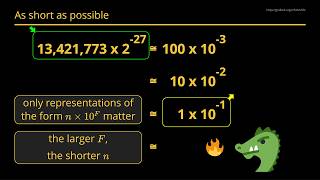
Fast Conversion from C++ Floating Point Numbers - New Dragon Algorithm
Explore advanced algorithms for converting C++ floating-point numbers to strings, including dragon-related techniques. Dive into the mathematics and intricacies behind efficient numeric representation and conversion methods.
Reflection Is Good for C++ Code Health
Explore C++ reflection's potential for C++26, including Python bindings, ABI hashing, and improved variant types. Learn how reflection can reduce repetitive code and enhance productivity.
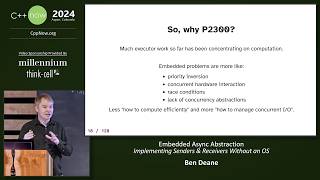
Embedded Asynchronous Abstraction C++ - Implementing Senders and Receivers Without an OS
Explore implementing senders and receivers for asynchronous work in embedded systems without an OS. Learn about P2300, concurrent behavior, and zero-cost abstractions for microcontrollers.
Value Oriented Programming Part V - Return of the Values
Explore value semantics in C++ programming, focusing on improved code readability, correctness, and maintainability. Learn techniques for value-oriented design and implementation.
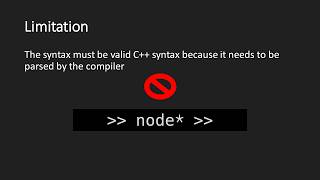
Expressive Compile-Time Parsers in C++
Explore compile-time parsers in C++ for expressive APIs and DSLs. Learn techniques, compare libraries, and discover applications in regular expressions, parser generators, and reflection features.
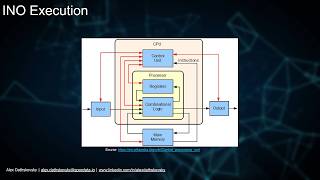
C++11 to C++23 in the C++ Memory Model - Lecture
Explore C++ memory model evolution from C++11 to C++23, covering threading, optimization, and best practices for robust, thread-safe code development.
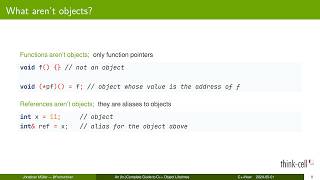
A Deep Dive Into C++ Object Lifetimes
Comprehensive exploration of C++ object lifetimes, covering creation, destruction, temporary extensions, memory management, unions, and related concepts. Insights from standards, proposals, and optimizations.
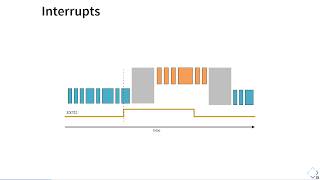
Employing Senders and Receivers to Tame Concurrency in C++ Embedded Systems
Explore how Senders and Receivers pattern can solve complex concurrency issues in baremetal systems, using Intel's open source library on an ARM-based development board.
Sailing the Security Seas with Tetragon Tutorial
Explore Tetragon for runtime security: learn to filter and examine events, strengthen defenses against intrusions, and gain hands-on experience using the tetra CLI in this interactive tutorial.
Unleashing the Power of Microservices with Dapr and Azure Container Apps
Explore how DAPR and Azure Container Apps enhance microservices scalability, resiliency, and maintainability while reducing complexity. Hands-on demonstration of building and deploying microservices to elevate your development skills.

Object Detection 101 Course - Computer Vision
Learn object detection fundamentals and apply skills in four practical projects, including car counting, people counting, PPE detection, and poker hand recognition using YOLO and computer vision techniques.
Learn OpenCV with Python - Including 3 Projects on Computer Vision
Comprehensive Python-based OpenCV tutorial covering installation, core principles, and practical projects. Ideal for beginners, focuses on hands-on implementation of computer vision techniques for real-world problem-solving.