Introduction to Artificial Intelligence - Assignment 1 and Lecture 4
Explore AI algorithms and data structures through interactive assignments in JavaScript. Learn BFS, DFS, and ID-DFS implementations for problem-solving in game environments.
Introduction to Artificial Intelligence: Hash Functions and Hash Tables - Lecture 6
Explore hash functions and hash tables in AI, covering properties, algorithms, and collision resolution techniques. Learn to implement efficient closed lists for search algorithms.
Introduction to Artificial Intelligence - Assignment 2 Overview - Lecture 7
Explore advanced AI concepts including heuristic functions, connectivity, optimizations, and bidirectional search. Gain practical insights for implementing efficient problem-solving algorithms in game environments.
Introduction to Artificial Intelligence: Game Theory and Matrix Games - Lecture 8
Explore game theory fundamentals and matrix games in AI, covering key concepts and strategies for problem-solving in competitive environments.
Introduction to Artificial Intelligence: MiniMax and AlphaBeta Search - Lecture 10
Explore MiniMax and Alpha-Beta search algorithms for two-player game AI, covering implementation, optimization, and practical applications in decision-making processes.
Minimax Search Enhancements in Artificial Intelligence - Lecture 11
Explore advanced Minimax search techniques, including move ordering, bit operations, and transposition tables, to enhance AI game-playing algorithms.
Intro to Artificial Intelligence - Evolutionary Computing - Lecture 13
Explore evolutionary computing techniques for AI problem-solving, including genetic algorithms and their applications in optimization and game AI.
Intro to Artificial Intelligence - RL Monte Carlo Methods - Lecture 18
Explore Monte Carlo methods in reinforcement learning, applying algorithmic techniques to solve AI problems in gaming environments.
Intro to Artificial Intelligence - Temporal Difference Learning - Lecture 19
Explore temporal difference learning and its applications in AI, focusing on practical implementations and problem-solving techniques.
Introduction to Artificial Intelligence: Neural Networks - Lecture 20
Explore fundamental concepts of neural networks, their structure, and applications in AI problem-solving environments.
Game Programming: Assignment 1 and C++ Environment Setup - Lecture 3
Learn game programming fundamentals, including vector math, rendering, AI, and physics. Set up C++ environment and understand assignment structure for creating functional games using ECS architecture and SFML library.

What Do You Mean by Cache Friendly - Optimizing Data Structures for CPU Performance
Explore cache-friendly data structures and algorithms in C++. Learn techniques to analyze and improve cache efficiency, optimizing performance through memory layout and access patterns.
Recipes for Reducing Allocations by C++ Containers - C++ on Sea 2022
Explore techniques to minimize allocations in C++ containers, including vector reservations, container choices, constructors, scope promotion, view types, and PMR allocators. Gain insights with benchmarks and diagnostics.

How to Rangify Your Code - C++ on Sea 2022
Learn to apply C++20 ranges to real-world code examples, using standard library and range-v3 library. Explore techniques for refactoring existing algorithms and thinking in terms of ranges.
Contractual Disappointment in C++ - Ensuring Robust Software Development
Explore effective strategies for robust C++ software development, focusing on contracts and interfaces to enhance usability, efficiency, and reliability in program operation.
New Algorithms in C++23 - Lecture 1
Explore new C++23 Ranges library algorithms and their types, from C++98 to C++23. Gain insights into advanced programming techniques and language features for efficient coding.
A Safer Iteration Model for C++ - Flux Library Introduction
Explore a safer iteration model for C++, introducing Flux library. Learn about reducing undefined behavior, performance implications, and quality-of-life improvements in C++20 Ranges.
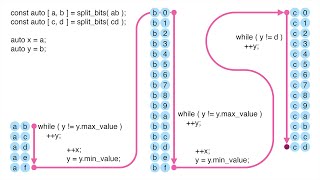
Why C++ Loops End - Midnote
Explore reasons for loop termination in C++ and learn to formally express them in code. Gain insights into stability, substitutability, and repeatability principles for robust loop design.
Polymorphism, Cohesion, and Coupling in C++ - Lecture
Explore low coupling and high cohesion through polymorphism in C++. Learn to implement a performance-efficient framework using template metaprogramming for easy composition and feature addition.
Employing Modern C++ for High Performance Delta-Coding Compression
Explore high-performance delta-coding compression using modern C++. Learn reflection-like techniques, delta compression principles, and micro-benchmarking for low-latency code optimization.
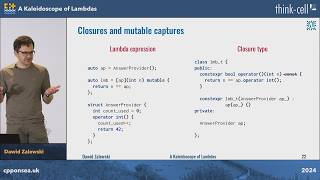
A Kaleidoscope of C++ Lambdas
Explore C++ lambda expressions' syntax, features, and applications. Learn to simplify code, implement functional programming techniques, and leverage lambda-specific idioms for more expressive and efficient C++ development.