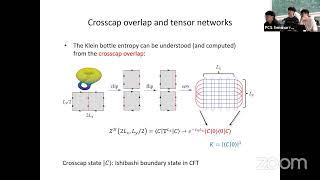
Klein Bottle Partition Function and Tensor Networks in 2D Conformal Critical Theories
Explore the combination of Klein bottle partition function and tensor networks to analyze 2D conformal critical theories and adjacent phases, including universal entropy and scaling functions.
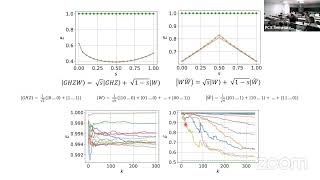
Variational Quantum Algorithms for the Geometric Measure of Entanglement
Explore Variational Quantum Algorithms, their challenges, and applications in determining Geometric Measure of Entanglement. Learn about barren plateaus and strategies to mitigate them.
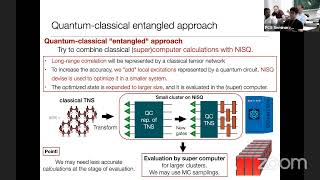
Quantum-Classical Entangled Approach with Tensor Networks for Spin Liquid
Explore quantum-classical entangled approaches using tensor networks for spin liquid states. Delve into efficient quantum circuit design for near-future noisy quantum computers, focusing on the honeycomb lattice Kitaev model.
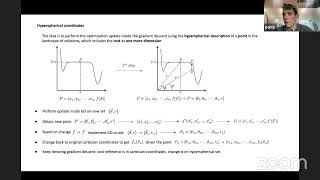
QML for Optimization via Variational Algorithms and Coordinate Transformations
Explore quantum machine learning's potential in NISQ devices, focusing on novel optimization techniques using coordinate transformations to overcome common barriers in gradient methods.
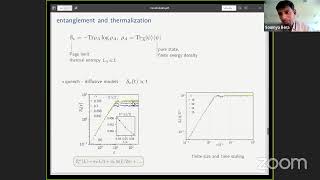
Internal Clock for Many-Body Delocalization
Explore the concept of internal clock in many-body delocalization, examining relaxation of charge imbalance and entanglement entropy in 1D disordered fermion systems.
Resource Saving via Ensemble Techniques for Quantum Neural Networks
Explore ensemble techniques for quantum neural networks, enhancing performance and mitigating hardware noise. Learn about bagging and AdaBoost methods for resource-efficient, large-scale quantum models.
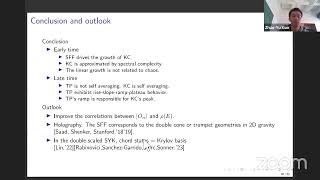
Chaos and Krylov Complexity
Explore the relationship between Krylov complexity and chaos in quantum systems, examining wave function evolution and transition probabilities to uncover universal behaviors in chaotic Hamiltonians.
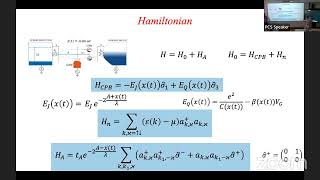
Mechanically Assisted Andreev Reflection in Cooper Pair Box Systems
Explore quantum mechanics through mechanically assisted Andreev reflection, Cooper pair boxes, and flying qubit states. Discover how mechanical motion impacts electric current in superconducting systems.
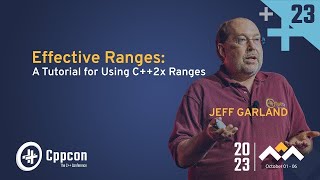
Effective Ranges: A Tutorial for Using C++2x Ranges
Master C++2x Ranges: Explore key concepts, algorithms, views, and integration with the standard library for efficient and modern C++ programming.
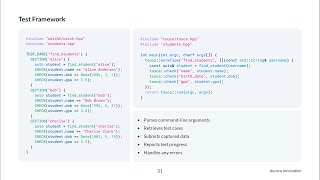
Continuous Regression Testing for Safer and Faster Refactoring in C++
Learn continuous regression testing techniques for safer, faster C++ refactoring. Discover how to build frameworks, write effective tests, and integrate with CI pipelines for automated execution.
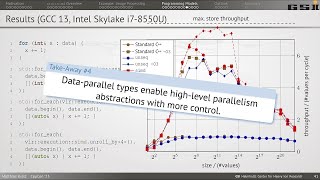
std::simd - Expressing Inherent Parallelism Efficiently Via Data-parallel Types
Explore efficient data-parallelism using std::simd in C++26, learning to optimize compute-intensive workloads and design data structures for high-throughput execution.
C++ Modules: Getting Started Today - Lecture
Explore C++20 modules: implementation, best practices, and CMake integration. Learn named modules, code structure, and interoperability with header-based code for practical application.
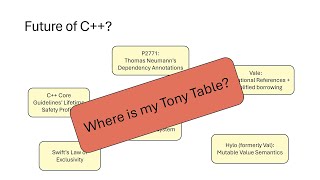
Lifetime Safety in C++ - Past, Present and Future
Explore C++ memory safety advancements, current mitigations, and future directions. Learn to enhance code safety without sacrificing performance or flexibility.

How C++23 Changes the Way We Write Code
Explore key C++23 features like std::expected, std::mdspan, deducing 'this', and std::print. Learn how these additions improve error handling, scientific computing, and simplify common idioms.
Parallelism Safety-Critical Guidelines for C++
Explore parallelism safety guidelines for C++, covering challenges in multicore architectures and potential issues with newer features. Gain insights into future rules for safety-critical software development.
Breaking Dependencies - The Visitor Design Pattern in C++ - Lecture
Explore the Visitor design pattern in C++: learn implementation strategies, benefits, and limitations for enhancing code extensibility and maintenance in large-scale software projects.
Quantifying Dinosaur Pee - Expressing Probabilities as Floating-Point Values in C++ - Lecture
Explore floating-point precision in C++ through probability calculations, from birthday paradoxes to dinosaur urine, with insights on numerical pitfalls and expected value concepts.
Rules for Radical C++ Engineers - Improving Code, Team, and Organization - Lecture
Discover strategies to effect positive change in your C++ code, team, and organization, drawing lessons from political activism and applying them to software engineering contexts.
Implementing Understandable World Class Hash Tables in C++ - CppCon 2022
Explore world-class hash table implementation in C++, focusing on Robin Hood hashing, parallel computation, and SIMD operations. Learn to optimize performance while maintaining code clarity and understandability.

C++20's Likely Attribute - Optimizations, Pessimizations, and Unlikely Consequences
Explore C++20's [[likely]] attribute, its impact on optimizations, and potential consequences. Gain insights into branch prediction, performance tuning, and effective benchmarking techniques.
Reflection in C++ - Past, Present, and Hopeful Future
Explore C++ reflection's evolution, potential applications, and future prospects. Gain insights into advanced programming concepts and language design for enhanced code flexibility and reuse.