Safety First - Low-Level C# Without the Unsafe Keyword
Explore low-level C# programming techniques without using unsafe code. Learn how to translate C to modern C#, handle memory allocation, and work with complex data structures safely and efficiently.
Documentation Office Hours - Editing Discourse and Sphinx-Based Documentation
Live demonstration of editing Discourse-based and Sphinx-based documentation, covering recent updates, planning discussions, and practical tips for technical authors and contributors.
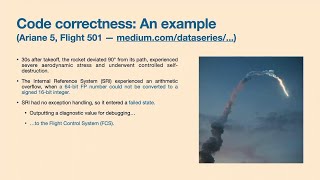
Functional Correctness: Haskell-ing Your Way to Reliable Code - FSCK 2024
Explore functional programming with Haskell to create robust, maintainable software. Learn key concepts like referential transparency and purity to enhance code reliability and correctness.

Cruising Along with Java - Modern Features and Best Practices
Explore Java's evolution from version 9 to 19, learning modern features for building efficient enterprise applications with improved design capabilities and enhanced security.
Combining Rust and Zig in Programming - Benefits and Considerations
Explore the surprising benefits of combining Rust and Zig in programming projects, focusing on memory safety, simplicity, and practical applications in language development.
Pattern Statistics and Model Comparison via Topological Data Analysis
Exploring topological data analysis for pattern quantification, model comparison, and feature design in zebrafish skin patterns and other complex systems.
Printer Hacking Adventures - Exploiting Network Vulnerabilities
Explore printer vulnerabilities and exploit chains for Canon and Lexmark models. Learn about firmware analysis, debugging closed systems, and network security implications of office printers.

Hidden Risks in Open-Source Code and AI Models
Explore vulnerabilities in AI models and open-source code, including a live demo of potential exploits. Learn about software supply chain security and strategies to protect against malicious attacks.
IAM Doomsday Prepper - Surviving the Apocalypse with Keycloak
Future-proof Keycloak projects with 'configuration as code'. Learn to use Keycloak Java Admin Client for improved security, reduced errors, and streamlined IAM management. Explore best practices and real-world examples.

Building and Testing Applications With Micronaut and Testcontainers in IntelliJ IDEA
Learn to build high-quality, testable applications using Micronaut and Testcontainers in IntelliJ IDEA. Graeme Rocher demonstrates efficient development techniques and improved integration testing experiences.
Understanding Exploitability with VEX, EPSS, and Other Standard Frameworks
Explore key frameworks for assessing software vulnerabilities, including VEX, EPSS, CVSS, and SBOMs. Learn to enhance security through automated policy and GitOps practices.

Improving Kafka Performance: Switching from ext4 to XFS for 80% Faster Writes
Detailed analysis of Kafka performance optimization, exploring file system impact on latency. Covers Kafka internals, tracing, journaled file systems, and the switch from ext4 to XFS for 80% speed improvement.

IntelliJ IDEA Performance Improvements - Past, Present, and Future
Explore IntelliJ IDEA's performance enhancements, including improvements in completion, highlighting, startup, and indexing, to better handle growing projects and larger codebases.
REST, gRPC, SignalR, and GraphQL for .NET Developers - Choosing the Right API Technology
Explore REST, gRPC, SignalR, and GraphQL for .NET APIs. Learn core concepts, implementation, and decision-making strategies to choose the right technology for your project.
Empower WebAssembly ML Over Diverse AI Hardware Accelerators Outside the Browser
Explore WebAssembly's potential for accelerating ML/AI workloads on diverse hardware outside browsers, enabling transparent performance boosts without code changes.
Who Is Using, Who Is Abusing? A Primer on Open Source Licensing
Explore open source licensing, recent disruptions, and implications for developers. Learn about various licenses, their applications, and impacts on both contributors and consumers of open source software.
YAML and YAMLScript: From Data Serialization to Functional Programming
Explore YAML's complexities and discover YAMLScript, a powerful new loader addressing common YAML issues while offering advanced programming capabilities and improved consistency across languages.
Harnessing the Power of Open Source for Cloud Native Development - Strategies for Success
Explore strategies for successful cloud native development using open source tools, focusing on Kubernetes and its ecosystem for managing containerized applications across diverse environments.
Unveiling the Test Champions: Comparing Testing Automation Systems for Embedded Environments
Explore testing automation systems for embedded environments, comparing strengths and use cases to enhance reliability and efficiency in development processes.
The Limits of Safety Engineering and the Cinderblock Problem
Explore safety engineering limitations in software development through practical examples and the "Cinderblock Problem," gaining insights for critical systems design.
Creating Versatile AI Agents Through WebAssembly and Rust
Explore WebAssembly+Rust's role in developing efficient, secure, and portable AI agents for open-source LLMs, enhancing cross-platform compatibility and optimizing resource usage.