Incubated Machine Learning Exploits: Backdooring ML Pipelines Using Input-Handling Bugs
Explore vulnerabilities in ML pipelines through input-handling bugs, introducing incubated ML exploits and backdoors. Learn about security implications and guidelines for ML practitioners.

Differences Between How-To and Tutorial Documentation - Open Documentation Hour
Explore the key differences between how-to guides and tutorials in technical documentation, focusing on their purposes, structures, and effective implementation strategies.

Encouraging Engineers to Write Their Own Documentation - Open Documentation Hour
Explore strategies to motivate engineers in documentation writing, covering framing, scope, assumptions, enforcement, education, collaboration, and overcoming common challenges in technical documentation.

The Challenges of Onboarding as a Tech Author
Explore challenges and strategies for successful onboarding as a technical author, including remote work, information overload, time management, and mastering new tools and products.
Sublinear Algorithms in Social Networks via Core-Periphery Decomposition
Explore sublinear algorithms for large networks using core-periphery structure and degree distribution. Learn about accelerating tasks like node sampling and shortest path computations.
A Bi-metric Framework for Fast Similarity Search
Explore a novel bi-metric framework for efficient nearest neighbor search, combining accurate but costly ground-truth metrics with faster proxy metrics to optimize data structures and query procedures.

On the Hard Problem of Pain - Understanding Higher-Level Intelligence
Explore the complex nature of pain through AI, psychology, and neuroscience perspectives, delving into higher-level intelligence and its implications.
Consciousness and Large Language Models - Understanding Higher-Level Intelligence
Explore the intersection of consciousness and AI through philosophical and scientific lenses, examining implications for higher-level intelligence and cognitive science.

AI as a Tool for Discovery in Animal Communication
Explore innovative AI applications for decoding animal communication, uncovering insights into nonhuman species' language and behavior.
On Partial-Order and Automata Techniques for Analyzing Communication
Explores verification and synthesis techniques for peer-to-peer and mailbox communication in concurrent programming, focusing on message-passing models and their applications in distributed systems.
Distributed Controller Synthesis for Deadlock Avoidance
Explore advanced techniques for synthesizing distributed controllers to prevent deadlocks in complex systems, enhancing system reliability and performance.
Ramsey Quantifiers in First-Order Logic - Complexity and Applications to Verification
Exploring Ramsey quantifiers in first-order logic, their complexity, and applications to verification, with focus on liveness and termination in infinite-state systems.
Automated Functional Synthesis: An Ideal Meeting Ground for Symbolic Reasoning and Machine Learning
Explores Manthan, a data-driven approach combining machine learning and symbolic reasoning to improve scalability in functional synthesis, viewing it as a classification problem.
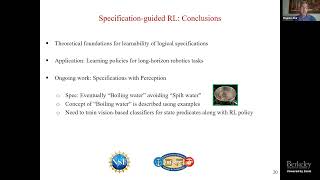
Specification-guided Reinforcement Learning
Explore specification-guided reinforcement learning techniques for synthesizing models and systems, presented by Rajeev Alur from the University of Pennsylvania.
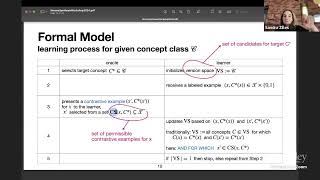
Learning From Contrastive Examples in Machine Learning
Explores how contrastive training examples impact active learning algorithms, focusing on sample complexity for geometric concepts and Boolean functions, with connections to self-directed learning.
Understanding the Expressive Power of Transformers Through Formal Language Theory
Explore the intersection of formal language theory and machine learning, focusing on transformer expressiveness and recent developments in understanding their learning capabilities.
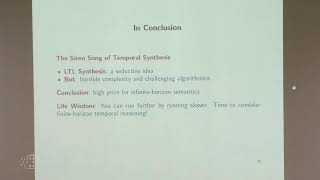
Linear Temporal Logic - From Infinite to Finite Horizon
Explore finite-horizon temporal synthesis in Linear Temporal Logic, its algorithmic advantages, and applications in reactive synthesis and infinite-horizon reasoning.
Synthesis of Privacy-Preserving Systems
Explore privacy-preserving system synthesis, addressing hidden signals, budget constraints, and incomplete information while satisfying specifications and protecting secrets.
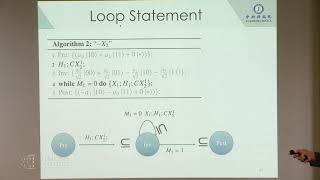
Automata-Based Approach for Quantum Circuit and Program Verification
Innovative automata-based technique for verifying quantum circuits, offering scalable analysis and bug detection through compact state representation and algebraic computations.
Multi-agent Games with Finite-horizon Goals
Explore complexity in multi-agent systems with finite-horizon goals, examining mathematical properties, use cases, and representation challenges in game theory and distributed systems analysis.
Computing Small Rainbow Cycle Numbers with SAT Modulo Symmetries
Explores computing rainbow cycle numbers using SAT modulo Symmetries, enhancing understanding of envy-freeness in fair division of indivisible goods and improving EFX allocation feasibility guarantees.