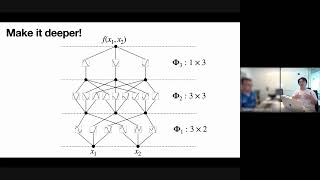
Kolmogorov-Arnold Networks - Alternatives to Multi-Layer Perceptrons
Explore Kolmogorov-Arnold Networks as alternatives to MLPs, offering improved accuracy and interpretability in data fitting and PDE solving. Discover their potential for scientific collaboration and law discovery.

Privacy Preserving Machine Learning with Fully Homomorphic Encryption
Explore Fully Homomorphic Encryption's role in advancing secure, privacy-preserving machine learning applications, focusing on Concrete ML and its integration with other technologies.

Concurrent Self-Adjusting Data Structures - Challenges and Solutions
Explore self-adjusting data structures and their concurrent implementations, focusing on SplayTree, CBTree, and Splay-List. Learn about efficient lazy rebuilding for multi-way structures like B-tree and IST.
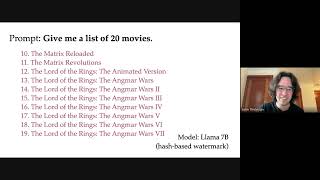
Robust Distortion-free Watermarks for Language Models
Explore robust watermarking techniques for language models, focusing on edit-resistant methods that preserve text distribution. Learn about key-based protocols and their applications.
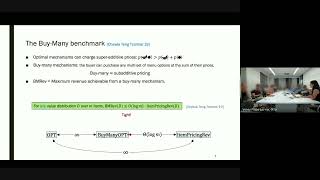
A Multi-Dimensional Online Contention Resolution Scheme for Revenue Maximization
Explore multi-buyer multi-item sequential pricing mechanisms for revenue maximization, focusing on approximating ex ante optimal revenue for subadditive buyers through a new multi-dimensional Online Contention Resolution Scheme.
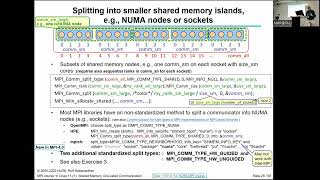
New Features in MPI 4.0
Explore new features in MPI 4.0, including large-count routines, persistent collectives, and the Sessions Model. Learn about hardware-based communicator splitting and improvements in error handling.

Enabling Next-Generation Processor Simulations with SimEng - NHR PerfLab Seminar
Explore next-gen processor simulations with SimEng. Learn about cycle-level modeling, microarchitecture research, and design space exploration for advanced CPUs and GPUs.
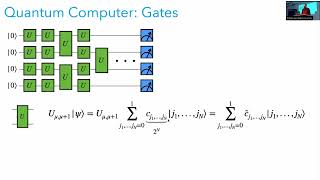
Quantum Computing Today and Tomorrow - Current State and Future Applications
Explore quantum computing's current state, potential applications, and future developments with insights from Prof. Dr. Michael Hartmann's seminar on recent advancements and upcoming challenges.
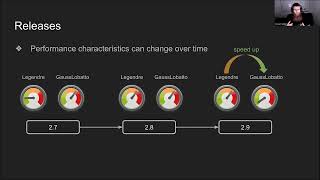
Configuration-Aware Performance Analysis for High-Performance Computing Frameworks
Explore configuration-aware performance analysis for HPC frameworks, focusing on feature selection impact and identifying performance regressions across software releases.

The Missing Python Introduction for Scientists - Performance and Efficiency
Explore Python's internals, performance optimization, and essential scientific libraries. Learn to write efficient code and choose the right tools for scientific computing tasks.
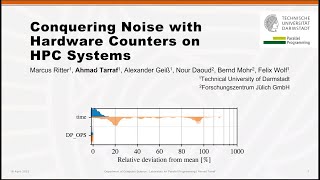
Conquering Noise with Hardware Counters on HPC Systems
Explore hardware counter noise resilience in HPC systems. Learn to select appropriate counters for accurate performance modeling and scaling behavior analysis.
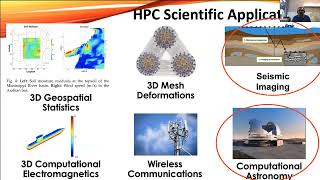
The Comedy Club of High-Performance Computing: Low-Rank Matrix Approximation Takes the Stage
Explore high-performance computing implementation of Tile Low-Rank Matrix-Vector Multiplication, its applications in seismic processing and astronomy, and performance advantages over dense implementations.
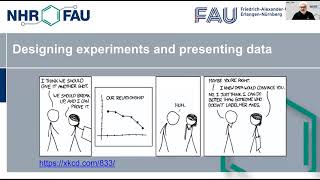
Experiments and Data Presentation in High Performance Computing
Learn effective techniques for conducting experiments and presenting data in high performance computing. Master key aspects of scientific benchmarking, statistical analysis, and data visualization for HPC research.
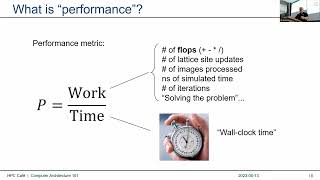
Computer Architecture 101 for Scientists and Its Impact on Cluster Jobs
Explore core concepts of parallel computer architecture and their impact on cluster job performance. Gain insights to optimize resource allocation and improve efficiency in supercomputing tasks.
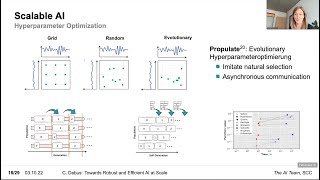
Towards Robust and Efficient AI at Scale
Explore robust, efficient AI for scientific time series forecasting. Learn scalable transformer architectures, energy optimization, and balancing performance with sustainability in large-scale AI applications.
DGEMM on Integer Tensor Cores - NHR Perflab Seminar
Explore double-precision matrix multiplication using Int8 Tensor Cores and the Ozaki scheme, focusing on high-precision computation with lower-precision hardware for machine learning applications.
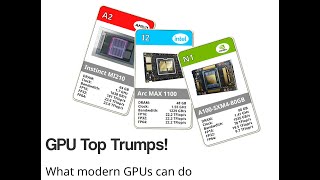
GPU Top Trumps - Comparing HPC Graphics Processing Units
Explore the capabilities and differences of various HPC GPUs, comparing NVIDIA models, examining competitors, and understanding new developments like APUs.

LLVM in HPC: Enabling Performance Portability, Interoperability, and Novel Features - Part 2
Explore recent LLVM efforts for HPC: portable CUDA, debugging at scale, GPU execution of legacy codes, automatic differentiation, ML in compilers, and static information impact.
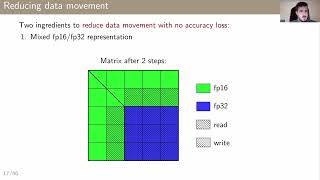
Mixed-Precision Computing: An Overview
Explore mixed-precision computing techniques for high performance and accuracy. Learn about refinement, modularity, and adaptivity in algorithms combining multiple precisions.
Processing Very Large Image Volumes with the Adaptive Particle Representation
Explore advanced techniques for processing massive image datasets using adaptive particle representation, enabling efficient visualization and analysis of terabyte-scale biomedical data.
Bridging Domain Science and HPC with Julia
Explore Julia's potential in HPC, combining scientific ecosystem with high performance. Gain insights on its strengths, limitations, and notable international projects from an experienced user.