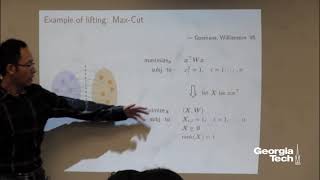
The Power of Nonconvex Optimization in Solving Random Quadratic Systems of Equations - Lecture 1
Explore nonconvex optimization for solving random quadratic systems, achieving optimal accuracy in linear time. Learn about applications in imaging science and neural networks.
Compatibility and the Lasso - Lecture 2
Explore compatibility and the Lasso in statistical learning with Sara van de Geer from ETH Zurich in this distinguished lecture on advanced machine learning techniques.

Understanding Human Functioning and Enhancing Human Potential through Computational Methods
Explore computational methods for analyzing human functioning, enhancing potential, and improving efficiency through multimodal approaches in diverse contexts.
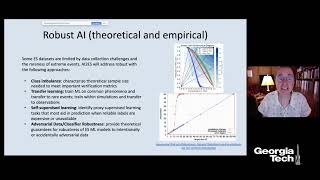
Building Trustworthy AI for Environmental Science
Explore trustworthy AI methods for environmental science, focusing on weather, climate, and coastal oceanography predictions, with insights on hail and tornado forecasting.
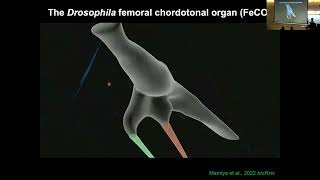
Neural Mechanisms of Limb Proprioception and Motor Control in Drosophila
Explore neural mechanisms of limb proprioception and motor control in fruit flies. Discover how proprioceptor subtypes encode joint position and movement, and examine computational models predicting leg proprioceptor activity during walking.
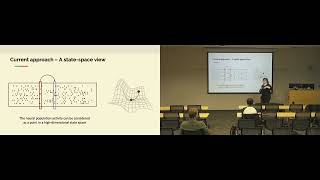
Tune in and Dropout - How Data Augmentation Can Help Us Build Better Brain Decoders
Explore data augmentation techniques for improving brain decoders, enhancing neural signal interpretation and brain-computer interface performance.
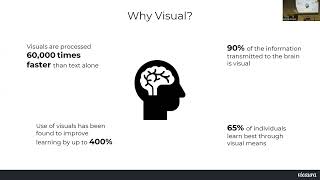
Delivering Intelligent Operations to Industrial Frontline through Visual Guidance and AI
Empower industrial frontline workers with AI and Visual Guidance for enhanced precision, speed, and reliability in critical operations.
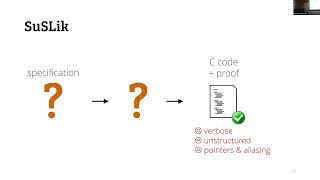
SuSLik: Deductive Synthesis of Safe Programs with Pointers - Tutorial 1b
Explore deductive program synthesis for creating provably correct pointer-manipulating programs using SuSLik. Practice specifying programs with formal logic and learn about separation logic.
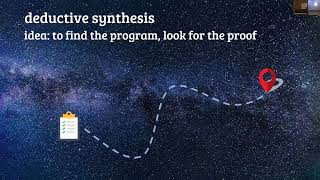
Tutorial on Deductive Program Synthesis - Part 2: Hands-on Derivation and Advanced Techniques
Learn deductive program synthesis through hands-on examples, exploring SSL rules, recursion handling, and step-by-step derivation of provably correct pointer-manipulating programs.

Moving Beyond the First Portrait of Our Milky Way's Black Hole by Leveraging Underlying Structure
Explore computational imaging techniques used to capture black hole images and leverage data structure to extract evolving details of the Milky Way's supermassive black hole.
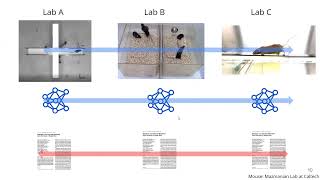
AI for Scientists: Accelerating Discovery through Knowledge, Data and Learning
Explore AI-driven scientific discovery, integrating machine learning with expert knowledge to automate data analysis and accelerate research across diverse domains.

Arduino Uno R4 WiFi - Sorting a List of Grades in an Array - Lesson 37
Learn to use Arduino arrays and implement sorting algorithms for ascending and descending order in this hands-on tutorial.
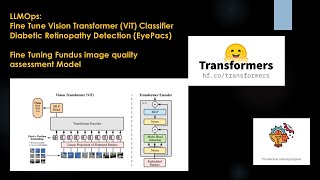
Fine-Tuning Vision Transformer Classifier for EyePacs Dataset Quality Model - Part 1
Fine-tune a Vision Transformer for image quality assessment using the EyeQ dataset, a subset of EyePacs, to enhance diabetic retinopathy detection capabilities.
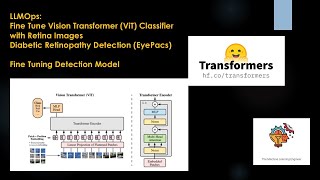
Fine-Tuning Vision Transformer for Diabetic Retinopathy Detection - Part 2
Fine-tune a Vision Transformer for diabetic retinopathy detection using EyeQ dataset. Learn to adapt pretrained models for specialized medical image classification tasks.
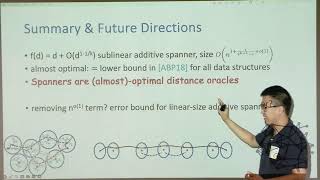
Almost-Optimal Sublinear Additive Spanners in Graph Theory
Explore sublinear additive spanners in graph theory, focusing on optimal stretch functions and size bounds for undirected unweighted graphs. Learn about recent advancements and their implications.
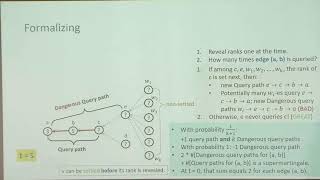
Sublinear Algorithms for Correlation Clustering
Explore sublinear algorithms for correlation clustering, focusing on a 3+eps approximation method using LCA probes, MPC rounds, and dynamic updates. Analyze technical results for maximal independent set computation.
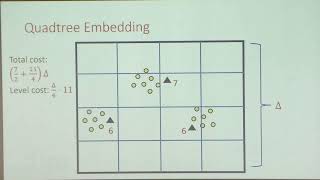
Fast Streaming Euclidean Clustering with Constant Space
Explore streaming algorithms for k-median and k-means clustering, achieving constant space complexity independent of data size and aspect ratio. Improve space and update time for approximate subspace embeddings.
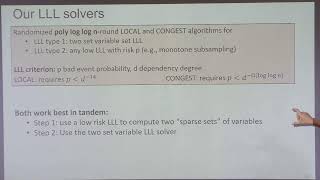
Sparsification for Communication-Efficient Distributed Symmetry-Breaking
Explore sparsification techniques for efficient distributed algorithms, focusing on local symmetry-breaking problems in graph theory and the CONGEST model.
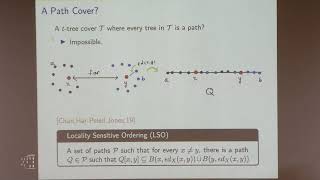
Recent Progress on Euclidean Spanners
Explore recent advancements in Euclidean spanners, including sparse, light, fault-tolerant, and dynamic variants, while discovering outstanding open problems in the field.
A Quasi-Monte Carlo Algorithm for Smooth Kernel Evaluation
Explore a novel data structure for density queries, combining discrepancy theory and LSH to build sparse coresets and enhance smooth kernel evaluation algorithms.
Parallel Algorithms for Local Problems in Sparse Graphs
Explore efficient parallel algorithms for locally checkable problems in sparse graphs, focusing on techniques beyond graph sparsification for improved performance in sublinear regimes.