
Robots Learning Like Humans: Leveraging Human-Inspired Techniques in Machine Learning
Explore how robots can learn from human-like methods, including video observation, natural language instructions, and curiosity-driven exploration.
Learning In-the-Wild Sensor Simulation for Autonomous Driving
Explore cutting-edge sensor simulation techniques for autonomous driving. Learn to create digital twins, manipulate scenarios, and generate realistic multi-sensor simulations to enhance self-driving vehicle development.
Towards High-Fidelity Open-Vocabulary 3D Scene Understanding
Explore open-vocabulary 3D scene understanding using Transformer-based networks and foundation models. Learn about object segmentation, human body part segmentation, and vectorized floorplan reconstruction.
Ubisoft La Forge Game Bot Team - Building ML-Based Game Actors
Explore Ubisoft La Forge's ML-based game actors, challenges in AAA games, and innovative approaches to simulating player behavior through concrete in-game examples.
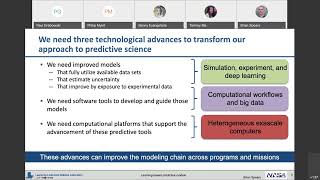
Cognitive Simulation: Combining Simulation and Experiment with Artificial Intelligence
Explore cognitive simulation techniques merging AI with experimental and simulation data for advanced scientific insights and predictive capabilities.
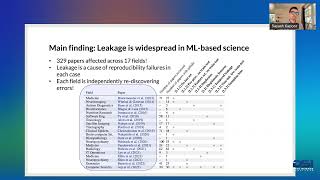
Leakage and the Reproducibility Crisis in ML-based Science
Explore data leakage and reproducibility issues in ML-based science. Learn about types of leakage, their impact on research, and proposed solutions for improving scientific reporting and methodology.
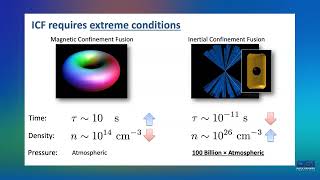
Calling the Shot: How AI Predicted Fusion Ignition Before It Happened
Explore how AI predicted fusion ignition at the National Ignition Facility, revolutionizing clean energy research and bringing us closer to harnessing the power of the stars.
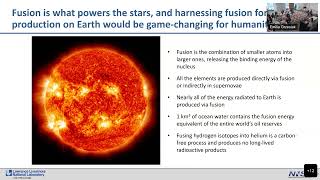
Machine Learning Applications in Scientific Problems with Sparse Data - Afternoon Address
Explore Dr. Kelli Humbird's career in data science, focusing on inertial confinement fusion and machine learning applications in scientific problems with sparse data.

ML for Solving PDEs: Neural Operators on Function Spaces
Explore AI advancements in scientific applications, including neural operators for weather and climate modeling, offering significant speedups and zero-shot generalization across function spaces.

Generative Machine Learning Approaches for Data-Driven Modeling and Reductions of Non-Linear Dynamics
Explore generative machine learning for data-driven modeling and reductions in scientific simulations, focusing on GD-VAEs and SDYN-GANs for non-linear dynamics and stochastic systems.
Power in the Age of Artificial Intelligence - Global Security Implications
Explore the global impact of AI on power dynamics, focusing on the U.S.-China rivalry and the race for AI dominance. Gain insights from a former Pentagon official on the future of warfare and international relations.
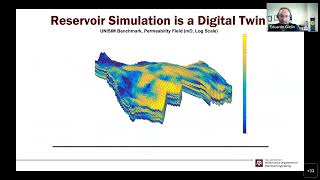
Guided Deep Learning Manifold Linearization of Porous Media Flow Equations for Digital Twins Operations
Explore advanced techniques in Digital Twin operations for reservoir management, focusing on physics-aware machine learning methods to enhance simulation accuracy and efficiency.
Leveraging Latent Representations for Predictive Physics-Based Modeling
Explore advanced techniques for leveraging latent representations in predictive physics-based modeling, focusing on surrogate models, inverse problems, and transfer learning for complex PDEs.
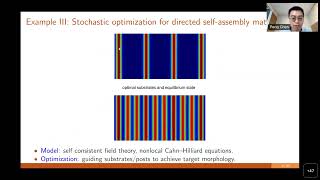
Derivative-Informed Neural Operators for Solving PDE-Governed Optimization Problems
Explore novel machine learning for solving optimization problems with PDEs, featuring derivative-informed neural operators for efficient, scalable solutions in high-dimensional parameter spaces.
Photorealistic Reconstruction from First Principles
Explore photorealistic reconstruction techniques combining compressed sensing and deep learning for computational imaging, focusing on recovering optical density and view-dependent color from calibrated photographs.
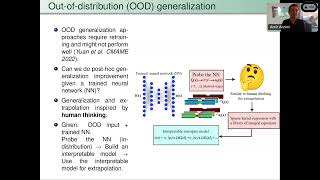
DDPS - A Flexible and Generalizable XAI Framework for Scientific Deep Learning
Explore a flexible XAI framework for scientific deep learning, enhancing interpretability and generalization in physics-based modeling through integral equations and sparse regression techniques.
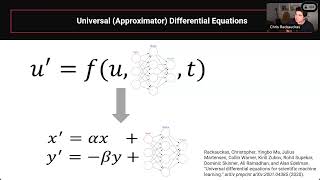
Generalizing Scientific Machine Learning and Differentiable Simulation Beyond Continuous Models
Explore generalizing scientific machine learning beyond continuous models, covering differentiable simulation for chaotic systems, stochastic processes, and inverse problems in advanced scientific computing.
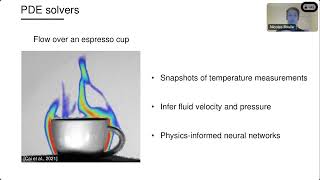
Elliptic PDE Learning: Provably Data-Efficient Techniques
Explore data-efficient PDE learning techniques, combining deep learning with physics and mathematics to discover properties of unknown physical systems from limited experimental data.
Integrating AI and Wargaming: Opportunities and Challenges
Explore opportunities and challenges of integrating AI into wargaming, enhancing strategic decision-making and scenario analysis for defense and security applications.
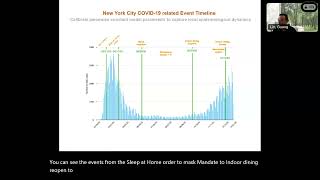
Towards Third Wave AI: Interpretable, Robust Trustworthy Machine Learning
Explore new theories and algorithms for complex dynamical systems, creating trustworthy AI for real-time prediction and national security applications. Learn about innovative neural networks and physics-integrated models.
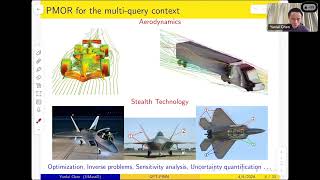
GPT-PINN and TGPT-PINN: Advanced Physics-Informed Neural Networks for Parametric PDEs
Explore GPT-PINN and TGPT-PINN for efficient parametric PDE solutions. Learn meta-learning techniques to reduce training time and network complexity while maintaining accuracy across parameter domains.