
Digital Manufacturing in Stainless Steel Industry
Explore digital manufacturing in the stainless steel industry and its impact on operational efficiency, yield, and quality.
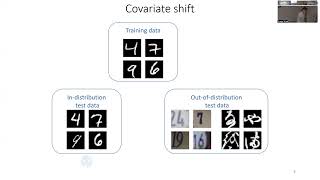
Tackling Covariate Shift with Node-Based Bayesian Neural Networks
Explore Bayesian neural networks for improved generalization under covariate shift, focusing on node-based BNNs as scalable alternatives and their performance in out-of-distribution image classification.

VMS: Interactive Visualization to Support the Sensemaking and Selection of Predictive Models
Explore interactive visualization for comparing and selecting predictive models, integrating performance, instance, and feature-level analysis to support informed decision-making in machine learning.

Sustainable AI Solutions - Energy Efficiency and Optimization
Explore energy-efficient AI methods and solutions for sustainability, with insights from industry and academia experts.
Compressing Multidimensional Weather and Climate Data Into Neural Networks
Compress multidimensional weather and climate data into neural networks, achieving high compression ratios while preserving accuracy for climate change analysis and severe weather prediction.

LRSCwait: Enabling Scalable and Efficient Synchronization in Manycore Systems
Explore scalable synchronization in manycore systems with LRSCwait. Learn about polling-free and retry-free operations for improved throughput and energy efficiency in shared-memory architectures.

Neural Graph Databases: Combining GNNs with Labeled Property Graphs
Explore neural graph databases, combining graph databases with graph neural networks using LPG2vec encoder for improved prediction accuracy in complex graph datasets.

Cppless: A Single-Source Programming Model for High-Performance Serverless
Explore Cppless, a single-source programming model enabling high-performance serverless applications in C++. Learn about transparent offloading, common abstraction layers, and composable architectures for efficient cloud computing.
Accelerating Data Serialization and Deserialization Protocols with In-Network Compute
Explore in-network compute techniques to accelerate data serialization/deserialization protocols, enhancing efficiency in datacenter and HPC systems. Learn about SmartNIC offloading and its impact on performance.

Streaming Task Graph Scheduling for Dataflow Architectures
Explore efficient scheduling techniques for dataflow architectures using canonical task graphs, steady-state analysis, and spatial block partitioning to optimize performance and device utilization.

Noise in the Clouds - Influence of Network Performance Variability on Application Scalability
Explore network performance variability in cloud computing and its impact on HPC workload scalability, comparing cloud providers with on-premise systems.
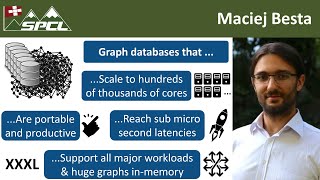
The Graph Database Interface: Scaling Online Transactional and Analytical Graph Workloads
Explore cutting-edge graph database technology scaling to 100,000+ cores. Learn about GDI, a new interface for high-performance, scalable graph processing in distributed memory systems.

EtherNET: The Present and Future of Datacenter and Supercomputer Interconnects
Explore the role of Ethernet in modern datacenters and supercomputers, examining its current state and future prospects in high-performance computing environments.
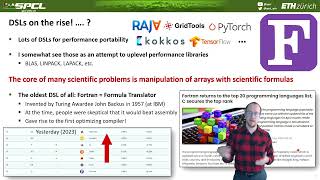
Fortran Optimization for Accelerator Devices - Data-Centric Representation
Explore data-centric optimization techniques for Fortran code on accelerator devices, enhancing high-performance computing capabilities.
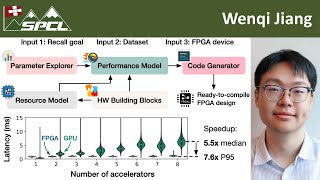
Co-design Hardware and Algorithm for Vector Search
Explore hardware-algorithm co-design for efficient vector search on FPGAs, enhancing performance in large-scale information retrieval and machine learning systems.
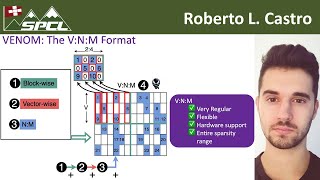
VENOM: A Vectorized N:M Format for Unleashing the Power of Sparse Tensor Cores
Explore VENOM, a vectorized N:M format for sparse tensor cores. Learn about high-performance sparse libraries and second-order pruning techniques for efficient deep learning model sparsification.

Swing: Short-cutting Rings for Higher Bandwidth Allreduce
Optimize allreduce performance on torus networks with Swing algorithm. Improve bandwidth by reducing distance between communicating nodes, outperforming existing methods by up to 3x.

Neural Probabilistic Logic Programming in Discrete-Continuous Domains - UAI 2023 Oral Session 1
Explore neural-symbolic AI integration with DeepSeaProbLog, combining logic, probability, and neural networks for discrete and continuous domains. Learn about its semantics, inference, and unbiased learning algorithm.

Human-in-the-Loop Mixup: Aligning Synthetic Data with Human Perception - Oral Session 2
Explore human-aligned synthetic data in machine learning, focusing on mixup regularization. Discover how perceptual judgments and uncertainties can enhance model reliability and generalization.
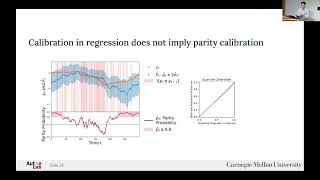
Parity Calibration in Sequential Regression - Forecasting Increase-Decrease Events
Explore parity calibration in sequential regression, focusing on predicting increase-decrease events rather than exact values. Learn its applications in epidemiology, weather forecasting, and nuclear fusion control.
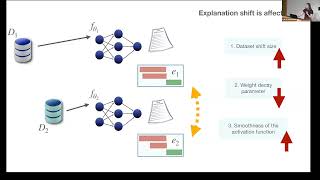
On Minimizing the Impact of Dataset Shifts on Actionable Explanations
Explore factors influencing explanation stability in AI models amid dataset shifts, focusing on model curvature, weight decay, and shift magnitude for robust actionable explanations.