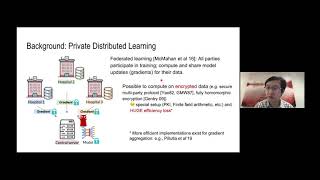
Instance-Hiding Schemes for Private Distributed Learning
Explore private distributed learning techniques, including instance-hiding schemes, cryptographic methods, and data augmentation, with insights on privacy laws and practical applications.

The Challenges of Model-Based Reinforcement Learning and How to Overcome Them - Csaba Szepesvári
Explore challenges in model-based reinforcement learning, including modeling errors and efficient planning, and discover strategies to overcome them in complex environments.
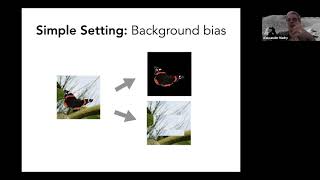
What Do Our Models Learn? - Aleksander Mądry
Exploring machine learning model behavior, biases in datasets, and challenges in dataset creation and replication for more robust and reliable AI systems.
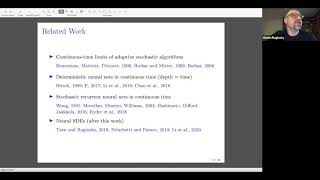
Neural SDEs - Deep Generative Models in the Diffusion Limit - Maxim Raginsky
Explore deep generative models through stochastic control, diffusion limits, and neural nets. Learn about efficient sampling, expressiveness quantification, and unbiased simulation techniques.
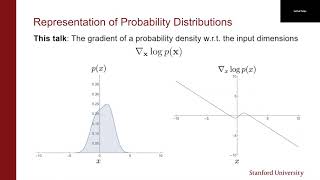
Generative Modeling by Estimating Gradients of the Data Distribution - Stefano Ermon
Explore generative modeling through gradient estimation of data distributions, covering deep energy-based models, score matching, and innovative sampling techniques for improved AI generation.
Black Hole Coarse Graining, Connes-Cocycle Flow, and Its Bulk Dual - Raphael Bousso
Explore black hole coarse graining, Connes-Cocycle flow, and its bulk dual in this advanced physics lecture, delving into entanglement wedge complementarity and ensemble interpretation.
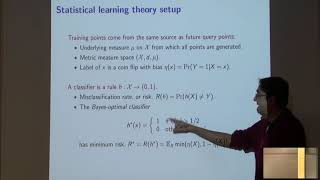
Convergence of Nearest Neighbor Classification - Sanjoy Dasgupta
Explore nearest neighbor classification's convergence, consistency, and accuracy rates in various spaces, with insights on smoothness conditions and adaptive classifiers.
High Dimensional Expansion and Error Correcting Codes - Irit Dinur
Explore high-dimensional expansion, error-correcting codes, and their connections. Delve into expansion constructions, property testing, and revolution complexes with expert Irit Dinur.
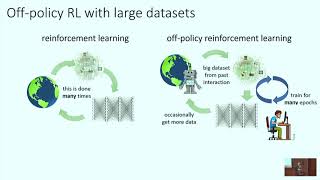
Deep Reinforcement Learning in the Real World - Sergey Levine
Explore deep reinforcement learning applications in real-world scenarios, focusing on off-policy methods, model-free and model-based approaches, and their practical implementations in robotics and manipulation tasks.
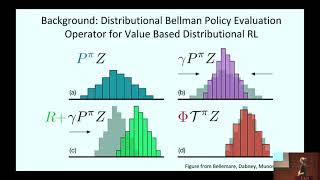
Towards Structural Risk Minimization for RL - Emma Brunskill
Explore structural risk minimization in reinforcement learning, focusing on efficient learning of risk-sensitive policies using conditional value at risk and optimistic exploration techniques.
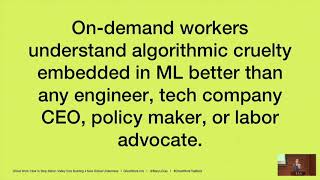
Algorithmic Cruelty and the Hidden Costs of Ghost Work - Mary Gray
Explore the hidden world of digital labor, examining automation's paradoxes, algorithmic impacts, and the social costs of today's platform-based work economy.
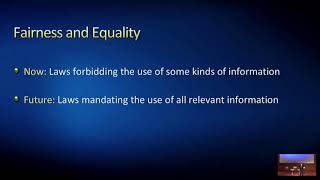
How Will Artificial Intelligence Change Ethics? - Pedro Domingos
Explore AI's impact on privacy, fairness, work, ethics, warfare, governance, and social media, examining how it challenges our understanding of human uniqueness.
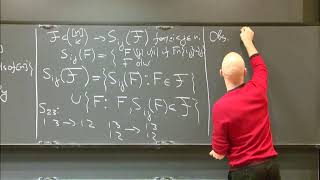
Extremal Set Theory - Andrey Kupavskii
Explore extremal set theory with Andrey Kupavskii, covering shifting techniques, partial orders, and the Katniss Theorem. Gain insights into minimizing shadows and analyzing complex cases in discrete mathematics.

Sparse Matrices in Sparse Analysis - Anna Gilbert
Explore sparse matrices in compressive sensing, focusing on expander graphs and their applications. Learn about metric repair scenarios and algorithms for sparse signal recovery.
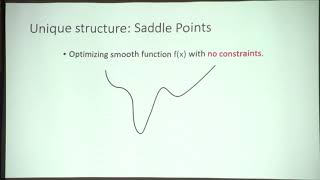
Optimization Landscape and Two-Layer Neural Networks - Rong Ge
Explore optimization landscapes and two-layer neural networks, focusing on non-convexity, saddle points, and symmetric distributions in theoretical machine learning.
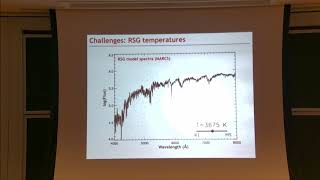
Red Supergiants - New Perspectives on Dying Stars - Emily Levesque
Explore new perspectives on red supergiants, their characteristics, and significance in stellar evolution. Learn about observational techniques, binary interactions, and implications for supernova research.
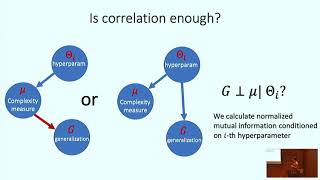
Toward a Causal Analysis of Generalization in Deep Learning - Behnam Neyshabur
Explore causal factors behind deep learning generalization, examining measures like path norm, flatness, and gradient noise to predict and understand model performance.
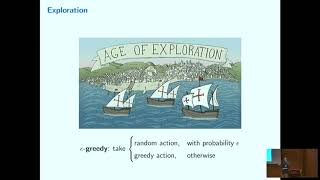
Provably Efficient Reinforcement Learning with Linear Function Approximation - Chi Jin
Explore efficient reinforcement learning with linear function approximation, covering key concepts like sample efficiency, value-based algorithms, and exploration in multi-armed bandits and linear MDPs.
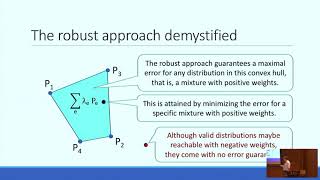
Learning Representations Using Causal Invariance - Leon Bottou
Explore causal invariance in machine learning representations, focusing on stable properties, extrapolation, and robust supervised learning techniques for improved model performance and generalization.
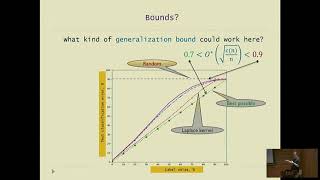
From Classical Statistics to Modern ML - The Lessons of Deep Learning - Mikhail Belkin
Explore the transition from classical statistics to modern machine learning, focusing on deep learning's impact, interpolation methods, and the "double descent" phenomenon in generalization theory.
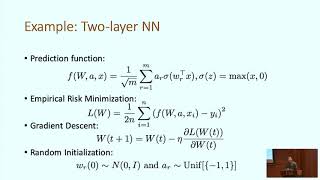
On the Connection Between Neural Networks and Kernels: A Modern Perspective - Simon Du
Explore connections between neural networks and kernels, focusing on over-parameterization, generalization, and neural tangent kernels. Insights on training dynamics and applications to various learning tasks.