Leveraging Rust Types for Program Synthesis
Explore how Rust's type system enhances program synthesis, simplifying specifications and improving performance. Learn about Synthetic Ownership Logic and the RusSOL tool for automatic synthesis of correct Rust programs.
ImageEye: Batch Image Processing using Program Synthesis
Explore a novel synthesis-based approach for fine-grained batch image processing, combining neural networks and symbolic reasoning to automate object-specific edits within images.
Operational Game Semantics for Generative Algebraic Effects and Handlers
Explore operational game semantics for generative algebraic effects and handlers in a typed call-by-value λ-calculus, focusing on dynamic allocation and first-class effect instances.
Fully Abstract Normal Form Bisimulation for Call-by-Value PCF
Explore a fully abstract normal form bisimulation for call-by-value PCF, combining applicative and environmental bisimulation with game semantics for program equivalence checking.
A Denotational Approach to Release/Acquire Concurrency - GALOP'24
Explore denotational semantics for Release/Acquire concurrency, focusing on trace semantics and game-like interpretations of program-environment interactions in shared-state languages.
Functorial Syntax for All - Representing and Reasoning About Binding Structures
Explore a Coq library for reasoning about variable binding in programming languages using functorial syntax, with insights from development and application across projects.
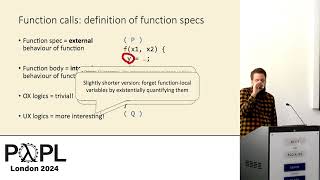
Unified Compositional Formal Methods: Exact Separation Logic and the Gillian Platform - Incorrectness'24
Explore unified compositional formal methods for program correctness and incorrectness reasoning, focusing on exact separation logic and the Gillian platform.
Crosys: Cross Architectural Dynamic Analysis for IoT Malware
Explore Crosys, a novel method for dynamic analysis of multi-architectural binaries through intermediate language interpretation and binary rewriting, addressing IoT malware analysis challenges.
ChoRus: Library-Level Choreographic Programming in Rust
Explore ChoRus, a Rust framework for choreographic programming. Learn about endpoint projection and its implementation for distributed systems using library-level techniques.
IsoPredict: Dynamic Predictive Analysis for Detecting Unserializable Behaviors in Weakly Isolated Data Store Applications
Explore dynamic predictive analysis for detecting unserializable behaviors in weakly isolated data store applications. Learn about IsoPredict's novel techniques and evaluation results.
A Family of Fast and Memory Efficient Lock- and Wait-Free Reclamation - PLDI 2024
Explore Crystalline, a novel family of non-blocking memory reclamation schemes addressing high performance, memory efficiency, and wait-freedom challenges in concurrent programming.
Hashing Modulo Context-Sensitive Alpha-Equivalence - PLDI 2024
Explore efficient hashing for lambda-terms with context-sensitive alpha-equivalence. Learn about improved algorithms for subterm comparison and structure sharing in mathematical knowledge graphs.
Compilation of Qubit Circuits to Optimized Qutrit Circuits
Explore an optimizing compiler for qutrit circuits that improves quantum computations, offering depth reduction and higher fidelity compared to manual implementations and qubit circuits.
Equivalence by Canonicalization for Synthesis-Backed Refactoring
Explore a novel program synthesis framework for refactoring code to use library components, featuring a sound equivalence checking technique and applications in functional and numerical computing.

Stream Types - A Foundational Theory of Typed Data Streams and Stream Transformers
Explore a foundational theory of typed data streams and transformers, covering complex sequential patterns, parallel structure, and programming idioms like punctuation and windowing.
A Tensor Compiler with Automatic Data Packing for Simple and Efficient Fully Homomorphic Encryption
Explore a tensor compiler for efficient fully homomorphic encryption, featuring automatic data packing to simplify programming and optimize performance in large-scale applications like neural networks.

An LLP (q, k) Parser Generator for Data Parallel Parsing
Generate an LLP(q,k) parser for data parallelism and explore its application in creating a high-performance JSON parser.
Apple Array Allocation - Static Memory Management for Flat, Immutable Arrays
Explore statically determined memory allocation for flat, immutable arrays in Apple array system, extending liveness analysis for JIT compilers in functional languages.
Zero-Overhead Parallel Scans for Multi-Core CPUs - ARRAY 2024
Explore efficient parallel scans for multi-core CPUs, achieving zero overhead and improved single-threaded performance in array languages.
Work Assisting - Linking Task-Parallel Work Stealing with Data-Parallel Self Scheduling
Explore a novel scheduling strategy for mixing data and task parallelism, preserving data parallelism structure while enabling flexible thread distribution and self-scheduling for improved performance.
Misconceptions About Loops in C - Challenges in Loop Analysis for Static Analysis Tools
Explore rare edge cases and challenges in loop analysis for C programming, enhancing understanding of static analysis tools and improving software verification techniques.