
Enabling the Shop Floor to Pave the Way for Efficiency and Sustainability - A Manufacturing Innovation Story
Discover how LEGO Group revolutionizes manufacturing through IoT implementation, focusing on digitalization, worker safety, and sustainable production methods to boost efficiency and productivity.

Methodology for Forecasting Election Results from Tweets
Discover advanced techniques for analyzing social media data to predict election outcomes using computational methods and Twitter sentiment analysis.

AI and Computational Politics - Symposium 2023
Explore the intersection of AI and political systems, examining computational propaganda, equity implications, and methodological approaches for analyzing modern political landscapes.

Political Barometer: Public Opinion Mining Using Tweets
Explore advanced techniques for mining public opinion from Twitter data to analyze political sentiment and create accurate political barometers in the digital age.
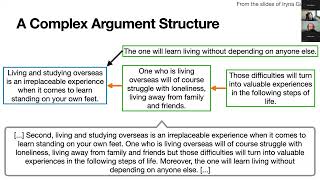
Analyzing Arguments from Political Debates
Explore advanced computational techniques for analyzing and understanding political debate arguments, focusing on AI-driven methods for extracting meaningful insights from political discourse.
Online Learning and Mistake Bound Analysis - Lecture 6B
Explore online learning algorithms and performance quantification through mistake bound methodology, focusing on mistake-driven learning approaches.
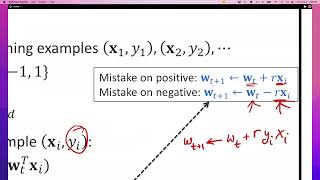
Introduction to the Perceptron Algorithm - Lecture 8
Dive into the fundamental concepts of the Perceptron algorithm, exploring its core mechanisms and applications in neural network foundations.
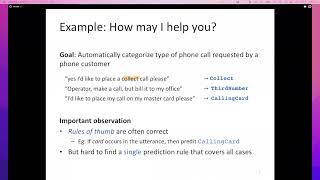
Boosting and Ensembles in Machine Learning - Lecture 18b
Discover how to transform weak learning algorithms into powerful predictive models through boosting and ensemble techniques in machine learning.
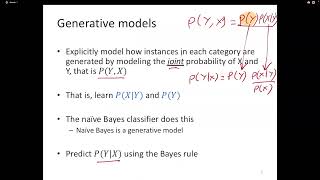
Discriminative and Generative Models in Machine Learning - Lecture 24B
Explore the key distinctions between discriminative and generative models in machine learning, focusing on their unique approaches and practical applications.
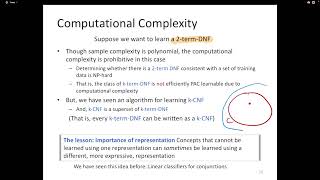
Positive and Negative Learnability Results in Machine Learning - Lecture 15
Delve into fundamental learnability concepts in machine learning, exploring both positive and negative results that shape our understanding of learning algorithms and their limitations.
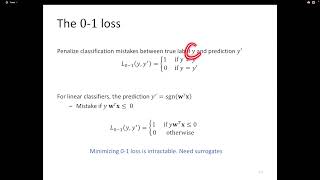
Loss Minimization in Machine Learning - Lecture 22
Explore the fundamental concept of learning as optimization through empirical risk minimization, focusing on loss minimization principles in machine learning applications.
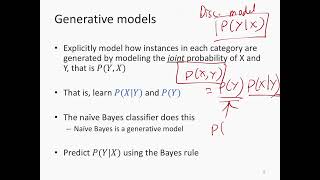
Generative and Discriminative Models in Machine Learning - Lecture 27B
Explore the fundamental differences between generative and discriminative models in machine learning through a concise high-level introduction to these essential modeling approaches.
Linear Models and Their Geometry in Machine Learning - Lecture 5
Explore the fundamental concepts and geometric principles behind linear classifiers, a cornerstone of machine learning algorithms and classification techniques.

Data Mining: Choosing k for MinHashing - Spring 2023
Delve into advanced min hashing concepts, exploring PAC learning, Central Limit Theorem, and Chernoff-Hoeffding Inequality to optimize k-value selection for accurate Jaccard similarity estimates.

Vulnerability Assessment of Substation Using Bayesian Attack Graph
Explore advanced techniques for assessing substation vulnerabilities through Bayesian attack graphs, focusing on network security and risk analysis methodologies in power infrastructure.

Distributed Merlin-Arthur Synthesis of Quantum States and Its Applications
Delve into quantum state synthesis through distributed computing, exploring novel protocols for quantum state generation and EPR-pair creation without quantum communication in network environments.

Maximum Tolerable Excess Noise in Continuous-Variable Quantum Key Distribution
Delve into groundbreaking research on quantum channel capacities and noise tolerance in continuous-variable quantum key distribution, featuring new bounds for entanglement distribution protocols.
Parallel Window Decoding for Scalable Fault-Tolerant Quantum Computation
Discover how parallel window decoding solves scalability challenges in quantum error correction, enabling faster and more efficient fault-tolerant quantum computations.
Foundations for Estimating Pauli Noise in Quantum Error Correction
Delve into quantum device characterization and Pauli noise estimation in error correction, exploring efficient protocols for syndrome measurements and practical implementation strategies.
Thrifty Shadow Estimation: Re-using Quantum Circuits and Bounding Tails
Explore statistical efficiency improvements in quantum shadow estimation through circuit reuse techniques, focusing on Haar random unitaries and practical implementations for near-term quantum computing.

Almost Qudits in the Prepare-and-Measure Scenario
Delve into quantum communication challenges when encoding information in carriers that nearly match standard qudits, exploring impacts on semi-device-independent protocols and dimension testing.