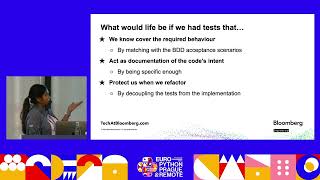
The Power of Spec-Based Testing - Adding Functional Requirements to Unit Test
Explore spec-based testing to enhance software quality by verifying behavior against specifications. Learn how this technique complements unit testing for more effective and efficient quality assurance.
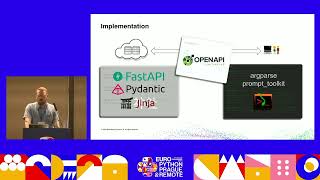
Designing a Human-Friendly CLI for API-Driven Infrastructure
Learn to design a dynamic CLI that generates commands from OpenAPI documentation, improving infrastructure management through a unified interface for both programmatic and human interaction.

Games of Life - Generative Art in Python
Explore algorithms for creating unique, cohesive graphics using Python. Learn about Clifford attractors, slime mold simulation, and geometric primitives to generate impressive 2D and 3D visualizations.
Python Linters at Scale
Discover strategies for efficiently scaling Python linters across large codebases and teams, including automated updates, consistent configurations, and performance optimizations.
Optimizing Your CI Pipelines
Discover techniques to enhance CI pipelines: parallelization, caching, early failure detection, and conditional runs for faster, more efficient builds and improved development workflows.
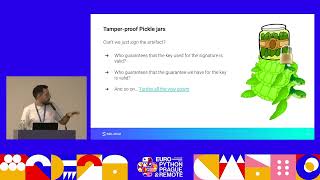
Poisoned Pickles Make You Ill
Explore the risks of using pickle for ML model serialization and learn effective strategies to protect against potential attacks and vulnerabilities in data science pipelines.
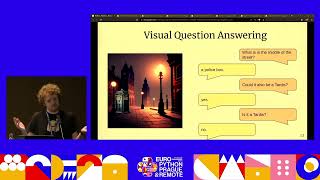
Robot Holmes and The MLington Murder Mysteries
Explore the world of Vision-Language AI through a detective story, uncovering recent developments and key players in this rapidly growing field of machine learning.
Rust for Python Data Engineers
Explore how Rust can enhance data engineering workflows, offering improved performance and safety. Learn about Rust's ecosystem for data processing, databases, and scientific computing to build scalable systems.
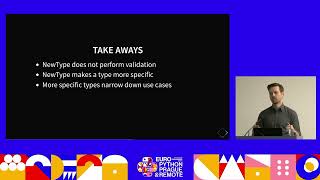
Bulletproof Python - Writing Fewer Tests with a Typed Code Base
Explore how a fully typed Python codebase can reduce the need for extensive testing, leveraging dependent types and exhaustiveness checking to enhance code reliability and efficiency.
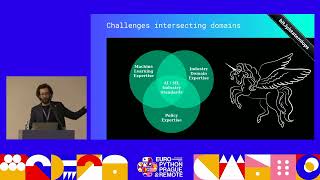
The State of Production Machine Learning in 2023
Explore challenges and solutions in production machine learning, focusing on reliability and scalability. Learn key concepts and recommended tools to tackle the increasing complexity of ML pipelines.
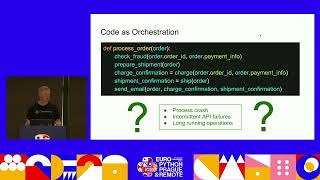
Temporal Python - A Durable, Distributed Asyncio Event Loop
Explore Temporal.io, an open-source platform enhancing asyncio with durability and distributed capabilities. Learn how it transforms fault-tolerant system design and implementation.
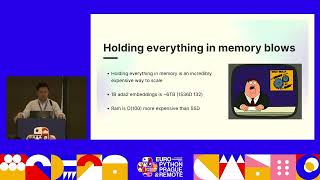
Serverless Billion-Scale Vector Search for AI Applications
Explore low-latency vector search on billion-scale datasets using LanceDB, an open-source solution for modern AI workflows like recommendation systems and LLM-based applications.
Large Language Models - From Prototype to Production
Explore practical approaches for leveraging Large Language Models in NLP projects, from initial prototypes to successful production deployments, with insights on their impact and future potential.
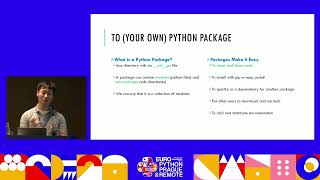
From Jupyter Notebooks to a Python Package - The Best of Both Worlds
Learn to transform Jupyter notebooks into a Python package, enhancing code sharing, refactoring, and version control while retaining notebook benefits. Gain practical skills for improved data science workflows.
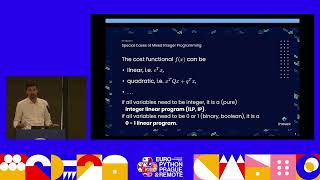
From Algorithms to Agendas - A Beginner's Guide to Integer Programming
Discover how Integer Programming optimizes conference scheduling, maximizing attendee satisfaction through efficient talk allocation to time slots and rooms.
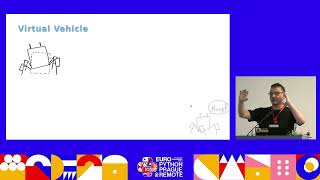
Async Robots
Explore parallel programming for interactive robot control using Python's async features. Learn from experiences with the Fluffbug robot, addressing challenges and solutions in CircuitPython.
Unlocking the Power of What-If Analysis for BI, Data, and AI with Taipy
Explore practical implementation of what-if analysis using Taipy for data exploration and decision-making. Learn to assess outcomes by varying input parameters in datasets.
The Challenges of Doing Infra-As-Code Without "The Cloud"
Explore challenges and solutions for implementing Infrastructure-as-Code in non-cloud environments, focusing on unique aspects and practical approaches.
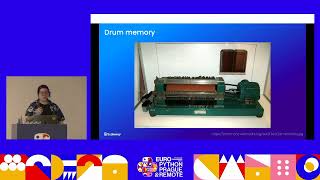
A Brief History of Data Storage
Explore the evolution of data storage from ancient clay tablets to modern digital solutions, examining key innovations, challenges, and future prospects in preserving human knowledge.
Being the DBA of the Future - A World of On-Premise and Cloud
Explore the evolving role of DBAs in hybrid environments, covering essential skills for managing on-premise and cloud databases, and strategies for adapting to future technological changes.
Policy-Based Management and Central Management Server
Explore policy-based management and Central Management Server for efficient SQL Server administration, including server registration, policy creation, and evaluation modes.