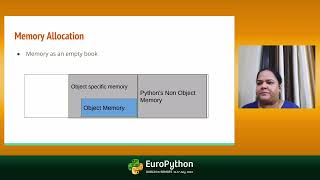
Memory Problems, Did Collector Forget to Clean the Garbage?
Explore Python memory management, common errors, and optimization techniques. Learn about CPython's allocation, garbage collection, and practical ways to improve code efficiency.
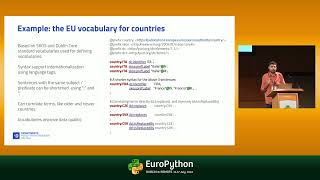
Self-Explaining APIs
Strategies and tools for creating semantically interoperable REST APIs, including contract-first development, RDF processing, and centralized catalogs. Ideal for those with API design experience.
Async Django
Explore asynchronous programming in Django, covering key concepts, tools, efficient practices, and Django's async request handling from NGINX to database operations.
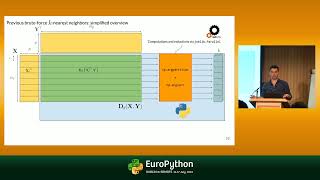
Scaling scikit-learn - Introducing New Sets of Computational Routines
Discover recent performance improvements in scikit-learn, exploring computational patterns, new routine implementations, and future hardware-specialized developments for enhanced machine learning efficiency.
Debugging Asynchronous Programs in Python
Explore powerful debugging techniques for asynchronous Python programs, including asyncio debug mode, tracebacks for unhandled exceptions, and monitoring tools for enhanced development efficiency.
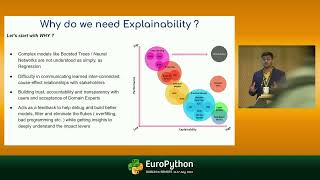
Synergize AI and Domain Expertise - Explainability Check with Python
Explore model explainability using SHAP algorithm in Python, focusing on building trustworthy AI models and integrating domain expertise for practical industry applications.

Real-Time Browser-Ready Computer Vision Apps with Streamlit
Learn to build real-time computer vision applications for browsers using Streamlit and streamlit-webrtc, with demos of object detection, speech-to-text, and style transfer.
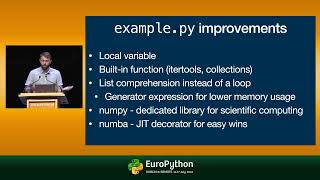
Writing Faster Python 3
Learn practical techniques for optimizing Python code performance, including efficient data structures, built-in functions, and alternatives to loops, with real-world examples and benchmarks.

Forget Mono vs. Multi-Repo - Building Centralized Git Workflows with Python
Discover a Python-based solution for unified Git workflows, transcending the mono vs. multi-repo debate and significantly enhancing CI/CD efficiency across all services.

Build-A-Database with Python
Unlock the inner workings of databases by building one from scratch using Python. Learn to create interfaces, implement data storage, and optimize performance with B-tree indexes.
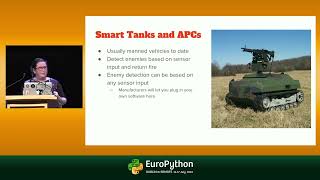
Killer Robots Considered Harmful
Explore the technological, legal, and ethical aspects of autonomous weapons and automated targeting systems in military conflicts, examining their potential impacts and controversies.

Is the News Media Polarized? Or Are We Being Conditioned to Think It Is?
Explore the intersection of computer science and media bias analysis, examining perceived polarization in news through neural networks and SVMs, with surprising insights on mainstream media's impact.
Robyn - An Async Python Web Framework with a Rust Runtime
Explore Robyn, a high-performance async Python web framework with a Rust runtime. Learn its creation, technical decisions, performance benefits, and future plans for web app development.
Saving Lives with Predictive Geo - AI
Explore geospatial Python libraries for Multi-Criteria Decision making, including imagery dataset processing, overlay analysis, and zonal statistics. Learn to create intuitive geo-visualization portals using vector tiles.
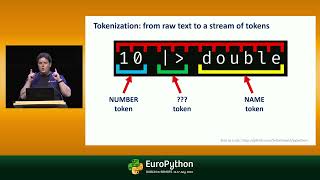
Demystifying Python’s Internals - Diving into CPython by Implementing a Pipe Operator
Dive into CPython's source code by implementing a pipe operator, exploring grammar, syntax trees, and core internals. Learn to navigate and modify Python's codebase for better understanding and potential contributions.
Secure Python ML - The Major Security Flaws in the ML Lifecycle and How to Avoid Them
Uncover critical security risks in machine learning lifecycle, from training to deployment. Learn practical mitigation strategies and tools to secure ML systems effectively.
Writing Secure Code in Python
Learn to identify and prevent security vulnerabilities in Python, including issues with eval(), pickle, and pip. Discover cryptographically-secure randomness and code auditing techniques for maintaining application security.
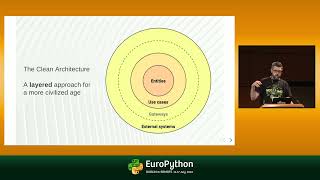
Clean Architectures in Python
Explore layered software design for maintainable, loosely coupled systems. Learn to implement clean architecture principles in Python, enhancing testability and reducing framework dependence.
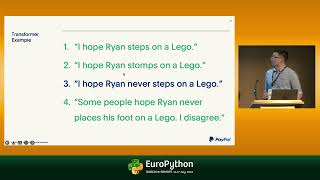
AI for Content Moderation at PayPal
Explore AI-driven content moderation strategies at PayPal, covering challenges, datasets, pre-trained models, and multi-language support for tackling hate speech and toxic content online.
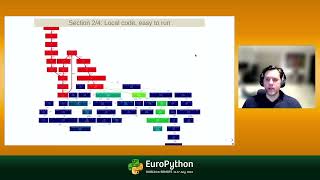
Why is it Slow? Strategies for Solving Performance Problems
Explore strategies for detecting, diagnosing, and solving performance issues in Python applications, covering tracing, profiling, isolation, reasoning, and prevention techniques.
Packaging Security with Nix
Explore how Nix, a functional package manager, enhances dependency security, addressing vulnerabilities in PyPI/pip and preventing issues like rogue packages that steal personal data.