Exceptional Performance
Explore the impact of exceptions on C++ performance, examining hardware architecture, memory hierarchy, and optimization techniques to understand when exceptions might enhance performance.
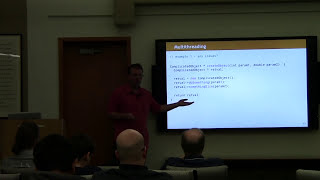
Multithreading is the Answer. What Was the Question? Part II
Explore challenges, solutions, and best practices for multithreaded C++ applications, covering architecture, design patterns, and C++11/17 features for improved readability and maintainability.
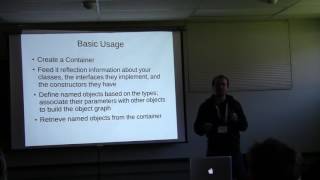
IoC++ - A IoC Framework for C++
Explore IoC++, a flexible dependency injection library for C++. Learn about runtime configuration, object graph management, and comparisons to similar frameworks like Boost.DI.
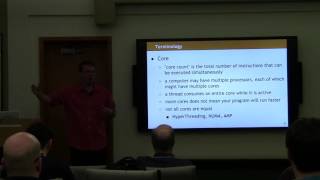
Multithreading is the Answer. What Was the Question? - Part I
Explore multithreading concepts, challenges, and solutions in C++ development. Learn when to use or avoid multithreaded code, and discover techniques for improved readability and maintainability.

Let's Make a Web Match-3 Game in C++14
Learn to create a web-based match-3 game using C++14, Emscripten, and experimental Boost libraries. Explore Dependency Injection and Meta State Machine concepts for efficient game development and cross-platform compatibility.
C++ Tool Support - Where We Are and Where We Are Heading
Exploring the evolution and benefits of C++ development tools, from basic editors to advanced IDEs, highlighting features that enhance productivity and code quality.
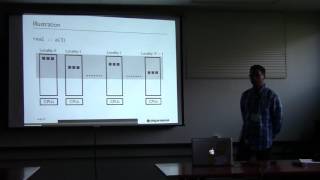
Extending C++ with Co-Array Semantics
Extending C++ with co-array semantics for efficient distributed computing in HPX, enabling SPMD schemes and simplified data transfer between localities in scientific applications.

The Fiber Library
Explore Boost.Fiber for fine-grained concurrency, efficient CPU usage, and simplified asynchronous I/O. Learn integration techniques, useful patterns, and load-balancing strategies for improved application performance.
Implementing Tuple in C++17
Explore C++17's impact on std::tuple implementation, including new language features, library changes, and design considerations. Dive into testing and benchmarking scenarios for tuple implementations.
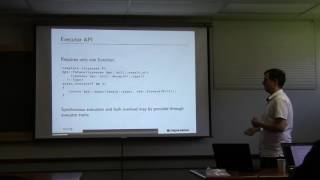
HPX and GPU Parallelized STL
Exploring GPU parallelization in HPX's STL implementation using C++AMP and SYCL standards. Discusses integration challenges, performance optimization, and the potential for simplified GPU programming in C++ applications.
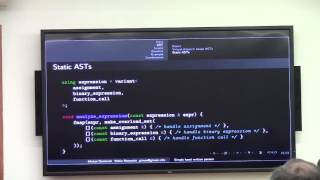
Simple Hand Written Parsers
Explore techniques for implementing recursive descent parsers, focusing on LL(1) grammars with insights on LL(k) and LL(*). Covers AST design, parser combinators, and tokenization for improved debuggability and error handling.
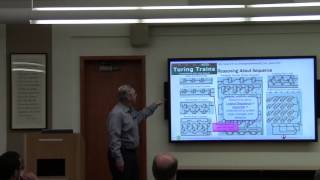
The CPU Cache - Instruction Re-Ordering Made Obvious
Explore CPU cache anatomy, its role in hardware/software design, and how instruction reordering impacts performance. Gain insights into modern system implementation and parallelism considerations.

An Interesting Lock-free Queue - Part 2
Explore advanced lock-free queue implementation, focusing on proving correctness, discussing provability vs testing, and expanding features to tackle new challenges in multi-producer, multi-consumer scenarios.
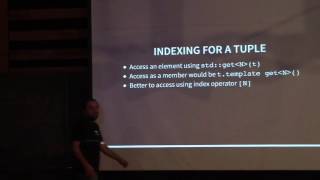
Goodbye Metaprogramming, and Hello Functional
Explore modern C++ features and functional constructs that simplify metaprogramming, moving beyond traditional template techniques to more elegant and efficient solutions.
The Design of a New C++ Build Toolchain
Exploring challenges and solutions in cross-platform C++ building, including cross-compilation, in/out-of-source builds, and package management. Discusses design decisions and features of the build2 toolchain and cppget.org repository.

C++ Performance in Practice - Align, Vectorise, Cache, Jump!
Explore hardware-driven C++ performance optimization techniques including memory alignment, SIMD, cache-friendliness, and branch prediction with code examples and benchmarks.

No Sane Compiler Would Optimize Atomics
Explore compiler optimizations for atomics, memory accesses, and architecture-specific features. Learn about standardizing concurrency tools and debunking misconceptions in low-level programming.
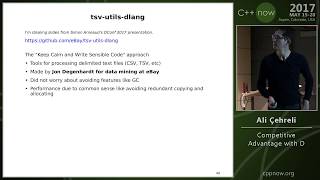
Competitive Advantage with D
Explore D programming language's competitive advantages, focusing on compile-time features, safety, and productivity. Learn how D simplifies systems programming and enhances software engineering.

Haskell Taketh Away - Limiting Side Effects for Parallel Programming
Exploring how limiting side effects in programming languages enhances parallel programming, with insights from Haskell and C++ on determinism, purity, and embedded domain-specific languages.
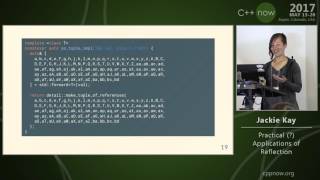
Practical Applications of Reflection
Exploring static type introspection in C++: benefits, costs, and comparison of recent reflection proposals. Analyzes library solutions, standard proposals, and potential impact on C++20 metaprogramming.
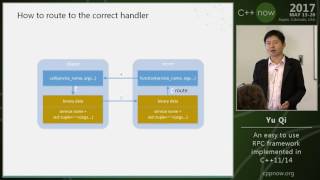
An Easy to Use RPC Framework Implemented in C++11 - 14
Explore rest_rpc, a modern C++ RPC framework simplifying client-server communication. Learn implementation challenges and solutions for type-safe, efficient, and user-friendly remote procedure calls.