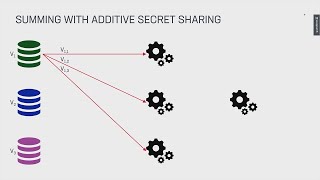
Introduction to Secure Multi-Party Computation
Explore secure multi-party computation techniques for joint calculations on private data without revealing inputs. Learn about homomorphic encryption, garbled circuits, and secret sharing.
How to Master C++
Practical advice for mastering modern C++ through five key programming mindsets: imperative, compile-time, functional, concurrency, and performance. Develop and blend these skills for continuous improvement.

How Bloomberg Uses Behavior-Driven Development to Test Distributed Systems
Explore Bloomberg's approach to testing distributed systems using Behavior-Driven Development and the 'behave' framework for enhanced end-to-end coverage and reliability.

And Then() Some(T) - Don't Look in the Box! - Practical Higher-Order Functions in C++ Combinators
Explore practical higher-order functions in C++, inspired by Rust and Haskell. Learn to write cleaner code using combinators for modular control flow management.

Modified Condition - Decision Coverage in Gcc - An Introduction, Motivation, Intuition and Tooling
Explore Modified Condition/Decision Coverage: its importance in safety-critical software, benefits, and implementation using GCC, with insights for automotive and aviation industries.

Multi Threading Model in Paradox Games - Past, Present and Future
Explore the evolution of multi-threading models in Paradox grand strategy games, from past implementations to current systems and future possibilities for improved performance and complexity.
What I Learned From Sockets - Applying the Unix Readiness Model When Composing Concurrent Operations in C++
Explore Unix socket concepts for composing concurrent operations in C++. Learn to apply select/poll mechanisms to various concurrency problems and discover C++ solutions for multi-future and coroutine scenarios.

Implementing a C++ Coroutine Task from Scratch
Explore advanced C++ coroutine implementation, focusing on optional asynchronous operations, design choices, and performance implications for experienced developers.
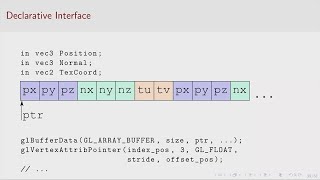
Building C++ Interfaces That Are Hard to Use Incorrectly
Techniques for designing robust C++ library interfaces that prevent misuse, leveraging the type system to catch errors at compile-time and reduce opportunities for bugs in user code.
Functional Programming in Modern C++ - The Imperatives Must Go!
Explore functional programming techniques in modern C++, including lambdas, STL algorithms, lazy ranges, and algebraic data types. Learn to write clearer, faster code using declarative styles and upcoming C++ features.
Function Contracts in Practice Using C++
Explore function contracts in C++, covering design principles, implementation strategies, and practical considerations for robust, maintainable, and high-performance software development.

The Story of the Code
Explore how code tells a story beyond instructions, revealing context, decisions, and evolution. Learn to preserve and convey this narrative for better understanding and future development.

Designing for C++ Concurrency Using Message Passing
Explore message passing in C++ concurrency design, covering frameworks, examples, and practical implementation to reduce synchronization errors and enhance system efficiency.
Khronos Sycl Language Framework for C++ Accelerators - Take Advantage of All the MIPS
Explore SYCL, a C++ framework for heterogeneous computing, enabling efficient use of various accelerators. Learn its features, applications, and advantages for high-performance computing and AI/ML development.
Continuously Checking for Quality of Your Packages
Discover tools and techniques for maintaining high-quality Emacs Lisp packages, including automated testing, linting, and continuous integration setup for GitHub and GitLab.
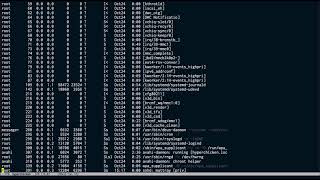
Interactive Remote Debugging and Development with TRAMP Mode
Explore interactive remote debugging and development using TRAMP Mode in Emacs. Learn to efficiently manage remote systems, debug code, and streamline your workflow with powerful tools and techniques.
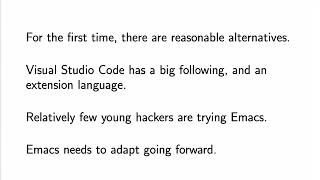
Emacs - The Editor for the Next Forty Years
Exploring Emacs' future: modernizing with Rust, enhancing HTML rendering, integrating developer tools, and expanding functionality while preserving its essence as a powerful, extensible editor.
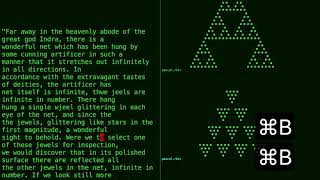
Beyond Vim and Emacs - A Scalable UI Paradigm
Explore a scalable UI paradigm that goes beyond traditional text editors, offering insights into innovative interface design for enhanced productivity and user experience.

Org-roam - Technical Presentation
Explore Org-roam's technical aspects, including its database structure, Git integration, and future developments. Learn how this powerful Emacs package enhances note-taking and knowledge management.
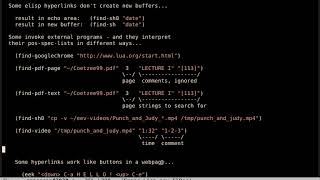
On Why Most of the Best Features in Eev Look Like 5-Minute Hacks
Exploração das características únicas do eev, destacando como suas melhores funcionalidades parecem hacks simples, mas são poderosas e eficientes para usuários do Emacs.
Incremental Parsing with Emacs-Tree-Sitter
Explore incremental parsing in Emacs using tree-sitter, covering features, implementation, and potential applications. Learn about syntax highlighting and pattern matching improvements.