TiDedup - A New Distributed Deduplication Architecture for Ceph
Explore TiDedup, a novel cluster-level deduplication architecture for Ceph, addressing shortcomings in existing designs and improving data reduction, I/O throughput, and reference correction efficiency.
MSRL - Distributed Reinforcement Learning with Dataflow Fragments
Explores MSRL, a distributed reinforcement learning system using fragmented dataflow graphs for flexible execution on GPU clusters, offering improved performance and adaptability.
Efficient Memory Overcommitment for I/O Passthrough Enabled VMs via Fine-grained Page Meta-data Management
Innovative approach for efficient memory management in virtualized systems, enhancing resource utilization while ensuring DMA safety through fine-grained page meta-data management.
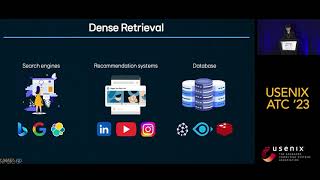
CXL-ANNS - Software-Hardware Collaborative Memory Disaggregation and Computation for Billion-Scale Approximate Nearest Neighbor Search
Innovative approach for scalable approximate nearest neighbor search using CXL memory disaggregation, caching, and parallel processing to significantly improve performance and efficiency.
Change Management in Physical Network Lifecycle Automation
Explores automated systems for managing large network lifecycles, focusing on change management challenges and solutions for conflict resolution and model representation updates.
Translation Pass-Through for Near-Native Paging Performance in VMs
Innovative memory virtualization mechanism achieving near-native performance in VMs. Enables direct guest-to-host address translation while maintaining isolation through hardware-supported memory tagging.
Decentralized Application-Level Adaptive Scheduling for Multi-Instance DNNs on Open Mobile Devices
Explores decentralized scheduling for multiple DNN-powered apps on open mobile systems, using Deep Reinforcement Learning to achieve balanced performance gains and energy savings across various scenarios.
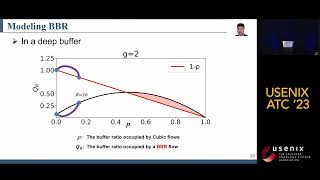
oBBR - Optimize Retransmissions of BBR Flows on the Internet
Optimizing BBR algorithm to reduce retransmissions while maintaining high throughput. Adaptive scaling of in-flight data cap and timely bandwidth estimate updates improve Internet streaming performance.
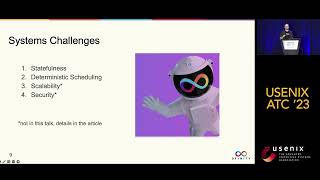
Decentralized and Stateful Serverless Computing on the Internet Computer Blockchain
Explore the Internet Computer blockchain's innovative approach to decentralized, stateful serverless computing, addressing scalability, persistence, and deterministic scheduling challenges.
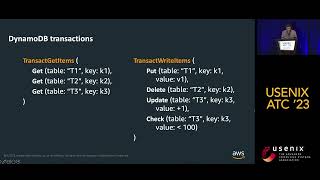
Distributed Transactions at Scale in Amazon DynamoDB
Explore how Amazon DynamoDB implemented distributed transactions without compromising performance, availability, or scale in NoSQL cloud databases using timestamp ordering protocol.
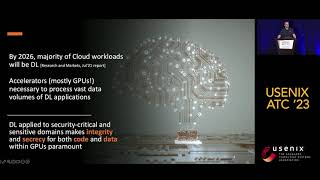
SAGE - Software-based Attestation for GPU Execution
Explore SAGE, a software-based attestation mechanism for secure GPU execution, offering code integrity, computation integrity, and data protection without hardware support.
Tectonic-Shift - A Composite Storage Fabric for Large-Scale ML Training
Innovative storage fabric design combining flash and HDD tiers to optimize power efficiency and IO performance for large-scale machine learning training, featuring application-aware caching policies.
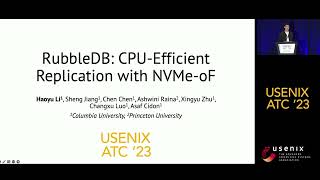
RubbleDB - CPU-Efficient Replication with NVMe-oF
Explores CPU-efficient replication in key-value stores using NVMe-oF, introducing novel mechanisms to address challenges and improve performance for write-heavy workloads.
Portunus - Re-imagining Access Control in Distributed Systems
Innovative cryptographic system using attribute-based encryption for secure, efficient TLS key management in distributed networks, enhancing access control without compromising performance.
Bridging the Gap between Relational OLTP and Graph-based OLAP
Explore GART, an innovative system bridging relational OLTP and graph-based OLAP, offering real-time graph analytics with superior performance and data freshness for dynamic applications.
Beware of Fragmentation - Scheduling GPU-Sharing Workloads with Fragmentation Gradient Descent
Innovative GPU scheduling technique using Fragmentation Gradient Descent to optimize resource allocation, reducing unallocated GPUs by up to 49% and improving utilization in large-scale machine learning clusters.
SecretFlow-SPU - A Performant and User-Friendly Framework for Privacy-Preserving Machine Learning
Explore SecretFlow-SPU, a framework for privacy-preserving machine learning that outperforms existing solutions and simplifies development for users without cryptography expertise.
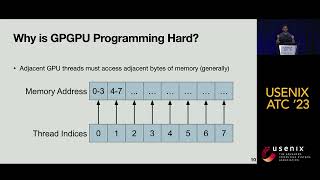
VectorVisor - A Binary Translation Scheme for Throughput-Oriented GPU Acceleration
Explore VectorVisor, a novel GPU acceleration approach for server-side applications, offering improved throughput and cost-efficiency through vectorized binary translation and CPU thread emulation.
AWARE - Automate Workload Autoscaling with Reinforcement Learning in Production Cloud Systems
Explore AWARE, an innovative framework using reinforcement learning for efficient workload autoscaling in cloud systems, offering faster adaptation and improved resource utilization.
Legion - Automatically Pushing the Envelope of Multi-GPU System for Billion-Scale GNN Training
Innovative system for accelerating billion-scale GNN training using multi-GPU caching, hierarchical partitioning, and automatic management, significantly outperforming existing solutions.
Understanding Microservice Performance
Explore microservice performance optimization, covering measurement techniques, key metrics, and strategies for identifying bottlenecks in both isolated and interconnected services.