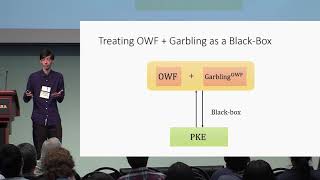
Limits on the Power of Garbling Techniques for Public Key Encryption
Explores limitations of garbling techniques in public key encryption, examining their effectiveness and potential constraints in cryptographic applications.
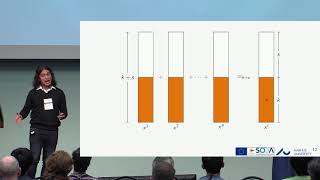
SPDZ2k - Efficient MPC mod 2^k for Dishonest Majority
Efficient multiparty computation protocol for dishonest majority settings, operating modulo 2^k. Presents novel techniques for secure computation with improved efficiency.

Continuously Non Malleable Codes in the Split State Model from Minimal Assumptions
Explore advanced cryptographic techniques for secure data encoding, focusing on non-malleable codes in split-state models and their applications in information security.
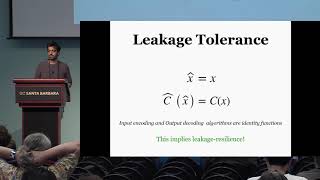
Private Circuits - A Modular Approach
Explore modular approaches to private circuits, focusing on cryptographic techniques for secure computation and data protection in various applications.
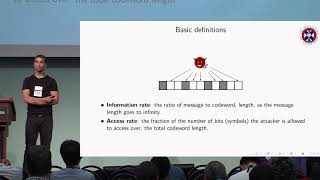
Non Malleable Codes for Partial Functions with Manipulation Detection
Explore non-malleable codes for partial functions, their applications, and construction methods. Learn about challenges, admissible function classes, and implementations in various models.

TinyKeys - A New Approach to Efficient Multi-Party Computation
Explore a novel approach to efficient multi-party computation with TinyKeys, focusing on protocol complexity, OT extension, and secure protocols for improved performance.

On the Complexity of Compressing Obfuscation
Explore the complexity of compressing obfuscation, focusing on indistinguishability obfuscation, compression hierarchy, and statistically secure compressing obfuscation in cryptography.

Pseudorandom Quantum States
Explore pseudorandom quantum states, their definitions, applications in quantum money, and related concepts like pseudorandom unitary operators in this cryptography research presentation.

Adaptive Garbled RAM from Laconic Oblivious Transfer
Explore innovative cryptographic techniques combining Adaptive Garbled RAM and Laconic Oblivious Transfer, advancing secure computation and data privacy in modern cryptography.

On the Round Complexity of OT Extension
Explore the round complexity of oblivious transfer extension protocols, examining theoretical advancements and implications for secure multiparty computation.
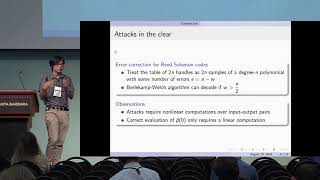
A Simple Obfuscation Scheme for Pattern Matching with Wildcards
Explore a novel obfuscation scheme for pattern matching with wildcards, presented at Crypto 2018, offering insights into cryptographic techniques and their applications.

Two Round Multiparty Secure Computation Minimizing Public Key Operations
Explore innovative techniques for efficient multiparty secure computation, focusing on minimizing public key operations in just two rounds of communication.

Non Interactive Zero Knowledge Proofs for Composite Statements
Explore advanced zero-knowledge proofs for composite statements, covering Sigma protocols, garbled circuits, and SNARK constructions. Learn about privacy-preserving credentials and RSA signatures.

Fault Attacks Made Easy - Differential Fault Analysis Automation on Assembly Code
Explore automated differential fault analysis techniques for assembly code, enhancing understanding of cryptographic vulnerabilities and attack methodologies.
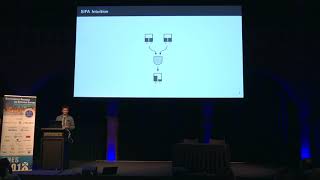
SIFA - Exploiting Ineffective Fault Inductions on Symmetric Cryptography
Explore a novel fault attack technique on symmetric cryptography, focusing on its effectiveness and implications for secure implementations.
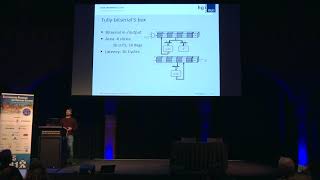
Spin Me Right Round - Rotational Symmetry for FPGA Specific AES
Explore rotational symmetry in FPGA-specific AES implementation, focusing on innovative approaches to enhance efficiency and side-channel protection in cryptographic designs.
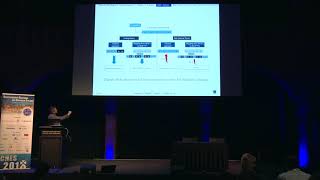
Linear Repairing Codes and Side Channel Attacks
Explore linear repairing codes and side channel attacks in cryptography, covering security issues, shading schemes, and practical applications through experiments and observations.

Stealthy Opaque Predicates in Hardware - Obfuscating Constant Expressions at Negligible Overhead
Explores hardware-based obfuscation techniques for constant expressions, presenting a novel approach with minimal overhead. Discusses applications in watermarking and security.
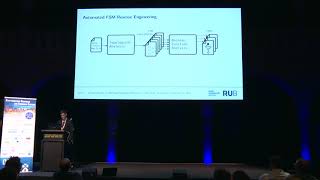
On the Difficulty of FSM Based Hardware Obfuscation
Explores challenges in finite state machine-based hardware obfuscation, analyzing vulnerabilities and proposing potential countermeasures for enhanced security in digital circuit design.

CHES 2018 Rump Session
Cryptographic hardware and embedded systems experts present cutting-edge research and innovations in a rapid-fire format, covering diverse topics in security and cryptography.
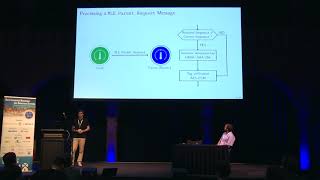
EM Analysis in the IoT Context - Lessons Learned from an Attack on Thread
Explore electromagnetic analysis in IoT, focusing on Thread protocol vulnerabilities. Learn key insights from a real-world attack and its implications for IoT security.