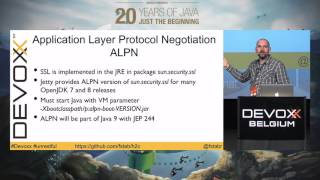
UnRESTful Web Services with HTTP2
Explore HTTP/2's advanced features for efficient, bidirectional communication in web services, moving beyond traditional REST constraints for improved performance and flexibility.

Providing Eyes, Ears, and a Mouth to Your IoT Project
Explore Intel RealSense for IoT projects: gesture control, voice recognition, and face detection. Enhance user experiences in home automation, robotics, and security using Raspberry Pi, Galileo, and Edison.
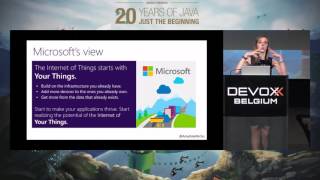
The Intelligence of Your Things
Explore IoT's potential with Azure, connecting devices to the cloud and leveraging previously inaccessible data streams for innovative business solutions.
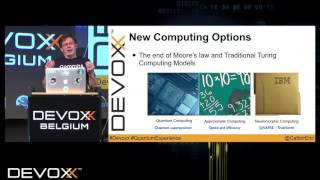
You Always Dreamt of Your Own Quantum Computer - Now You Can Have It in the Cloud
Explore quantum computing in the cloud with IBM's accessible platform. Learn about qubits, gates, algorithms, and error correction through practical experiments and simulations.
Composite Builds with Gradle
Explore Gradle's Composite Build feature to combine multiple builds, replace binary dependencies with project dependencies, and simplify mono-repo management for improved development workflow.
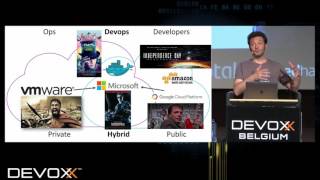
Nuts and Bolts of Docker
Comprehensive guide to packaging, deploying, and scaling Java applications with Docker. Learn to reduce environment mismatches and simplify deployment for more efficient development workflows.
Javaslang - Functional Java Done Right
Explore Javaslang's functional programming features, including persistent data types and immutable collections, to enhance Java 8's lambda capabilities and create more robust, efficient code.
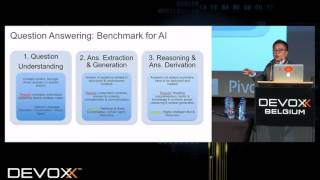
Deep Dive into Watson's Neural Networks
Explore Watson's neural networks, machine learning algorithms, and cognitive capabilities. Learn how Watson enables human-like conversations, deep searches, and continuous learning in AI platforms.
Units of Measurement - The First IoT JSR
Explore JSR 363 for standardized IoT measurement representation, enabling accurate data handling in smart devices and scientific applications. Learn implementation and contribute to Java's IoT growth.
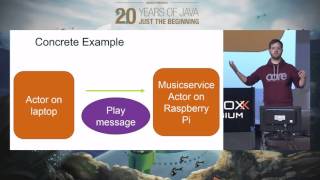
REST No More, Use an Actor and Lego and Raspberry Pi's
Explore IoT using Scala and Akka to control Lego trains with Raspberry Pi's. Learn how remote actors can replace REST endpoints in applications, demonstrated through an automated Lego train system.
IOT, Timeseries and Prediction with Android, Cassandra and Spark
Explore IoT potential using smartphone sensors, Cassandra for timeseries storage, and Spark for real-time data analysis and activity prediction.

The Design of a Reliable and Secure Operating System
Explore MINIX 3, a revolutionary multiserver OS designed for enhanced reliability and security, featuring a minimal kernel and modular architecture for improved stability and live updates.
Predicting the Future with Machine Learning
Explore machine learning's power to predict future events, from flight delays to sentiment analysis, with practical steps for building and deploying predictive models using Azure tools.
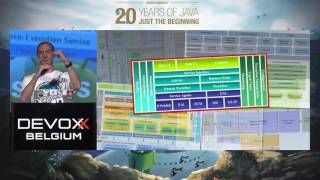
Software Architecture as Code
Explore lightweight software architecture approaches, architecturally-evident coding styles, and representing architecture models as code to align design with implementation.

Tensorflow and Deep Learning - Without a PhD
Comprehensive introduction to TensorFlow and deep learning, covering neural networks, convolutional networks, regularization techniques, and practical applications in image and language processing.

Reactive Programming
Explore reactive programming concepts, from observables to error handling, with practical code examples for building resilient, scalable, and responsive applications.
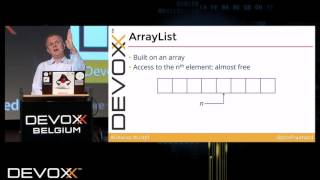
Array Linked to a List - The Full Story
Comprehensive exploration of Java collections, comparing ArrayList and LinkedList performance, discussing CPU caches, and examining Java 9 enhancements. Includes JMH benchmarking and lambda-based implementations.
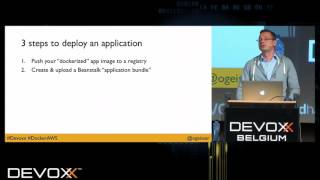
Running Docker in Production on AWS
Explore tools and strategies for deploying Docker containers in AWS production environments, covering host management, service integration, orchestration, updates, monitoring, and log management.
Open Sesame! Conversations With My Front Door
Explore building a voice-controlled smart home system using Raspberry Pi, open-source software, and natural language processing. Learn to create an extensible bot for managing electrical devices.
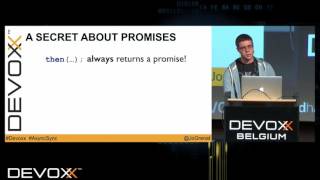
Avoid the Headaches - Make Your Asynchronous Code Look Synchronous
Learn techniques to simplify asynchronous JavaScript code using promises, generators, coroutines, and async/await syntax. Improve legacy codebases and write cleaner, more maintainable asynchronous logic.
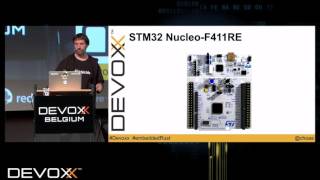
Embedded Rust - Rust on IoT Devices
Explore Rust for secure IoT development: full memory access, cross-compilation for microcontrollers, and bare-metal debugging. Learn how Rust combines safety and performance for embedded systems.