
Making Friends With Artificial Intelligence
Eric Horvitz explores the human-centric future of AI, discussing how computational systems will complement human cognition, anticipate needs, and help us prepare for surprises in supportive ways.

New Hope for Humans in an A.I. World
Explore Artificial Swarm Intelligence as a potential defense against AI dangers, tapping into collective human knowledge to create super-intelligence surpassing individual capabilities.

The Rise of Artificial Intelligence through Deep Learning
Explore the AI revolution through deep learning with Yoshua Bengio. Discover progress, challenges, and societal impacts of human-level AI, emphasizing the importance of public understanding for collective decision-making.

How Will Artificial Intelligence Affect Your Life
Explore AI's recent advancements in computer vision, speech recognition, and language understanding, and their impact on robotics, healthcare, creativity, and hardware design.

Artificial Intelligence and the Future of Education Systems
Explore how AI and machine learning challenge our economy and education systems, and discover potential solutions through questioning established norms.

Learning Differentially Private Mechanisms
Explore techniques for developing privacy-preserving algorithms and mechanisms, focusing on differential privacy principles and their practical applications.

A Decentralized and Encrypted National Gun Registry
Explore innovative approaches to gun registration using decentralized and encrypted technologies, addressing privacy concerns and enhancing data security.

How Not to Prove Your Election Outcome
Reveals critical flaws in e-voting systems, demonstrating how sophisticated cryptography can inadvertently introduce vulnerabilities that allow undetectable election fraud despite apparent verifiability.
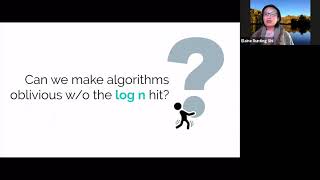
Path Oblivious Heap - Optimal and Practical Oblivious Priority Queue
Explore an innovative, efficient oblivious priority queue algorithm with optimal performance and practical applications in secure data structures and sorting.
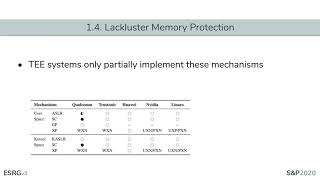
Understanding the Prevailing Security Vulnerabilities in TrustZone-Assisted TEE Systems
Comprehensive analysis of security vulnerabilities in TrustZone-assisted Trusted Execution Environments, exploring architecture issues, implementation bugs, and hardware flaws across popular TEE systems. Offers insights for improving TEE security.
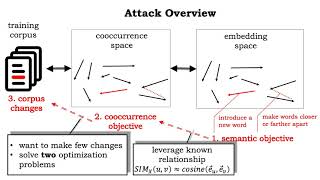
Humpty Dumpty - Controlling Word Meanings via Corpus Poisoning
Explore how attackers can manipulate word embeddings through corpus modifications, affecting downstream NLP tasks and fooling defenses. Learn about implications for information retrieval and translation.
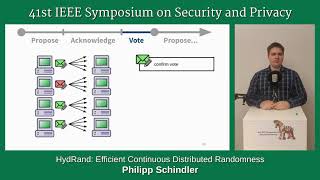
HydRand - Efficient Continuous Distributed Randomness
Explore HydRand, a novel protocol for generating continuous, unpredictable, and bias-resistant randomness in distributed systems, improving scalability and ensuring reliable output delivery.
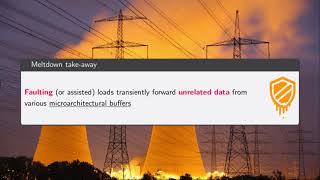
Hijacking Transient Execution through Microarchitectural Load Value Injection
Explore microarchitectural vulnerabilities and load value injection techniques to understand transient execution hijacking in modern processors.

Automatically Detecting Bystanders in Photos to Reduce Privacy Risks
Explore techniques for automatically identifying bystanders in photos to enhance privacy protection, using visual cues and machine learning models to detect non-primary subjects in images.

On the Security of Two-Round Multi-Signatures
Analyzes security flaws in two-round multi-signature schemes, presents attacks, and proposes mBCJ as a secure alternative for large-scale collaborative signing applications.
Stealthy Porn - Understanding Real World Adversarial Images for Illicit Online Promotion
Explore real-world adversarial techniques used to evade image-based detection in online porn promotion, analyzing evasion methods and their effectiveness against popular content detectors.
Why Does Your Data Leak? Uncovering the Data Leakage in Cloud from Mobile Apps
Explores root causes of data leaks in cloud-based mobile apps, revealing authentication and permission issues. Presents automated analysis techniques to identify vulnerabilities in cloud API usage.
On the Feasibility of Rerouting-Based DDoS Defenses
Analyzes the feasibility of rerouting-based DDoS defenses, highlighting fundamental trade-offs and limitations in current inter-domain infrastructure. Emphasizes the need for rigorous security analysis and real-world testing of new defense proposals.
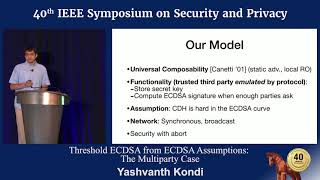
Threshold ECDSA from ECDSA Assumptions - The Multiparty Case
Explores extending threshold ECDSA protocols to arbitrary thresholds, proposing a new scheme with improved efficiency and security under weaker assumptions for cryptocurrency applications.
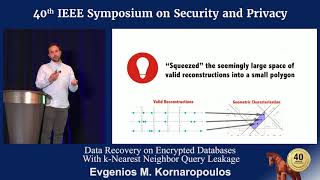
Data Recovery on Encrypted Databases with k-Nearest Neighbor Query Leakage
Explores data recovery attacks on encrypted databases supporting k-nearest neighbor queries, analyzing feasibility of exact reconstruction and proposing practical approximate reconstruction methods for spatial data.
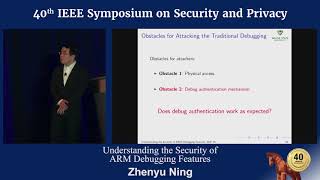
Understanding the Security of ARM Debugging Features
Comprehensive analysis of ARM debugging features' security implications across various platforms, exposing vulnerabilities and demonstrating the Nailgun attack to highlight potential risks.