Max-Flow and Friends, In Almost Linear Time
Explore cutting-edge algorithms for max-flow problems and related graph theory concepts, focusing on recent breakthroughs in achieving near-linear time complexity.
The Role of Conventions in Adaptive Human-AI Interaction
Explores partner modeling in multi-agent coordination, focusing on representation learning, conventions, and strategies for reducing non-stationarity in decentralized systems.
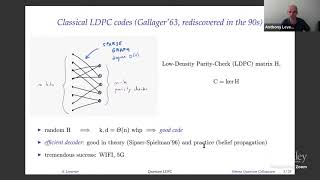
The Quantum LDPC Manifesto - Quantum Colloquium
Exploring recent advancements in quantum LDPC codes and their potential to revolutionize quantum fault-tolerance strategies, with insights on improved encoding rates and minimum distances.

Verifiable Quantum Advantage Without Structure - Quantum Colloquium
Explore groundbreaking research on verifiable quantum advantage without relying on structured problems, challenging traditional approaches in quantum computing.
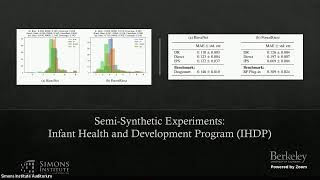
Orthogonal Statistical Learning
Explore statistical learning with nuisance parameters, focusing on excess risk guarantees and Neyman orthogonality. Discover applications in treatment effects, policy optimization, and more.
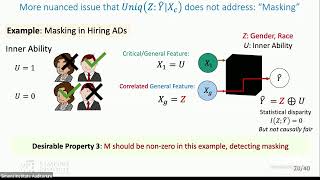
Algorithmic Fairness From The Lens Of Causality And Information Theory
Explore algorithmic fairness through causality and information theory, focusing on identifying and explaining sources of disparity in ML models and quantifying accuracy-fairness trade-offs.
Scalable and Reliable Inference for Probabilistic Modeling
Explore scalable and reliable inference techniques for probabilistic modeling, focusing on Metropolis-Hastings, Gibbs sampling, and stochastic gradient MCMC methods for efficient data analysis and deep learning applications.
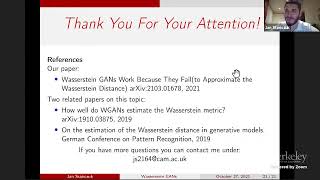
Wasserstein GANs Work Because They Fail - to Approximate the Wasserstein Distance
Explore the counterintuitive success of Wasserstein GANs despite their failure to accurately approximate the Wasserstein distance, offering insights into their effectiveness in generative modeling.

Panel on Quantum Machine Learning and Barren Plateaus
Expert panel explores quantum machine learning challenges, focusing on barren plateaus and their implications for algorithm design and practical quantum computing applications.
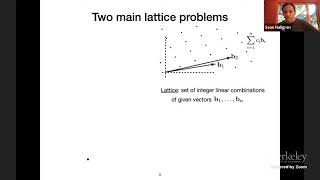
An Efficient Quantum Algorithm for Lattice Problems Achieving Subexponential Approximation Factor
Explore a groundbreaking quantum algorithm for lattice problems, offering subexponential approximation and exponential speedup over classical methods in polynomial time.
Hidden Symmetries of Computational Problems
Explore hidden symmetries in computational problems, uncovering geometric methods for optimization and sampling with insights from experts in mathematics and quantum computing.
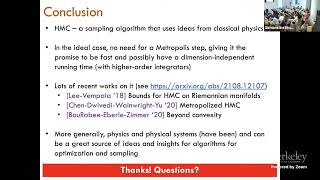
An Introduction to Hamiltonian Monte Carlo Method for Sampling
Explore the Hamiltonian Monte Carlo method for efficient sampling in high-dimensional spaces, its theoretical foundations, and practical applications in optimization and machine learning.
Power and Limitations of the QAOA
Explore the capabilities and constraints of the Quantum Approximate Optimization Algorithm (QAOA) in solving complex computational problems.

The Quantum Approximate Optimization Algorithm - Recent Results
Explore recent advancements in quantum optimization techniques, focusing on the Quantum Approximate Optimization Algorithm and its applications in solving complex computational problems.
Overview of Multi-Variate Function Based Public-Key Cryptography and Cryptanalysis
Explore quantum-resistant cryptography, focusing on multivariate function-based systems and their cryptanalysis in the post-quantum era.
Overview of Code-Based Crypto Assumptions
Explore code-based cryptography assumptions, including Hamming codes, decoding problems, and cryptosystems. Learn about security analyses and generic attacks in post-quantum cryptography.
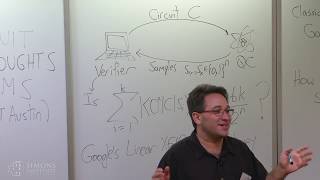
Random Circuit Sampling: Thoughts and Open Problems
Explore quantum computing challenges and potential solutions in random circuit sampling, discussing current research and future directions.
Quantum Algorithms and Post-Quantum Cryptography
Explore quantum algorithms, post-quantum cryptography, and their impact on computing. Delve into exponential speedups, NIST standards, lattices, and isogeny-based cryptography.

Lattice Trapdoors
Explore lattice trapdoors in cryptography, their algorithms, complexity, and applications in program obfuscation with expert Shweta Agrawal from IIT Madras.
The Short Integer Solutions Problem and Cryptographic Applications
Explore the Short Integer Solutions Problem, its cryptographic applications, and connections to lattice-based algorithms, complexity, and security in this advanced mathematical lecture.

Mathematics of Lattices
Explore fundamental concepts and applications of lattice theory in algorithms, complexity, and cryptography with expert insights from UC San Diego researcher Daniele Micciancio.