
Learning to Predict Arbitrary Quantum Processes
Explore quantum learning theory and its surprising ability to predict local properties of arbitrary quantum circuits, contrasting with classical limitations and highlighting potential for efficient quantum dynamics prediction.
Generalization and Robustness in Offline Reinforcement Learning
Explore offline reinforcement learning for safety-critical applications, covering generalization, robustness, and imitation learning in large-scale settings with rich function approximation.
Foundations of RL
Explore key reinforcement learning algorithms: TD learning, Q-Learning, and Natural Policy Gradient. Learn about finite-time performance bounds and their underlying principles.
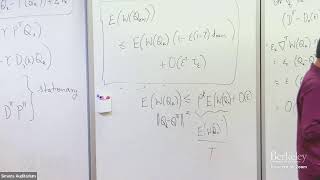
Foundations of RL
Explore key reinforcement learning algorithms: TD learning, Q-Learning, and Natural Policy Gradient. Learn about finite-time performance bounds and their underlying principles.
When Is Scale Enough?
Exploring performance predictability in deep learning as models and datasets scale up, focusing on large language models and investigating solvable problems through scaling alone.

Beginner Linux for Ethical Hackers - Scripting with Bash
Learn essential Bash scripting for ethical hacking: grep, cut, tr, loops, and if statements. Create and improve a ping script while mastering Linux command-line tools for cybersecurity.
ChatGPT - Water Sector Applications
Explore AI and large language models in water industry applications, including ChatGPT capabilities, live demos, software integration, and potential risks and opportunities.
How to Stop Your Organization's Kubernetes Costs from Spinning Out of Control
Discover strategies to monitor, optimize, and control Kubernetes costs in enterprise environments. Learn about different cost types, implementation considerations, and practical solutions for effective K8s spend management.
The Geometry of Tensors - Carolina Araujo
Explore tensor decomposition, its applications, and geometric interpretation. Learn about recent developments in determining tensor ranks and their significance in various fields.
Optimal Transportation, Monge-Ampère Equations and Riemannian Ricci Bounds - Lecture 1
Explore optimal transportation, Monge-Ampère equations, and Riemannian Ricci bounds in this advanced mathematics lecture by L. Ambrosio from Scuola Normale Superiore di Pisa.
Innovating Faster with Security and Quality - GitLab and HackerOne Best Practices
Explore GitLab's secure code shipping practices, tools, and industry best practices. Learn how they leverage HackerOne's community for swift security issue detection and prioritization.
Approximating Many-Electron Wave Functions Using Neural Networks - IPAM at UCLA
Explore neural network applications in quantum mechanics, focusing on Fermionic neural networks for approximating many-electron wave functions and enhancing variational quantum Monte Carlo methods.
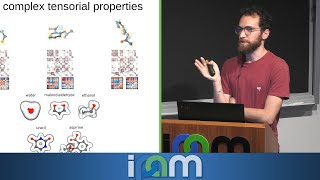
Message Passing Neural Networks for Atomistic Systems - Molecules
Explore message passing neural networks for molecular systems, focusing on their application in quantum mechanics and multiscale approaches to atomistic modeling.
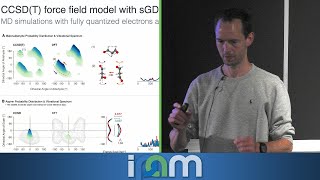
Non-Locality in Machine Learning Force Fields - IPAM at UCLA
Explore non-locality in machine learning force fields with Stefan Chmiela, focusing on multiscale approaches in quantum mechanics and their applications in computational chemistry.
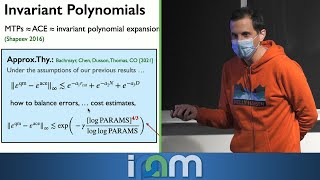
Modelling Atomic Properties with the Atomic Cluster Expansion - IPAM at UCLA
Explore atomic cluster expansion for hybrid interatomic potentials, covering methodology, applications, and theoretical foundations in quantum mechanics and materials science.
Learning to Explore with Scalable Supervision - IPAM at UCLA
Discover efficient reinforcement learning techniques for robotic control, balancing self-supervision and human guidance to overcome exploration challenges in high-dimensional spaces.
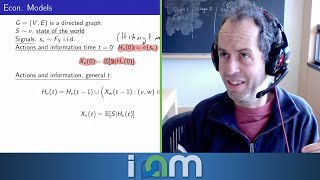
Some Mathematical Theorems on Agreement and Learning in Networks - IPAM at UCLA
Explore mathematical theorems on agreement and learning in networks, presented by MIT's Elchanan Mossel at IPAM's Mathematics of Collective Intelligence Workshop.
Gibbs Sampling for Convex Bodies and an L_0 Isoperimetric Inequality
Explore Gibbs sampling for high-dimensional distributions, focusing on convergence guarantees and conductance bounds for sampling from convex bodies. Gain insights into this widely-used algorithm's efficiency and limitations.
Creating Complex Scientific Workflows that Reach into the Real World - IPAM at UCLA
Explore laboratory automation and complex scientific workflows with ESCALATE software, focusing on experiment planning, data capture, and machine learning integration for halide perovskite synthesis.
Future Exascale Architectures - IPAM at UCLA
Explore future exascale computing architectures and their applications in materials science, presented by Lawrence Livermore National Laboratory expert Erik Draeger at UCLA's IPAM.
Neur2SP- Neural Two-Stage Stochastic Programming - IPAM at UCLA
Explore Neur2SP, a novel approach to two-stage stochastic programming using neural networks. Learn how this method efficiently solves complex decision-making problems under uncertainty.