Secure Distributed Matrix Multiplication
Explore information-theoretic methods for secure distributed matrix multiplication, focusing on trustworthy machine learning applications and techniques.
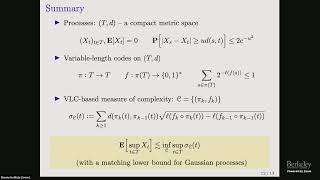
Majorizing Measures, Codes, and Information
Explore the connections between majorizing measures, coding theory, and information theory in machine learning, with insights from Maxim Raginsky.
A -Con-Sequential View of Information for Statistical Learning and Optimization
Explore information-theoretic approaches to statistical learning and optimization, focusing on sequential methods for improved trustworthiness in machine learning.
Improving Accuracy-Privacy Tradeoff via Model Reprogramming
Explore innovative techniques for enhancing the balance between model accuracy and data privacy through advanced model reprogramming strategies.
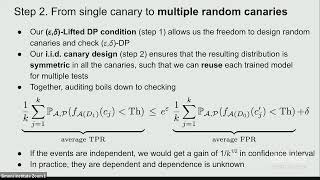
Fundamental Trade-Offs in FL-FA - Sparsity - DP - Communication Constraints
Explore trade-offs in federated learning, focusing on sparsity, differential privacy, and communication constraints. Gain insights into balancing these factors for effective machine learning.
Selection Sort with Example
Learn the Selection Sort algorithm through a detailed example, understanding its implementation and efficiency for sorting data structures.
Train a PyTorch Neural Network Step-by-Step - PyTorch Deep Learning
Learn to build and train a PyTorch neural network for image classification, achieving 85% accuracy on Fashion MNIST. Covers data preparation, network architecture, loss functions, optimization, and model visualization.
PyTorch Datasets, DataLoaders and Transforms - GPU Series Part 3
Explore PyTorch's data handling tools: Datasets, DataLoaders, and Transforms. Learn to prepare, visualize, and optimize data for GPU-accelerated deep learning using Fashion-MNIST dataset.
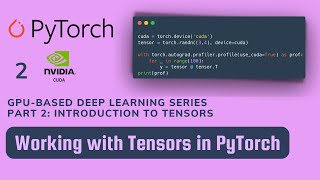
Introduction to Tensors - PyTorch with GPU Series Part 2
Explore tensor initialization, GPU usage, operations, memory sharing, and profiling in PyTorch for efficient deep learning model development.

Hands on Introduction to Docker and Data Persistence With Docker Volumes
Comprehensive Docker tutorial covering image management, container operations, Dockerfile creation, and data persistence using volumes and bind mounts. Hands-on approach with practical examples.
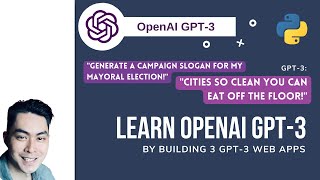
GPT-3 Tutorial: Building Projects for Email Writing and Ad Slogan Generation
Hands-on tutorial exploring GPT-3's capabilities through practical projects, including LaTeX translation, email composition, and ad slogan generation. Covers API setup, model parameters, and unexpected results.
Introduction to Containers on Perlmutter - IPAM at UCLA
Explore containerization on Perlmutter supercomputer, focusing on implementation, benefits, and practical applications in high-performance computing environments.
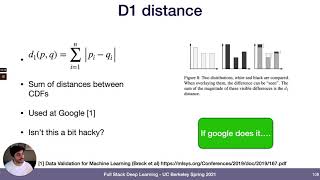
Monitoring ML Models - Full Stack Deep Learning - Spring 2021
Learn techniques for monitoring ML models in production, including detecting data drift, measuring changes, and using tools to maintain model health and performance over time.
ML Testing & Explainability - Full Stack Deep Learning - Spring 2021
Explore ML testing and explainability techniques to enhance model performance, build confidence, and understand limitations. Learn software testing practices, CI/CD, and interpretable AI approaches.
Ethics - Full Stack Deep Learning - Spring 2021
Explore AI ethics, covering long-term challenges, hiring practices, fairness, representation, and best practices. Gain insights into crucial ethical considerations for AI development and implementation.
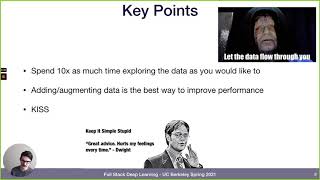
Data Management - Full Stack Deep Learning - Spring 2021
Explore ML infrastructure for data management: ingestion, storage, processing, exploration, labeling, and versioning. Learn about tools and best practices for effective dataset handling in deep learning projects.

Pieter Abbeel on Research Directions - Full Stack Deep Learning - November 2019
Explore cutting-edge deep learning methods with Professor Pieter Abbeel, covering few-shot learning, reinforcement learning, imitation learning, domain randomization, architecture search, and unsupervised learning.

This Function Knows Your Phone Number
Explore a humorous mathematical puzzle involving recursive phone numbers and exponential functions, blending math concepts with comedic storytelling.
Understanding Internet, Networks, Web and More
Comprehensive introduction to internet fundamentals, covering networks, WWW, IP addresses, browsers, client-server architecture, and real-world examples like Facebook and Google.
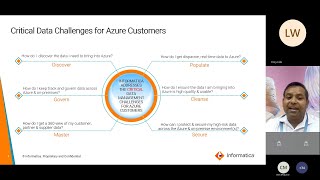
Better Data Drives Better Analytics with Informatica Intelligent Data Management
Discover how Informatica's Intelligent Data Management Cloud enables real-time data integration and quality for Azure Synapse, ADLS, and Power BI, empowering businesses to create impactful analytics.
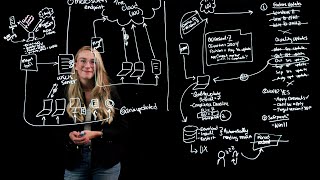
Managing Windows Updates in the Cloud - The Blueprint Files
Explore Windows update management in cloud environments, comparing WSUS and Windows Update, and learn strategies for optimal update handling in on-premises and cloud setups.