
Tree Terminology - Data Structures
Explore essential tree data structure concepts, including roots, nodes, edges, and relationships, to build a strong foundation for advanced programming and algorithm design.

Shell Sort with Example
Learn the Shell Sort algorithm through examples, understanding its unique approach of sorting elements based on their distance for improved efficiency.

Queue Implementation Using Linked List - Data Structures
Explore queue implementation using linked lists, covering enqueue, dequeue, and display operations for efficient data structure management.

Queue Implementation Using Arrays - Data Structures
Learn to implement queues using arrays, covering FIFO mechanism, enqueue/dequeue operations, and handling overflow/underflow conditions in this concise data structures tutorial.

Stack Implementation Using Arrays - Data Structures
Learn to implement stacks using arrays, covering LIFO mechanism, push and pop operations, and overflow/underflow conditions in this concise data structures tutorial.

Double Linked List - Data Structures
Learn to implement and visualize double linked lists, covering creation, insertion, and display operations for efficient data management and manipulation.

Network Security - SHA 512 (Authentication Algorithm)
Learn about SHA-512, a secure hash algorithm for authentication. Explore padding, initialization, processing, and output generation in this comprehensive overview of the cryptographic function.

Network Security - AES (Advanced Encryption Standard) Algorithm
Explore AES encryption algorithm's structure, operations, and key components for secure network communication and data protection.

Monitor K8s Applications Effortlessly at Scale With Groundcover + EBPF
Explore effortless Kubernetes monitoring with groundcover and eBPF. Learn to simplify application management, troubleshoot issues, and leverage intuitive dashboards for enhanced visibility and control.
Topological Quantum Matter, Entanglement, and a "Second Quantum Revolution" by Duncan Haldane
Explore topological quantum matter, entanglement, and the "second quantum revolution" with Nobel laureate Duncan Haldane. Discover exotic states, quantum information theory, and potential applications in quantum computing.
Topology of Complexes and Distributed Computing
Exploring simplicial models in distributed computing, focusing on chromatic subdivisions and Weak Symmetry Breaking, with insights into combinatorial-simplicial questions and related mathematical challenges.
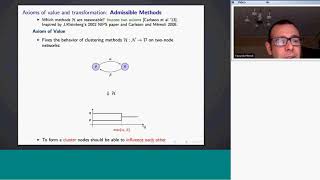
Hierarchical Clustering on Asymmetric Networks
Explore hierarchical clustering techniques for asymmetric networks, examining methodologies and applications in data analysis and network science.

Craig B. Gentry: Homomorphic Encryption
Explore groundbreaking advancements in cryptography with Craig B. Gentry's lecture on homomorphic encryption, a revolutionary technique for secure data processing in untrusted environments.
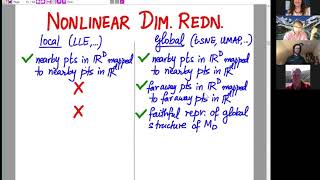
Dimension Reduction - An Overview
Comprehensive overview of dimension reduction techniques, from linear methods like PCA to nonlinear approaches such as LLE, Isomap, t-SNE, and UMAP, with practical application to chemical reaction data.
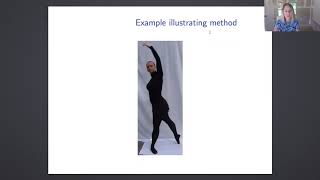
The Medial Axis - Image Analysis, Homological Simplification, Gerrymandering
Explore applications of the medial axis in image segmentation, shape simplification, and detecting gerrymandered districts. Learn about innovative approaches in computational geometry and topology.
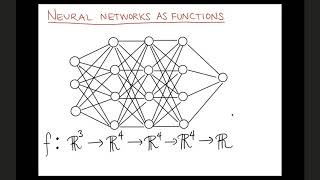
On the Topological Expressiveness of Neural Networks
Explore the topological constraints of neural network architectures and their impact on function representation, with insights from recent research and ongoing work in the field.
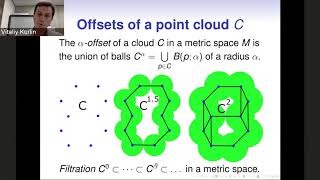
Skeletonization Algorithms With Theoretical Guarantees for Point Clouds
Explore skeletonization algorithms for point clouds, including Mapper, alpha-Reeb graphs, and Homologically Persistent Skeleton. Compare their performance on synthetic and real data sets.
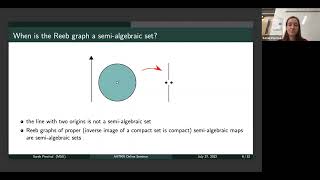
Computation of Reeb Graphs in a Semi-Algebraic Setting
Explore semi-algebraic geometry in applied topology, focusing on Reeb graphs and spaces. Learn about an efficient algorithm for computing semi-algebraic descriptions of Reeb graphs.
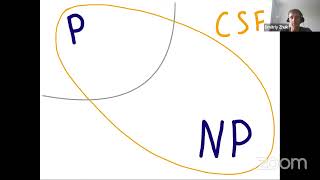
Constraint Satisfaction Problem - What Makes the Problem Easy
Explore constraint satisfaction problems, their complexity, and variants. Learn about polynomial-time solvable cases and NP-complete instances in this mathematical deep dive.
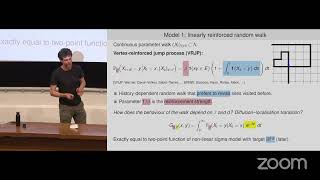
Spin Systems with Hyperbolic Symmetry
Explore spin systems with hyperbolic symmetry, their origins, applications in probabilistic models, recent findings, and open questions in this advanced mathematical discussion.
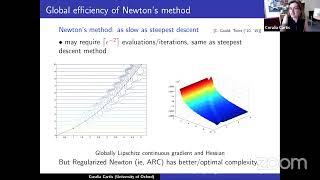
Evaluation Complexity of Algorithms for Nonconvex Optimization
Overview of global convergence rates and evaluation complexity for nonconvex smooth optimization methods, comparing steepest descent and Newton's method, and exploring benefits of higher-order regularization algorithms.