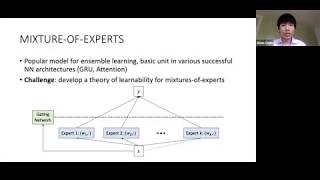
Learning Mixtures of Linear Regressions in Subexponential Time via Fourier Moments
Explore efficient algorithms for learning mixtures of linear regressions using Fourier moments, overcoming previous barriers and achieving subexponential time complexity.
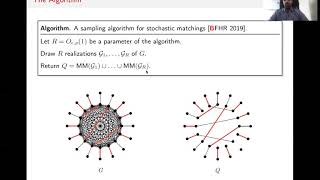
Stochastic Matching with Few Queries - 1-Epsilon Approximation
Explore efficient algorithms for stochastic matching, focusing on (1-epsilon) approximation with limited queries. Learn about vertex independent matchings and local algorithms.
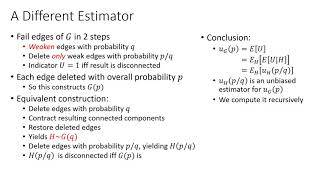
A Phase Transition and Quadratic Time Estimator for Network Reliability
Explore network reliability estimation, including a novel quadratic-time approach, phase transitions, and unbiased estimators for efficient analysis of complex networks.
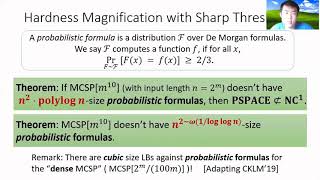
Sharp Threshold Results for Computational Complexity
Explore cutting-edge research on computational complexity, focusing on sharp threshold results, hardness magnification, and probabilistic formulas in this advanced theoretical computer science talk.

On the Need for Large Quantum Depth
Explore quantum computing depth, its implications for quantum supremacy claims, and the challenges in designing oracle problems for quantum circuits.
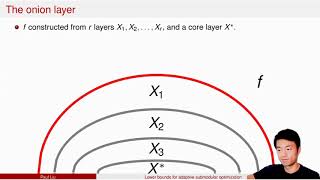
A Polynomial Lower Bound on Adaptive Complexity of Submodular Maximization
Explore adaptive complexity in submodular maximization, covering nonmonotone approximation and hardness. Gain insights into this advanced computational topic through a concise presentation of key concepts and findings.
Estimating Normalizing Constants for Log-Concave Distributions - Algorithms and Lower Bounds
Explore algorithms and lower bounds for estimating normalizing constants in log-concave distributions, covering annealing, Monte Carlo methods, and Langevin dynamics.
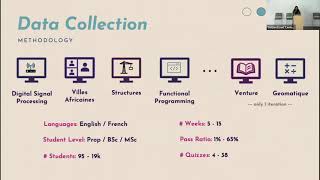
Meta Transfer Learning for Early Success Prediction in MOOCs
Explore innovative deep learning techniques for predicting student success in MOOCs, focusing on meta transfer learning and attention layers to enhance early intervention strategies.

Addressing Issues of Equity and Youth Agency in Computing Education Through a Graphic Novel
Explore equity and youth agency in computing education through a graphic novel, empowering students and educators to critically engage with technology's ethical complexities and societal impact.

Software Engineering at Google
Explore Google's software engineering principles: time, scale, and tradeoffs. Learn sustainable practices for maintaining large codebases and managing change in long-term projects.

The Art of Concurrency in Go
Explore Go's concurrency through hands-on coding of a network utility. Learn best practices, avoid pitfalls, and gain practical understanding of Go's powerful concurrency mechanisms.
Maximizing the Potential of Documents, NLP, and AI - Technical and Non-technical Challenges
Explore technical and non-technical challenges in maximizing document potential with NLP and AI, focusing on SEEK's employment marketplace and innovative solutions for data processing and team organization.

The Essence of Software - Why Systems Often Fail by Design, and How to Fix Them
Explore software design flaws, their impact on user experience, and innovative solutions using concept-based approaches. Learn to create more intuitive and effective systems.

Machine Learning for Algorithm Design
Explore data-driven algorithm design using machine learning, combining theoretical foundations with practical applications to improve performance for various combinatorial problems.
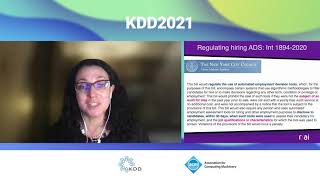
KDD TransFAT - Translating Fairness, Accountability, and Transparency - Julia Stoyanovich
Explore ethical AI challenges in automated decision systems, focusing on fairness, accountability, and transparency in hiring processes and beyond.
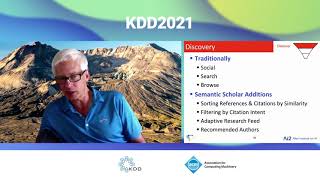
Semantic Scholar- Tera-Scale NLP to Accelerate Scientific Research--Daniel Weld
Explore Semantic Scholar's AI-powered tools for accelerating scientific research, including adaptive feeds, personalized alerts, and advanced summarization techniques.
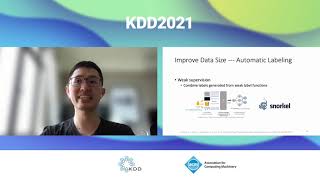
Towards an Easy-to-use AI Platform - Data, Algorithms, and Systems - Wei Wang
Explore the development of user-friendly AI platforms, covering data preparation, model construction, debugging, and deployment, with a focus on enhancing efficiency and accessibility.
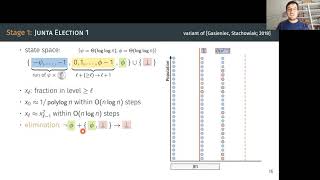
Optimal Time and Space Leader Election in Population Protocols
Explores optimal time and space complexity for leader election in population protocols, presenting a novel algorithm achieving O(n log n) interactions with Θ(log log n) states per agent.
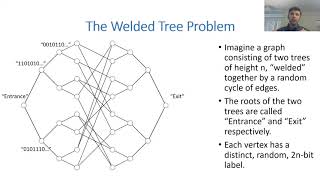
Computations with Greater Quantum Depth Are Strictly More Powerful - Relative to an Oracle
Explore the power of quantum depth in computation, examining conjectures, hybrid systems, and key results through an oracle-based approach and simulation algorithms.
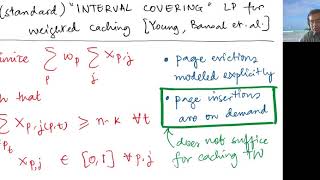
Caching with Time Windows
Explore efficient caching strategies using time windows, including weighted caching algorithms and technical challenges in optimizing cache performance.
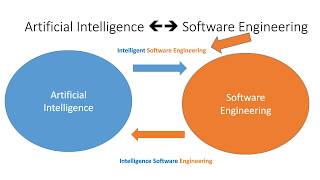
50 Years of Software Engineering - So Now What?
Exploring software engineering's evolution over 50 years, challenges in the industry, and the need for a common ground to increase competency and innovation across all sectors.