Efficient Zero Knowledge Proof from Interactive Proofs
Explore efficient zero-knowledge proofs derived from interactive proofs, focusing on new algorithms, performance improvements, and comparisons to existing systems.
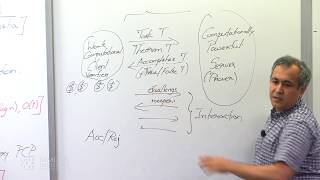
Probabilistically Checkable Proofs - Part I
Explore probabilistically checkable proofs, focusing on proof verification, randomized verifiers, and proof rewriting techniques in this advanced theoretical computer science lecture.
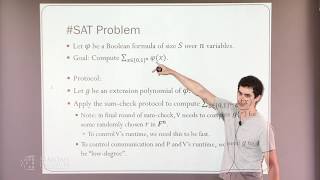
Interactive Proofs - Part II
Explore advanced concepts in interactive proofs, including arithmetician protocols, sharpset, and general-purpose techniques. Learn about applications, limitations, and cutting-edge developments in this field.
Designing Robust Learners
Explore robust machine learning techniques to handle data perturbations and improve model resilience, focusing on TV estimation, modulus examples, and arbitrary loss scenarios.

Better Learning from the Past - Counterfactual - Batch RL
Explore counterfactual and batch reinforcement learning for improved decision-making under uncertainty, with focus on generalization bounds and policy optimization techniques.

How to Fail Interpretability Research
Explore common pitfalls in AI interpretability research, including misconceptions about user trust, model understanding, and evaluation methods.
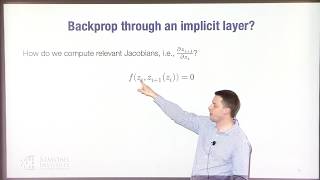
Integrating Constraints into Deep Learning Architectures with Structured Layers
Explore integrating constraints into deep learning using structured layers, covering deep equilibrium models, implicit layers, and weight-tied networks for enhanced architecture design.
Towards Verified Deep Learning
Explore formal methods for verifying deep learning systems, focusing on robustness, semantic analysis, and applications in cyber-physical systems with UC Berkeley's Sanjit Seshia.
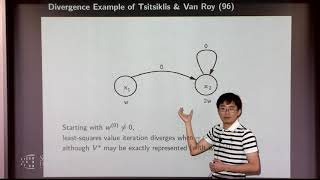
Reinforcement Learning via an Optimization Lens
Explore reinforcement learning through an optimization lens, covering MDPs, Bellman equations, and novel approaches to solving RL problems using linear programming and primal-dual formulations.

Reinforcement Learning in Recommender Systems - Some Challenges
Explore challenges in applying reinforcement learning to recommender systems, including scale, stochastic action sets, and user learning over long horizons. Gain insights on addressing these issues.

Off-Policy Policy Optimization
Explore advanced reinforcement learning techniques, focusing on off-policy optimization, batch methods, and sequential decision-making in deep learning contexts.
Optimality and Approximation with Policy Gradient Methods in Markov Decision Processes
Explore policy gradient methods in Markov Decision Processes, covering optimality, approximation, and key concepts like entropy regularization and natural policy gradient.
On the Hardness of Reinforcement Learning With Value-Function Approximation
Explore challenges in reinforcement learning with value-function approximation, focusing on batch learning in large MDPs and the limitations of realizability assumptions.
Reinforcement Learning in Feature Space: Complexity and Regret
Explore reinforcement learning in feature space, focusing on complexity, regret analysis, and innovative approaches like MatrixRL. Learn about state feature mapping and its applications in real-world scenarios.

Machine Learning-Based Design of Proteins and Small Molecules
Explore machine learning techniques for designing proteins and small molecules, covering directed evolution, model-based optimization, and challenges in deep learning applications.
Knowledge Is Embedded in Language Neural Networks but Can They Reason?
Explore language models' reasoning capabilities, from n-grams to transformers, and discuss future research directions in neural state machines for improved natural language understanding.
Sample-Complexity of Estimating Convolutional and Recurrent Neural Networks
Explore sample-complexity in estimating neural networks, focusing on CNN and RNN architectures. Learn about generative models, minimax analysis, and key results through theoretical proofs and practical experiments.
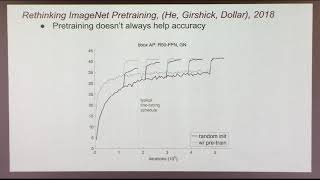
Towards Understanding Transfer Learning with Applications to Medical Imaging
Explore transfer learning in medical imaging, focusing on deep learning applications, performance evaluation, and feature similarity analysis using CCA. Insights on ImageNet models and chest X-rays included.
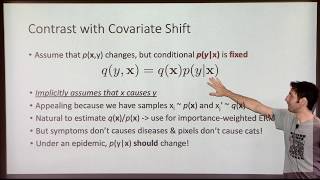
Robust Deep Learning Under Distribution Shift
Explore deep learning challenges under distribution shift, covering adversarial attacks, label shift detection, and domain adaptation techniques for robust model performance in real-world scenarios.

Interpretability - Now What?
Explore machine learning interpretability methods, focusing on Testing with Concept Activation Vectors (TCAV) and its applications in image prediction and medical diagnosis.
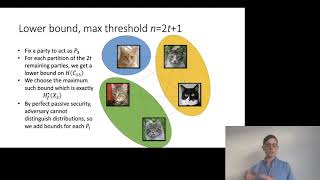
More Communication Lower Bounds for Information-Theoretic MPC
Explores communication complexity lower bounds in information-theoretic secure multiparty computation, covering perfect passive and malicious security settings with various party thresholds and reactive functionalities.