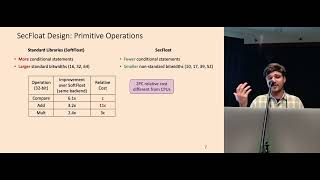
SecFloat- Accurate Floating-Point Meets Secure 2-Party Computation
Explore SecFloat, a novel approach combining accurate floating-point arithmetic with secure two-party computation, enhancing privacy-preserving data analysis and machine learning.
Copy, Right? A Testing Framework for Copyright Protection of Deep Learning Models
Explore a testing framework for copyright protection of deep learning models, covering multi-level metrics, test case generation, and evaluation against various model manipulation techniques.
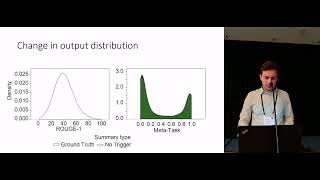
Spinning Language Models: Risks of Propaganda-as-a-Service and Countermeasures
Explore risks and countermeasures of using language models for propaganda, including classification vs sequence-to-sequence models, spin techniques, and defense strategies.
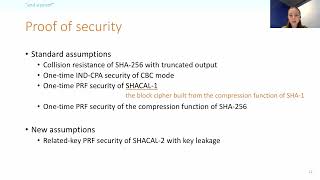
Four Attacks and a Proof for Telegram
Explore cryptographic vulnerabilities in Telegram's MTProto 2.0 protocol, including symmetric channel attacks, related key issues, and implementation flaws. Learn about security models and proofs for messaging apps.

Quantifying Blockchain Extractable Value - How Dark Is the Forest?
Explore the concept of Blockchain Extractable Value in DeFi, its implications, and potential risks, including transaction replay attacks and their impact on blockchain security.
Post-Quantum WireGuard
Explore post-quantum cryptography in WireGuard, covering core handshake security, computational models, and key confidentiality for enhanced network protection.

Did You Mix Me? Formally Verifying Verifiable Mix Nets in Electronic Voting
Explore formal verification of mix nets in electronic voting, focusing on cryptographic properties, software independence, and machine-checked proofs for enhanced security and transparency.

When Function Signature Recovery Meets Compiler Optimization
Explore function signature recovery techniques and their interaction with compiler optimizations, addressing challenges and presenting improved methodologies for enhanced code analysis.
Self-Supervised Euphemism Detection and Identification for Content Moderation
Explore a novel self-supervised algorithm for detecting and identifying euphemisms in online content, enhancing content moderation capabilities.
Keep the Dirt- Tainted TreeKEM, Adaptively and Actively Secure Continuous Group Key Agreement
Explore Tainted TreeKEM, an innovative approach to secure continuous group key agreement, offering adaptive and active security while maintaining efficiency.
Ebb-and-Flow Protocols: A Resolution of the Availability-Finality Dilemma
Explore innovative consensus protocols that balance availability and finality in distributed systems, focusing on the Ebb-and-Flow property and its implications for blockchain technology.
Epochal Signatures for Deniable Group Chats
Explore secure group chat protocols with epochal signatures, focusing on deniability, ephemeral keys, and hidden interactions for enhanced privacy and security.
SIRNN- A Math Library for Secure RNN Inference
Explore SIRNN, a math library enabling secure RNN inference, covering applications, challenges, optimizations, and performance evaluations for privacy-preserving machine learning.
CryptGPU: Fast Privacy-Preserving Machine Learning on the GPU
Explore GPU-accelerated privacy-preserving machine learning techniques for enhanced performance and scalability in image classification and private training.
High-Assurance Cryptography in the Spectre Era
Explore cutting-edge cryptography techniques addressing Spectre vulnerabilities, focusing on constant-time implementations and speculative execution semantics for enhanced security.
Invisible Probe - Timing Attacks with PCIe Congestion Side-channel
Explore timing attacks using PCIe congestion side-channels, including challenges, contributions, experiments, and potential mitigations in this IEEE presentation.
Zero Knowledge for Everything and Everyone - Fast ZK Processor with Cached ORAM for ANSI C Programs
Explore fast ZK processors with cached ORAM for ANSI C programs, enhancing efficiency in zero-knowledge proofs and expanding their applications across various domains.
Diogenes: Lightweight Scalable RSA Modulus Generation with a Dishonest Majority
Explore lightweight RSA modulus generation with a dishonest majority, covering protocol design, secure multiplication, and zero-knowledge constraints for enhanced cryptographic security.

Detecting AI Trojans Using Meta Neural Analysis
Explore meta neural analysis techniques for detecting AI trojans, covering Jumbo Learning, feature extraction, query tuning, and adaptive attacks.
Doing Good by Fighting Fraud - Ethical Anti-Fraud Systems for Mobile Payments
Explore ethical anti-fraud systems for mobile payments, addressing algorithmic bias and user challenges while examining key metrics and design principles for effective fraud detection.
Merkle Squared - A Low-Latency Transparency Log System
Explore a low-latency transparency log system using Merkle trees, covering monitoring protocols, owner monitoring, and lookup mechanisms for enhanced data integrity.