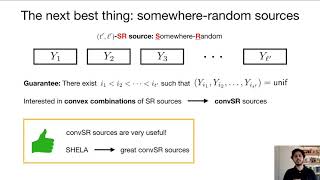
How to Extract Useful Randomness from Unreliable Sources
Explore techniques for extracting randomness from unreliable sources, including multi-source extraction, adversarial models, and applications in cryptography. Learn about somewhere-random sources and their potential.
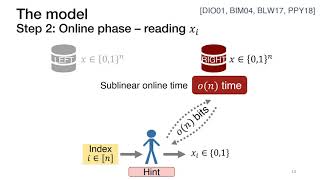
Private Information Retrieval with Sublinear Online Time
Explore efficient private information retrieval protocols with sublinear online time, focusing on communication complexity, computation complexity, and security proofs in cryptographic systems.
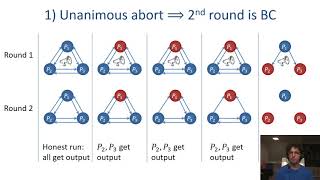
Broadcast-Optimal Two-Round MPC
Explore secure multiparty computation, focusing on two-round protocols. Analyze impossibility results, lower bounds, and feasibility in broadcast-optimal settings.
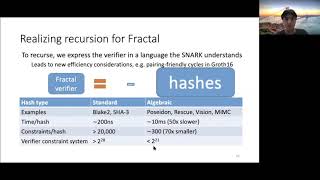
Fractal - Post-Quantum and Transparent Recursive Proofs from Holography
Explore post-quantum cryptography and transparent recursive proofs using holography, focusing on the Fractal system's foundations, implementation, and practical applications in cryptographic security.
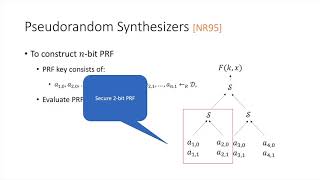
Key-Homomorphic Pseudorandom Functions from LWE with Small Modulus
Explore key-homomorphic pseudorandom functions based on Learning With Errors, focusing on small modulus applications, security implications, and potential limitations in cryptographic systems.
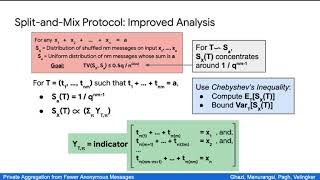
Private Aggregation from Fewer Anonymous Messages
Explore innovative techniques for private data aggregation, focusing on reducing anonymous messages while maintaining accuracy and privacy in distributed systems.

Blind Schnorr Signatures and Signed ElGamal Encryption in the Algebraic Group Model
Explore blind Schnorr signatures and signed ElGamal encryption in the algebraic group model, examining their security properties and applications in cryptographic protocols.

The Price of Active Security in Cryptographic Protocols
Explore cryptographic protocol security, focusing on active security complexity in secure multiparty computation. Learn about new compilers, communication complexity, and open problems in the field.
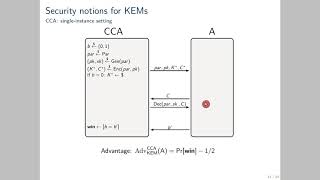
Everybody's a Target - Scalability in Public-Key Encryption
Explore multi-instance security and scaling behavior of cryptographic schemes, focusing on key-encapsulation mechanisms and CDH-type problems in public-key encryption.
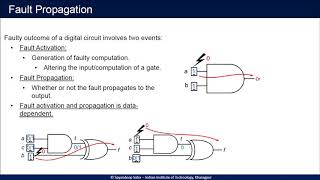
Fault Template Attacks on Block Ciphers Exploiting Fault Propagation
Explore fault template attacks on block ciphers, leveraging fault propagation to bypass countermeasures. Learn about innovative cryptographic techniques and their implications for security.
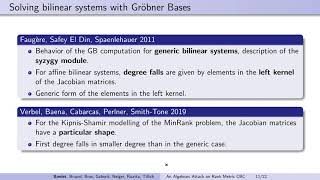
An Algebraic Attack on Rank Metric Code-Based Cryptosystems
Explore algebraic attacks on rank metric code-based cryptosystems, examining the McEliece system, rank decoding, and theoretical security implications for various cryptographic schemes.
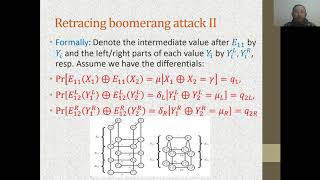
The Retracing Boomerang Attack
Explore advanced cryptanalysis techniques, focusing on the Retracing Boomerang Attack and its variants. Learn about block ciphers, differential attacks, and applications to AES.
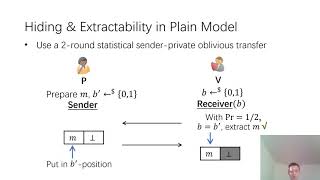
Statistical Zaps and New Oblivious Transfer Protocols
Explore statistical zaps, new oblivious transfer protocols, and their applications in cryptography. Delve into interactive proof systems, witness indistinguishability, and statistical security in two-party protocols.
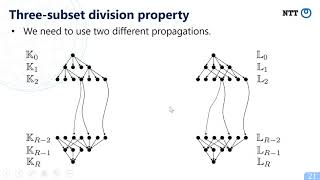
Modeling for Three-Subset Division Property Without Unknown Subset - Improved Cube Attacks
Explore advanced cube attack techniques for cryptanalysis, focusing on three-subset division property modeling and its applications to stream ciphers like Trivium.

Multi-Party Computation 1
Explore multi-party computation fundamentals, adaptive security, and practical applications in this comprehensive overview of secure collaborative data analysis techniques.

Quantum Cryptography 1 - Continued
Explore multiparty quantum computations, one-way functions, and obfuscation in this advanced continuation of quantum cryptography concepts.
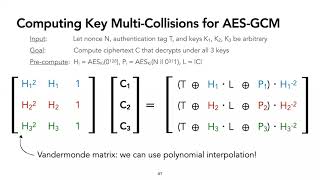
Partitioning Oracle Attacks
Explore partitioning oracle attacks in cryptography, focusing on authenticated encryption, key multi-collisions, and vulnerabilities in protocols like Shadowsocks and OPAQUE.
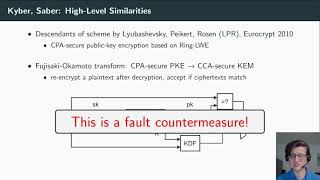
Fault Attacks on CCA-Secure Lattice KEMs
Explore fault attacks on lattice-based key encapsulation mechanisms, focusing on Kyber and Saber. Learn about implementation security, attack strategies, and potential countermeasures.
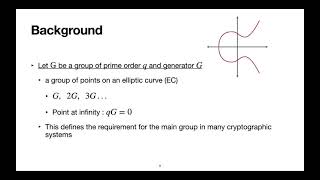
Baby Sharks - Small-Subgroup Attacks to Disrupt Large Distributed Systems
Explore small-subgroup attacks on distributed systems, focusing on MPC implementation vulnerabilities and real-world implications for cryptographic protocols and distributed key generation.
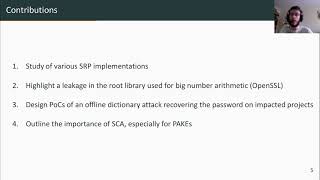
PARASITE - Password Recovery Attack Against SRP Implementations in the Wild
Explore password recovery attacks on SRP implementations, focusing on FLUSH+RELOAD techniques, modular exponentiation vulnerabilities, and mitigation strategies for cryptographic systems.
Cryptographic Protocols and Secure Computation I
Explore cryptographic protocols, secure computation, and their applications in communication. Delve into PRFs, gap assumptions, and two-party computation concepts.