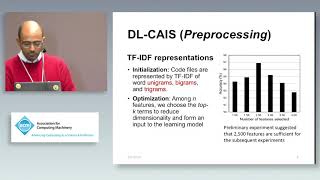
Large-Scale and Language-Oblivious Code Authorship Identification
Explore a Deep Learning-based system for large-scale, language-independent code authorship identification, addressing challenges in extraction and obfuscation resilience.

Fraud De-Anonymization for Fun and Profit
Explore innovative techniques for detecting and combating search rank fraud in online systems using deep learning and multi-worker validation approaches.

ABY3 - A Mixed Protocol Framework for Machine Learning
Explore privacy-preserving machine learning with ABY3, a framework addressing data collection concerns through encrypted computations and secure multi-party protocols.

Improved Non-Interactive Zero Knowledge with Applications to Post-Quantum Signatures
Explores advanced non-interactive zero-knowledge proofs, enhancing efficiency and security for post-quantum signatures using MPC protocols in the preprocessing model.

DeepMem: Learning Graph Neural Network Models for Fast and Robust Memory Forensic Analysis
DeepMem: A graph-based deep learning approach for fast and robust memory forensic analysis, using novel memory graph models and neural networks to enhance object detection in raw memory dumps.
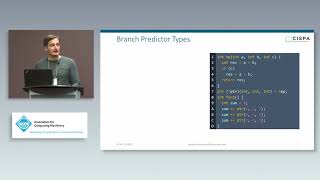
Ret2spec- Speculative Execution Using Return Stack Buffers
Explore speculative execution security risks, focusing on return stack buffer vulnerabilities and potential countermeasures in modern CPUs.
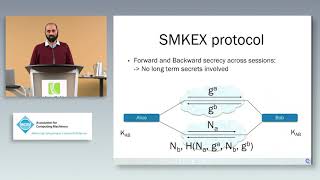
Secure Opportunistic Multipath Key Exchange
Explore a novel key exchange protocol offering opportunistic encryption benefits and protection against active attackers, without relying on trusted third parties or pre-established secrets.

Advanced Cryptography: Promise and Challenges
Explore advanced cryptography beyond communication security, including zero knowledge and secure multi-party computation. Learn about its potential, performance, and current usability challenges.
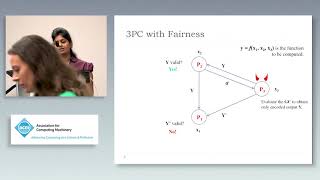
Fast Secure Computation for Small Population over the Internet
Explore efficient protocols for secure multiparty computation, focusing on fairness and guaranteed output delivery in 3-party and 4-party settings over the internet.

A Better Method to Analyze Blockchain Consistency
Introduces a simplified Markov-chain method for analyzing blockchain consistency, improving upon previous complex approaches and applicable to various Nakamoto protocol variations.

Compressing Vector OLE
Explore secure two-party protocols for vector oblivious linear evaluation, its applications, and improvements in pseudorandom correlations and sparse vector-OLE generation.
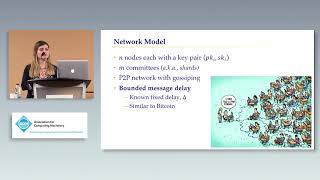
RapidChain - Scaling Blockchain via Full Sharding
Explore RapidChain's innovative full sharding approach to overcome blockchain scalability limitations, enhancing performance and efficiency in decentralized networks.

General State Channel Networks
Explore off-chain protocols and state channel networks as scalable solutions for cryptocurrencies, focusing on payment channels, smart contracts, and virtual state channels.

New Constructions for Forward and Backward Private Symmetric Searchable Encryption
Explore advanced techniques for dynamic symmetric searchable encryption, focusing on forward and backward privacy to enhance data security in cloud environments.

Secure Outsourced Matrix Computation and Application to Neural Networks
Explore practical solutions for encrypted matrix operations in homomorphic encryption, including novel encoding methods and efficient evaluation strategies for basic matrix arithmetic and neural networks.

Fast Multiparty Threshold ECDSA with Fast Trustless Setup
Explore efficient multiparty ECDSA signatures with fast, trustless setup. Learn about threshold schemes, communication optimization, and implementation details for secure digital signatures.
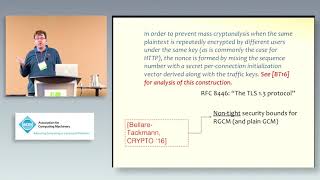
The Multi-User Security of GCM, Revisited - Tight Bounds for Nonce Randomization
Revisiting GCM's multi-user security with new concrete bounds, focusing on nonce re-use across users and re-keying impacts. Provides refined parameterization of adversarial resources for improved security analysis.
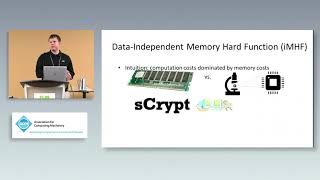
Bandwidth-Hard Functions - Reductions and Lower Bounds
Explore memory hard functions, their applications in cybersecurity, and the metrics used to evaluate their effectiveness. Learn about ASIC advantages and strategies to mitigate them.

Fast Secure Multiparty ECDSA
Explore secure distributed ECDSA signing, its challenges, and innovative solutions for threshold signing in cryptography and blockchain applications.

Deep Fingerprinting: Undermining Website Fingerprinting Defenses with Deep Learning
Explore advanced website fingerprinting attacks using deep learning, challenging existing defenses and analyzing their effectiveness against Tor and other protective measures.

Mitigating Risk While Complying With Data Retention Laws
Explore strategies for safeguarding data subject to retention laws, including encryption techniques and compliance proofs, to mitigate risks while meeting legal obligations.