Topology of Complexes Arising in Models for Distributed Computing
Explore simplicial models in distributed computing, focusing on chromatic subdivisions and their applications to problems like Weak Symmetry Breaking, leading to new mathematical questions.
Bilevel Learning Approaches in Variational Image
Explore bilevel optimization for image denoising, covering variational models, optimality conditions, and Newton-type algorithms. Compare local and non-local approaches using test images.
Large Scale Machine Learning and Convex Optimization - Lecture 3
Explore advanced stochastic optimization techniques for large-scale machine learning, including novel Newton-based methods and combinations of batch and online algorithms for improved convergence rates.
Generalization in Deep Learning Through the Lens of Implicit Rank Minimization
Explores implicit regularization in deep learning through matrix and tensor factorizations, revealing tendencies towards low ranks. Discusses implications for generalization and potential improvements in neural network design.
Recent Progress on the KLS Conjecture
Explore recent advancements in the KLS conjecture, its implications, and the stochastic localization technique used to achieve current best bounds for the Cheeger isoperimetric coefficient.
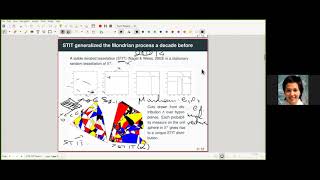
Stochastic Geometry to Generalize the Mondrian Process
Explore stochastic geometry's application to the Mondrian process, enhancing machine learning techniques like random forests and Bayesian optimization through novel geometric insights.

The Power of Randomization - Distributed Submodular Maximization on Massive Datasets
Explore distributed algorithms for submodular maximization in machine learning, focusing on a parallel approach that achieves constant factor approximation guarantees for large-scale problems.
Randomized Composable Core-Sets for Submodular Maximization
Explores randomized composable core-sets for distributed submodular and diversity maximization, presenting improved algorithms and analysis techniques for big data optimization problems.
An O(1)-Approximation for Minimum Spanning Tree Interdiction
Explore an O(1)-approximation algorithm for minimum spanning tree interdiction, improving upon previous O(log(m)) solutions. Learn about network interdiction and its applications in infrastructure protection.
Lectures on Standard and Less Standard Asymptotic Methods - Lecture 1
Explore advanced asymptotic methods for evaluating infinite sums and recognizing sequence patterns. Learn techniques from standard to unconventional, with practical examples and high-precision computations.
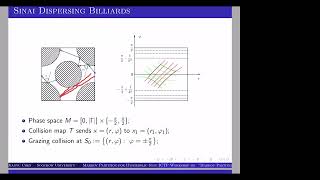
Markov Partition for Hyperbolic Systems with Singularities - ICTP 2021
Explore Markov partitions in hyperbolic systems with singularities, covering scatters, collision maps, uniform hyperbolicity, and SRB measures. Gain insights into advanced mathematical concepts and their applications.
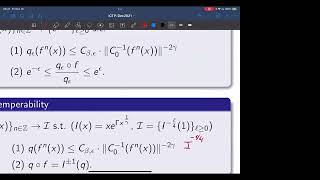
Symbolic Dynamics for Orbits with 0 Lyapunov Exponents - ICTP 2021
Explore symbolic dynamics for orbits with zero Lyapunov exponents, covering key concepts like spacing reduction, temperability, and the greedy algorithm.
Matthias Mnich - Time- and Space-Optimal Algorithms for the Many-Visits TSP
Optimizing algorithms for the many-visits TSP problem, improving time and space complexity while maintaining logarithmic dependence on tour length. Discusses applications and compares with previous work.
Proof Mining in Bounded Arithmetic
Explore proof mining in bounded arithmetic, focusing on computational content, complexity classes, and applications in mathematical logic and theoretical computer science.
Peter Dybjer - Intuitionistic Type Theory
Explore intuitionistic type theory, inductive definitions, and finite axiomatizations in this advanced lecture on mathematical foundations and type systems.
Ran Levi- Topological Analysis of Neural Networks
Explore topological analysis of neural networks, from C. elegans to complex brain structures. Discover surprising findings and innovative approaches in computational neuroscience.
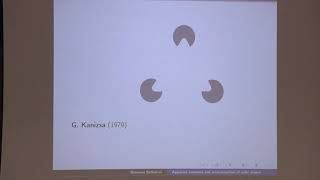
Apparent Contours and Reconstruction of Solid Shapes
Explore 3D shape reconstruction from apparent contours in Computer Vision, covering topological challenges and the Appcontour program's role in this fascinating field.
Ergodicity in Smooth Dynamics 1
Explore ergodicity in smooth dynamics, covering introductory concepts, examples, proofs, and higher dimensions with experts Jana Rodriguez-Hertz and Amie Wilkinson.
Asymptotics of Orthogonal Polynomial Ensembles via Integrable Methods
Explore statistical properties of random matrices and point processes, focusing on asymptotics of orthogonal polynomial ensembles and their applications in various fields of mathematics and physics.
Asymptotics for the Lower Tail of the KPZ Equation
Exploration of asymptotic behavior in the KPZ equation's lower tail, covering motivation, proofs, and generalizations for advanced mathematics researchers.

Ring 0 to Ring -1 Exploitation with Hyper-V IPC
Explore advanced exploitation techniques targeting Hyper-V's inter-process communication, moving from kernel-level to hypervisor-level vulnerabilities in virtualized environments.