Polynomial-time Classical Simulation of Roetteler's Shifted Bent Function Algorithm
Explore polynomial-time classical simulation of Roetteler's shifted bent function algorithm, examining symbolic rewriting techniques and their implications for quantum circuit analysis.
Circuit Width Estimation via Effect Typing and Linear Dependency
Explore circuit width estimation in quantum programming using effect typing and linear dependency. Gain insights into Proto-Quipper-R's type system for resource analysis of quantum algorithms.
Qadence: A Differentiable Interface for Digital-Analog Quantum Programs
Explore Qadence, a high-level interface for digital-analog quantum programs. Learn about its flexible design, native differentiability, and focus on real device execution for quantum machine learning algorithms.
Facilitating the Bootstrapping of a New Instruction Set Architecture
Explore tools and verification mechanisms for developing new instruction set architectures, focusing on semi-automated approaches to streamline system software and simulator infrastructure creation.
NUMAlloc: A Faster NUMA Memory Allocator
Explore a novel memory allocator designed for NUMA architecture, offering improved performance and scalability for multithreaded applications through innovative memory management techniques.
PinIt: Influencing OS Scheduling via Compiler-Induced Affinities in Embedded Media - LCTES 2023
Explore PinIt, a compiler-directed methodology optimizing OS scheduling for embedded media applications. Learn how it enhances performance by minimizing harmful thread migrations and maintaining data locality.
Concurrent GCs and Modern Java Workloads - A Cache Perspective
Explore the impact of concurrent garbage collectors on Java workloads, focusing on cache pollution and performance implications for modern server applications.
MultiGPU Performance-Portable Solution for Array Programming Based on Kokkos
Explore a new Kokkos-based API for transparent, portable multiGPU array computation. Learn about implementation variations, autotuning, and performance comparisons with MPI+Kokkos on top supercomputers.
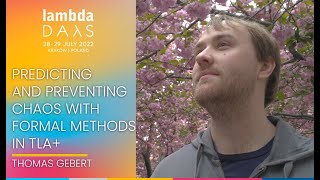
Predicting and Preventing Chaos with Formal Methods in TLA+ - Lambda Days 2022
Explore formal methods in TLA+ to predict and prevent chaos in distributed computing. Learn how to design robust systems beyond untestable whiteboard drawings and ad-hoc scripts.
A New Perspective on Commutativity in Verification
Explore a fresh perspective on commutativity in program proofs, focusing on its application in automated verification goals for various program types and properties.
Internalizing Indistinguishability with Dependent Types
Explore a novel type system combining dependency tracking and dependent types, internalizing indistinguishability for enhanced information flow control and program equivalence reasoning.
Nominal Recursors as Epi-Recursors - POPL 2024
Explore nominal recursors in syntax with bindings, comparing expressiveness and viewing them as epi-recursors. Develop a framework for comparison and apply to nominal corecursors, validated with Isabelle/HOL.
A Universal, Sound, and Complete Forward Reasoning Technique for Machine-Verified Proofs of Linearizability
Explore a universal, sound, and complete proof method for machine-verifiable linearizability proofs. Learn about its application to complex algorithms and verification using TLAPS.
Inference of Probabilistic Programs with Moment-Matching Gaussian Mixtures
Explore a novel approach to probabilistic program inference using Gaussian mixtures, offering improved accuracy and efficiency for complex models and distributions.
Optimal Program Synthesis via Abstract Interpretation - POPL 2024
Explore a framework for optimal program synthesis using abstract interpretation, improving scalability with A* search and heuristics for numerical constant optimization in domain-specific languages.
Mechanizing Refinement Types
Explore the mechanization of refinement types, combining semantic subtyping and parametric polymorphism. Learn about λRF calculus, data propositions, and metatheory proofs in LiquidHaskell and Coq.
Pipelines and Beyond: Graph Types for ADTs with Futures
Explore a novel graph type system enabling arbitrary combinations of futures and recursive data types in parallel programming, enhancing pipelining and performance optimization techniques.
Bayesian Inference Using Probabilistic Programming
Explore Bayesian inference techniques and probabilistic programming concepts with expert insights from Hong Ge at LAFI'24.
Some Things I Wish I Hadn't Seen - Challenging Concurrency Patterns in Code
Explore complex concurrency patterns in code bases, examining challenging examples that push the boundaries of theoretical understanding and practical implementation.
In-Order Execution Nails Every Weak Memory Behavior
Explore in-order execution's comprehensive coverage of weak memory behaviors, unveiling its significance in modern computing systems.
How Do We Know That Weak Memory Matters?
Explore weak memory's impact on system reliability and security, examining evidence and alternative explanations with Mike Dodds.