Mixed and Verified Consistency with Propel and ConOpY
Explore mixed consistency in distributed systems using ConOpY language and Propel type system for verifying CRDTs, enhancing data replication and local-first applications.
Multi-Stage Vertex-Centric Programming for Agent-Based Simulations
Explore multi-stage vertex-centric programming for agent-based simulations, improving performance and control flow in complex graph algorithms through meta-programming techniques.

Beyond RSS: Towards Intelligent Dynamic Memory Management - Work in Progress
Explore a novel trace-based simulation methodology for dynamic memory allocation, analyzing workload-allocator interactions using 2D bin packing to minimize fragmentation and optimize memory usage.

Heap Size Adjustment with CPU Control
Explore automatic heap sizing in JVM garbage collection, trading memory for computation based on CPU utilization. Learn about implementation in ZGC and its impact on performance and energy.
A Tool for the Definition and Deployment of Platform-Independent Bots on Open Source Projects
Explore a tool for creating platform-independent bots in open-source projects, enhancing automation and community interaction through a Domain-Specific Language.

Synthesizing Specifications - Automatic Generation of Program Behavior Descriptions
Explore automatic synthesis of program specifications using Spyro, a tool that generates precise L-properties based on user queries and domain-specific languages, applicable in various programming contexts.

Reference Capabilities for Flexible Memory Management
Explore Verona's innovative approach to memory management using isolated regions and reference capabilities, enabling predictable and controlled memory use in concurrent programming.

Mutually Iso-Recursive Subtyping - OOPSLA 2023
Explore mutually iso-recursive subtyping, addressing challenges in type recursion for programming languages. Gain insights into efficient type checking and subtyping for intermediate code representations.

Type-Safe Dynamic Placement with First-Class Placed Values
Explore type-safe dynamic placement in distributed systems using first-class placed values. Learn about Dyno, a language enabling static reasoning with dynamic placement flexibility.

Counterexample Driven Quantifier Instantiations with Applications to Distributed Protocols
Explore a novel interactive verification methodology using relational abstraction to tackle quantifier reasoning challenges in infinite-state systems, with applications to distributed protocols.

MemPerf: Profiling Allocator-Induced Performance Slowdowns
Explore MemPerf, a novel profiler for identifying allocator-induced performance slowdowns. Learn about life-cycle based detection, thread-aware modeling, and unified methods for pinpointing memory access issues.

Mobius: Synthesizing Relational Queries with Recursive and Invented Predicates
Explore an innovative approach to synthesizing relational queries with recursion and invented predicates, outperforming state-of-the-art baselines in runtime and accuracy.

Message Chains for Distributed System Verification
Explore an automated bookkeeping method using message chains to simplify verification of asynchronous distributed programs, revealing execution structure and aiding in system-level reasoning.

Validating IoT Devices with Rate-Based Session Types
Explore a novel framework for implementing and validating rate-based message passing systems in IoT domains using session types, ensuring rate error freedom and type preservation.

Synthesizing Efficient Memoization Algorithms
Explore an automated approach for synthesizing efficient memoization algorithms from declarative specifications, addressing challenges through novel synthesis techniques and evaluation on real-world benchmarks.

Equality Saturation Theory Exploration à la Carte
Explore Enumo, a new language for programmable theory exploration in equality saturation. Learn to guide rule inference, build rulesets, and develop strategies for optimizing compilers and synthesizers.

Resource-Aware Soundness for Big-Step Semantics
Explore resource-aware extensions to lambda calculus semantics and type systems, ensuring well-typed programs avoid resource exhaustion through coinductive reasoning and big-step formalization.
Combining Dependency, Grades, and Adjoint Logic in Type Systems
Explore new dependent type systems combining graded/linear types with modal operators and Adjoint Logic. Delve into meta-theoretic properties and graded substitution in advanced type theory.
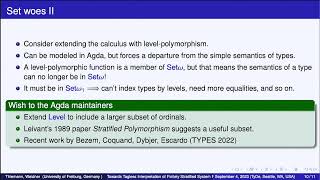
Towards Tagless Interpretation of Stratified System F
Explore the design of an intrinsically typed, tagless interpreter for stratified System F in Agda, focusing on advanced type theory concepts and implementation strategies.
A Dependently Typed Language with Dynamic Equality
Explore a novel dependently typed language with dynamic equality, addressing usability issues in type systems and providing clearer error messages through runtime equality checking.
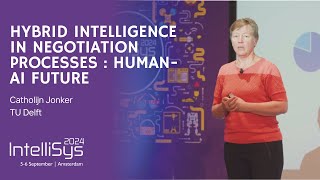
Hybrid Intelligence in Negotiation Processes
Explore hybrid intelligence in negotiation, combining human expertise with AI for enhanced decision-making. Learn about societal values, inclusivity, and real-world applications in this insightful keynote.