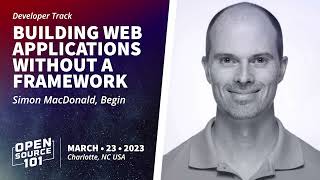
Building Web Applications Without a Framework
Explore HTML-first approaches and web standards for building modern applications without relying on traditional frameworks. Learn to leverage the web platform's capabilities.

What We Learned from 570K ChatGPT Interaction Logs In The Wild
Explore insights from 570K ChatGPT conversations, revealing diverse user prompts and potential toxic use-cases. Learn about fine-tuning instruction-following models using this rich dataset.
AI, Communication and the End of Trust
Explore AI's impact on trust in human interactions, including generative AI's challenges to accountability and trust maintenance in various domains.
Violet Teaming AI in the Life Sciences
Explore AI's impact on life sciences, balancing opportunities in health and biosecurity risks. Learn about violet teaming to maximize benefits while minimizing downsides in biological engineering.
Building Trustworthy AI with Common Sense - Lecture
Explore building trustworthy AI with common sense for robust decision-making, discovery, and misinformation tackling. Learn about CARE principles and neuro-symbolic architectures for explainable, adaptive AI systems.

The Early Years of ISI - How to Change the World Through Hardware
Explore groundbreaking hardware innovations at USC's Information Sciences Institute through Bob Parker's insights on early advancements and their global impact.
Data-Centric Approach to Machine Learning in Health Applications
Explore robust data management practices for machine learning in health applications, addressing common pitfalls and showcasing solutions from neuroscience and cell biology research.

Modular Language Models: Addressing Limitations of Dense Training
Explore modular language models: specialized components for distinct domains, enabling customization, parallelization, and sparse activation. Discover a new approach to collaborative LM development.

Drinking From The Firehose of Science: Developments in Semantic Scholar and Scientific Literature Access
Explore recent developments in Semantic Scholar and learn how to leverage its APIs for scientific literature analysis. Discuss strategies to increase diversity in scientific participation.
AI on the Edge: Post-CMOS Hardware and Device Materials - Session IV
Explore cutting-edge advancements in post-CMOS hardware and device materials for energy-efficient neuromorphic computing and edge AI applications.
AI on the Edge: Hardware-Software Co-Design for Graph Analytics and Neural Networks - Session 3
Explore cutting-edge research on hardware-software co-design for AI, including graph analytics, neural networks, object detection, and federated learning.
AI on the Edge: Neuromorphic Computing - Session 2
Explore neuromorphic computing through research on brain-machine interfaces, electronic skin, hippocampal memory prostheses, and retina-inspired circuits.
AI on the Edge - TinyML and Machine Learning for Edge Devices - Session 1
Explore cutting-edge research on TinyML and edge AI, covering neural navigation, IoT deep learning, distributed transformers, and collaborative edge training.
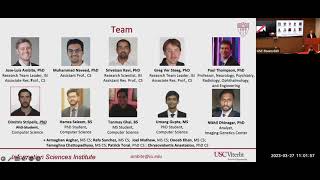
Federated Learning and Integration of Biomedical Data
Explore federated learning for secure biomedical data collaboration, integrating data harmonization and imputation techniques. Discover applications in neuroimaging tasks.
Diffusion, Probability, and the Age of Creative AI
Explore diffusion models in AI art generation, their information-theoretic foundation, and improvements in density estimation, interpretability, and sampling speed.

Getting AI to Do Things I Can't - Automatically Searching and Explaining Patterns in Text
Explore techniques for leveraging AI in complex NLP tasks, including pattern searching and SQL labeling, while enabling effective human oversight and uncovering unexpected insights.
Cognitive Electronic Warfare: Using AI to Solve EW Problems
Explore AI applications in electronic warfare, including real-time learning and evaluation techniques for enhancing battlefield responsiveness and effectiveness against complex emitters.

Designing and Evaluating Language Models for Human Interaction
Explore language model design and evaluation for human interaction, covering text infilling, collaborative writing analysis, and a new framework for assessing human-AI language interaction.
From NLP to NLU: Why We Need Varied, Comprehensive, and Stratified Knowledge - Neuro-Symbolic AI
Explore the importance of knowledge in AI systems for improved language understanding, addressing challenges in generative AI, and enhancing neuro-symbolic approaches for safer, more explainable AI.
Socially Responsible Machine Learning: Security, Robustness, and Beyond
Explore socially responsible machine learning, focusing on security and robustness. Discover methods to enhance adversarial robustness and address challenges in the era of foundational models.
Meta-Learning Dynamics Forecasting Using Task Inference
Explore meta-learning dynamics forecasting using task inference to improve generalization across heterogeneous domains in deep learning models for predicting complex systems.