The Truth About AI: How to Build an Intelligent Machine - Lecture 1
Professor Mike Wooldridge explores the nature of artificial intelligence through experiments and demonstrations, investigating how AI learns and what it can do in this Royal Institution Christmas Lecture.
NeurIPS 2023 Poster Session 4 - Highlights in Machine Learning Research
Explore cutting-edge machine learning research in temporal action segmentation, test-time adaptation, recurrent neural networks, dictionary learning, equivariant adaptation, cross-task generalization, and adversarial learning.
How to Calculate Time Complexity with Examples - Part 1
Learn to calculate time complexity with practical examples, focusing on analyzing algorithms efficiently for better problem-solving and optimization in computer science.
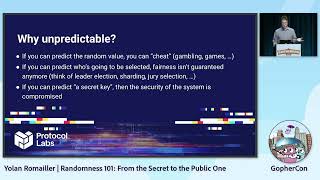
Randomness 101 - From Secret to Public - Lecture
Explore the intricacies of randomness in Go, from biases and potential pitfalls to creating and using various types of random number generators for secure and efficient applications.
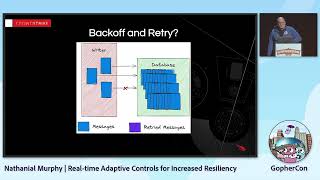
Real-time Adaptive Controls for Increased Resiliency - Lecture
Explore real-time Adaptive Controls for dynamic tuning of distributed systems, enhancing resilience through automatic parameter adjustment based on error and latency sampling, as implemented at CrowdStrike.
Promoting Linux - An End-User Manifesto for Increasing Adoption
Strategies for promoting Linux adoption: advocacy, tolerance, acknowledging limitations, highlighting improvements, separating from FOSS ideology, campaigning for applications, and contributing to the community.

Mamba: Linear-Time Sequence Modeling with Selective State Spaces
Explore Mamba, a novel linear-time sequence modeling architecture using selective state spaces. Learn about its advantages over Transformers and its applications in language, audio, and genomics.
Phi-2: Small Language Model Performance Tutorial - Google Colab with Python
Explore Microsoft's Phi-2, a compact yet powerful language model outperforming larger counterparts. Learn its training methods and test capabilities in coding, math, reasoning, and data extraction using Google Colab.
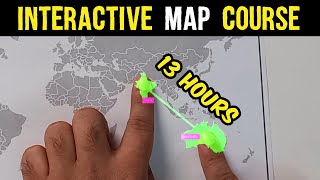
Interactive Map Using Computer Vision
Learn to create an interactive map using computer vision techniques. Develop projects like country identification, flight time calculation, and a Q&A game while mastering polygon creation and corner point detection.
OTTL Me Why: Transforming Telemetry in the OpenTelemetry Collector - Just Got Better
Explore OpenTelemetry Transformation Language (OTTL) for processing telemetry data in the OpenTelemetry Collector. Learn use cases, best practices, and future developments for effective data transformation and routing.
Energy Observability Using Kepler - Revolutionizing Cloud Efficiency
Explore Kepler, an innovative framework for monitoring power consumption in Kubernetes environments, enhancing cloud efficiency through advanced observability techniques and machine learning.
Accelerate Your GenAI Model Inference with Ray and Kubernetes
Explore serving large GenAI models efficiently using KubeRay on Kubernetes with hardware accelerators. Learn to scale workloads, optimize performance, and reduce costs for production-ready AI inference.
Monitoring and Metadata - Exploring Approaches to Attaching Metadata to Logs, Metrics and Traces
Explore approaches for attaching metadata to logs, metrics, and traces in complex systems. Learn how metadata enhances observability, enables effective troubleshooting, and improves analysis in monitoring systems.
The Attacker Perspective - Insights From Hacking Alibaba Cloud's Managed Kubernetes Environments
Explore real-world hacking of managed Kubernetes environments, from initial access to unauthorized database access. Learn to strengthen deployments and enhance security posture through this step-by-step case study.
The New Database Landscape - Revealing Shifts and Charting the Next Horizon
Explore the evolving database landscape, challenges for professionals, and insights from Redgate's 2024 report. Learn strategies to thrive in cross-database environments and discover new solutions.
Limitless Growth and Opportunities - Data and Innovation in an AI World
Explore Azure's latest database innovations, AI technologies, and real-world applications. Learn to unlock your data's potential for enhanced application development and analytics.

Linux for Beginners - Full Course
Comprehensive introduction to Linux, covering installation, terminal usage, file systems, permissions, and shell scripting. Ideal for beginners seeking practical skills in Linux administration and command-line operations.
What the AI Revolution Means for Open Source, Open Tech and Open Societies
Explore AI's impact on open-source communities, addressing challenges in access, innovation, discrimination, and environmental concerns while discussing potential solutions and ethical frameworks.
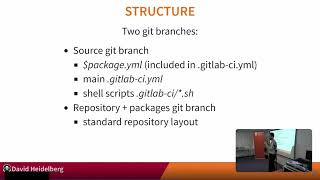
Empower Your Users to Maintain Software Within the Debian Repository
Learn to create and manage a basic Debian repository, enabling users to update software easily. Explore CI package generation, Git versioning, and streamlined developer workflows.
The Games of Intelligence - Human, Artificial and Emotional
Explore os jogos da inteligência humana, artificial e emocional, discutindo os avanços da IA e propondo uma nova abordagem para avaliar a inteligência emocional das máquinas.
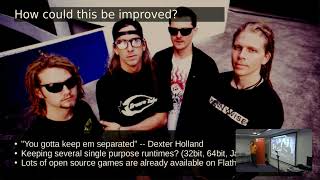
Snapshot in Time - Leveraging Snap and Flatpak to Preserve Software Legacy
Explore how Snap and Flatpak containerization can be used to preserve older software, addressing challenges in software preservation and ensuring long-term access to our digital heritage.