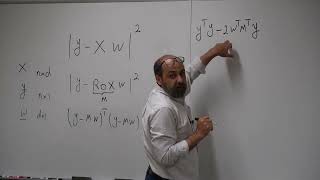
Deep Learning: Dropout and Batch Normalization - Lecture 5
Delve into dropout and batch normalization techniques, understanding their mechanisms and effectiveness in deep learning, with insights on loss function smoothness and Lipschitzness.
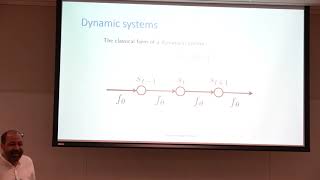
Recurrent Neural Networks and Backpropagation Through Time - Lecture 8
Dive into recurrent neural networks, exploring LSTM, GRU architectures, and advanced concepts like backpropagation through time and gradient challenges in deep learning implementations.
Denoising Diffusion Probabilistic Models and Generative Moment Matching Networks - Lecture 17
Delve into diffusion models and DDPMs, exploring progressive data refinement techniques and generative moment matching networks using Maximum Mean Discrepancy for distribution analysis.
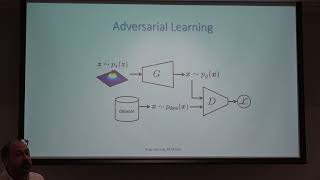
Generative Adversarial Networks and Adversarial Autoencoders - Lecture 16
Dive into advanced concepts of GANs and AAEs, exploring conditional implementations, mode collapse solutions, and practical applications in supervised and unsupervised learning scenarios.
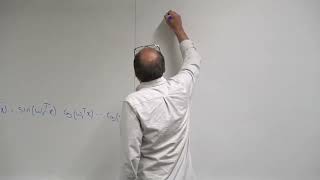
Variational Autoencoders and Performers in Deep Learning - Lecture 15
Delve into advanced deep learning concepts including Variational Autoencoders (VAE), variational inference, ELBO computation, and Performer-based Transformer architectures.
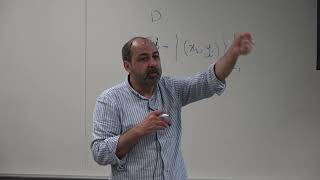
PAC Learnability in Deep Learning - Lecture 20
Delve into statistical machine learning fundamentals, exploring PAC learnability concepts and their application in deep learning, with focus on generalization theories and practical challenges.
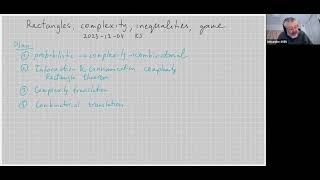
Rectangles, Complexity and Games in Communication Theory - December 4, 2023
Delve into communication complexity theory through rectangles, exploring inequality principles, combinatorial strategies, and their applications in computational game theory.
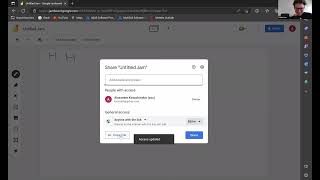
PAC Learning of Decision Trees
Explore the theoretical foundations of PAC learning algorithms and their application to decision tree construction in this advanced computational complexity seminar.

PAC Learning: From Finite Families to CNF Formulas - Lecture on March 20, 2023
Dive into PAC learning concepts, exploring finite families, conjunctions, k-CNFs, and NP-completeness in proper learning for 2-term CNF through advanced computational complexity theory.
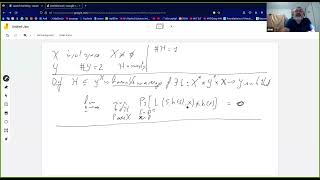
Basic Results About Learning in Computational Complexity - March 2023
Dive into fundamental concepts of computational complexity and learning theory through Bruno Bauwens' detailed exploration at the prestigious Kolmogorov seminar.
Introduction to Probably Approximately Correct (PAC) Learning
Dive into computational complexity and PAC-learning concepts through an in-depth seminar discussion at the prestigious Kolmogorov seminar series on complexity theory.
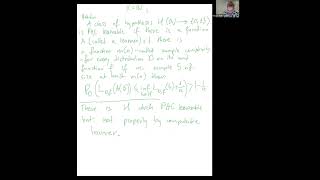
Computable PAC Learning - Part 2
Dive into advanced concepts of computable PAC learning through an in-depth exploration of theoretical frameworks and computational complexity in machine learning theory.
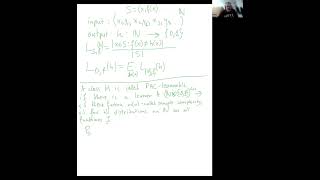
Computable PAC Learning - Part 1
Dive into computational complexity and PAC learning theory through an in-depth exploration of foundational concepts, statistical learning frameworks, and algorithmic approaches.
Vapnik-Chervonenkis Theorem and Statistical Learning Theory
Dive into the fundamental Vapnik-Chervonenkis theorem, exploring how VC-dimension relates to machine learning generalization and error rates in hypothesis spaces.

Combinatorial Rectangles, Kolmogorov Complexity and Experts' Aggregation - March 4, 2024
Delve into communication protocols, exploring their relationship with Kolmogorov complexity, combinatorial rectangles, and the fascinating world of experts' opinion aggregation.
Trained Quantum Neural Networks are Gaussian Processes
Explore the mathematical foundations of quantum neural networks, focusing on their convergence to Gaussian processes and implications for training in supervised learning scenarios.
Quantum State Learning Implies Circuit Lower Bounds
Delve into groundbreaking research connecting quantum state tomography with circuit complexity, exploring implications for quantum learning algorithms and classical circuit lower bounds.
Concatenate Codes and Space Optimization for Fault-Tolerant Quantum Computation
Discover groundbreaking advances in fault-tolerant quantum computation through concatenated codes, achieving 90%+ reduction in space overhead while maintaining high threshold and modularity in quantum architectures.
Potential and Limitations of Near-Term Quantum Computing
Explore the current landscape of quantum computing, examining both promising applications and key limitations in intermediate-scale quantum devices, with focus on error mitigation and practical implementations.
Taming Quantum Time Complexity
Explore advanced quantum computing concepts focusing on time complexity, exactness, and thriftiness in quantum algorithms through novel transducer-based approaches and state conversion techniques.
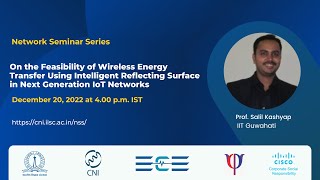
Feasibility of Wireless Energy Transfer Using Intelligent Reflecting Surface in Next Generation IoT Networks
Explore wireless energy transfer technology in IoT networks, focusing on intelligent reflecting surface implementation, challenges, and solutions for efficient power transmission and harvesting.