
Quantum PCPs: On Adaptivity, Multiple Provers and Reductions to Local Hamiltonians
Delve into advanced quantum PCP theory, exploring adaptivity, multiple unentangled provers, and their connections to local Hamiltonians through rigorous mathematical frameworks and complexity theory analysis.
Polynomial-Time Classical Simulation of Noisy IQP Circuits
Explore groundbreaking research on classical simulation of noisy IQP circuits, revealing how quantum supremacy experiments may be more vulnerable to classical computation than previously known.
Sample-Efficient Constrained Reinforcement Learning with General Parameterized Policies
Delve into advanced reinforcement learning concepts with Dr. Mondal as he explores sample-efficient algorithms for Constrained Markov Decision Processes, focusing on parameterized policies and practical applications.
Risk-Sensitive Bandits - Arm Mixtures Optimality and Regret-Efficient Algorithms
Delve into risk-aware sequential decision-making through distortion riskmetrics, exploring optimal arm mixture strategies and new algorithms for tracking these mixtures in multi-armed bandit problems.

Constant-Depth Circuits for Uniformly Controlled Gates and Boolean Functions
Explore constant-depth quantum circuits using Fan-Out and Global Tunable gates, focusing on implementations for Uniformly Controlled Gates and quantum memory applications.

Quantum Cryptography Without One-Way Functions
Explore advanced quantum cryptography concepts and theoretical frameworks that challenge traditional one-way function dependencies in secure communication systems.
Majorization and Passivity in Quantum Information Theory - Lecture 4
Explore majorization and passivity concepts in quantum information theory, focusing on fundamental principles and their applications in advanced quantum systems.
Quantum Generic Hardness for Discrete Logarithms and Integer Factorization
Explore quantum computational complexity of discrete logarithm problems and integer factorization, examining generic algorithms' limitations and establishing new theoretical bounds for quantum operations.
Quantum Complexity of Testing Signed Graph Clusterability
Explore quantum algorithms for testing signed graph clusterability, featuring a novel approach with O(N^1/3) query complexity and proven advantages over classical methods.

Two Prover Perfect Zero Knowledge for MIP* - Theory of Quantum Computation
Delve into advanced quantum computing theory exploring perfect zero-knowledge protocols in MIP* systems, focusing on two-prover implementations and boolean constraint systems for quantum computation.

Tracial Embeddable Strategies - Lifting MIP* Tricks to MIPco
Delve into advanced quantum computation theory exploring tracial embeddable strategies and their applications in approximating two-party correlations in the commuting operator model.

An Improved Quantum Max Cut Approximation via Maximum Matching
Discover groundbreaking improvements in Quantum Max Cut approximation through maximum matching techniques, achieving a 0.595 approximation ratio using simplified 2-qubit state outputs.
Closed-form Analytic Expressions for Shadow Estimation with Brickwork Circuits
Explore closed-form analytical expressions for quantum shadow estimation using brickwork circuits, focusing on two-layer parallel two-local Haar-random unitaries and their practical implementations.
Shallow Shadows: Expectation Estimation Using Low-Depth Random Clifford Circuits
Explore quantum state measurement optimization through random Clifford circuits, focusing on efficient estimation techniques and practical applications in one-dimensional quantum systems.
Computational Quantum Secret Sharing
Discover groundbreaking advances in quantum secret sharing schemes, exploring computational security approaches that achieve efficient distribution and reconstruction of quantum states with reduced share sizes.
Towards a Theory of Exploration in Continuous-Time Reinforcement Learning
Delve into advanced theoretical frameworks for continuous-time reinforcement learning, exploring relaxed controls and rough path theory for modeling exploration processes in stochastic environments.
Sequential Clustering of Data Streams from Unknown Distributions
Explore sequential nonparametric clustering techniques for data streams, focusing on universal tests that efficiently group streams based on distribution proximity, with applications in statistical analysis.
Between Promise and Reality - Navigating the Landscape of Indic Language LLMs Amidst Hyperbole and Hope
Explore the current state, challenges, and real-world implications of Indic language LLMs, separating ambitious claims from actual achievements in linguistic AI development.
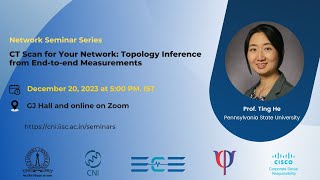
CT Scan for Your Network: Topology Inference from End-to-end Measurements
Discover network topology inference techniques through end-to-end measurements, exploring how to extract routing information and link metrics without direct access to network infrastructure or internal nodes.
eBPF Security - Introduction to Kernel-Level Security Monitoring
Explore advanced eBPF security implementations in networking and transport stacks, focusing on KubeArmor maintenance, packet routing optimization, and data-center network security principles.
eBPF Fundamentals and Applications - Keynote
Dive into advanced eBPF concepts and applications with Intel expert Brendan Gregg, exploring cutting-edge kernel observability techniques and performance analysis tools.