Mathematical Problems in Machine Learning - Lecture 2
Delve into mathematical probability fundamentals and their applications in machine learning through advanced theoretical concepts and problem-solving approaches from Stanford expertise.
Mathematical Problems in Machine Learning - Lecture 4
Delve into advanced mathematical probability concepts applied to machine learning through Stanford expert Andrea Montanari's comprehensive theoretical exploration and analysis.
Machine-Precision Neural Networks for Multiscale Dynamics
Discover how multi-stage neural networks can achieve machine-precision accuracy in scientific predictions, addressing spectral bias and improving deep learning applications in multiscale physics problems.
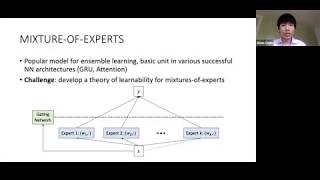
Learning Mixtures of Linear Regressions in Subexponential Time via Fourier Moments
Explore efficient algorithms for learning mixtures of linear regressions using Fourier moments, overcoming previous barriers and achieving subexponential time complexity.
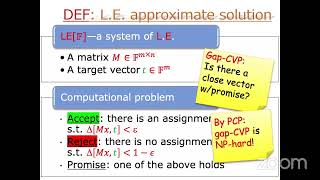
Mathematics of Computation Through the Lens of Linear Equations and Lattices
Explore mathematical foundations of computation through linear equations and lattices, covering error correction, vector problems, and lattice theory with implications for future computing.
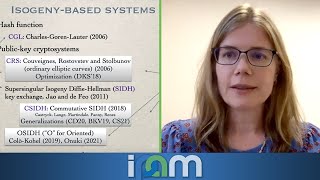
Classical and Quantum Algorithms for Isogeny Problems
Explore classical and quantum algorithms for isogeny problems in post-quantum cryptography, focusing on computational challenges, path finding in isogeny graphs, and reductions to other problems in elliptic curve cryptography.
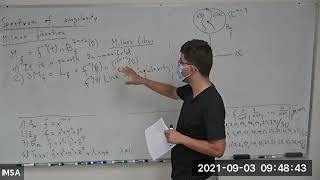
Spectrum of Singularities
Explore hypersurface singularity spectra: definition, properties, and computational techniques. Learn about Thom-Sebastiani theorem, semicontinuity, and applications in algebraic geometry.
Gradient Descent, Stochastic Gradient Descent, and Acceleration - Part 2
Explore advanced gradient-based optimization methods for large-scale machine learning, including stochastic gradient descent and accelerated versions, with convergence analysis and ODE connections.
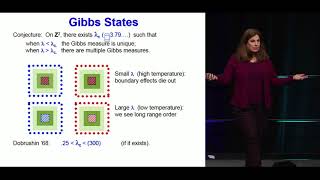
Emergent Phenomena in Random Structures and Algorithms
Explore emergent phenomena in random structures and algorithms, focusing on mathematical insights and applications in complex systems and computational methods.
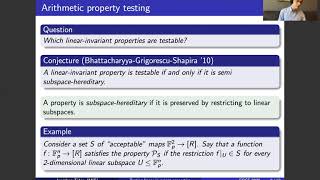
Testing Linear-Invariant Properties
Explore efficient methods for testing linear-invariant properties in mathematical structures, focusing on advanced techniques and their applications in various fields.
Faster Pairing Computations on Curves with High-Degree Twists
Explore faster pairing computations on curves with high-degree twists, focusing on techniques like Miller's Algorithm and sexy twists to enhance cryptographic efficiency.
On the Hardness of Learning Under Symmetries
Explore the challenges of machine learning with symmetries in this talk by MIT's Thien Le, examining computational and statistical gaps in learning and optimization.
The Ghost in the Machine
Explore the nature of mind, consciousness, and reality through an AI perspective, delving into cognitive science concepts and their implications for understanding human intelligence and selfhood.
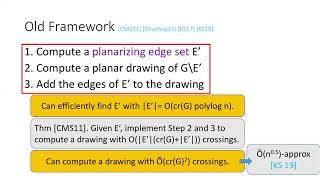
Towards Better Approximation of Graph Crossing Number
Explores advanced techniques for approximating graph crossing numbers, focusing on new frameworks and theorems for both general and bounded-degree graphs.
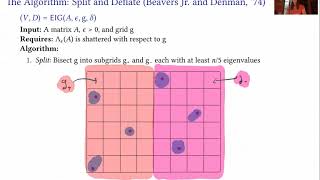
Pseudospectral Shattering the Sign Function and Diagonalization in Nearly Matrix Multiplication Time
Explore advanced matrix algorithms, including pseudospectral shattering and diagonalization techniques, for efficient computation in nearly matrix multiplication time.
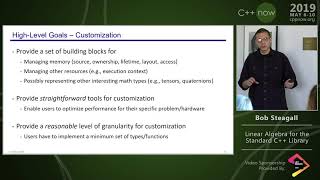
Linear Algebra for the Standard C++ Library
Exploring a proposal to add linear algebra components to the C++ standard library, covering design, rationale, and implementation details for matrices, vectors, and related operations.
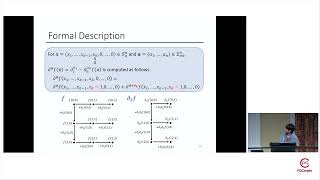
Fast Enumeration Algorithm for Multivariate Polynomials Over General Finite Fields - Session II
Explore fast enumeration algorithms for multivariate polynomials over finite fields, enhancing post-quantum cryptography understanding and applications.
Convert Binary to Decimal Number in Python - From Scratch
Aprenda a converter números binários para decimais usando Python, implementando o algoritmo do zero para uma compreensão profunda do processo.

Formalizing Giles Gardam's Disproof of Kaplansky's Unit Conjecture
Explore the formalization of Giles Gardam's disproof of Kaplansky's Unit Conjecture using Lean 4, combining deductive proving and verified computation.
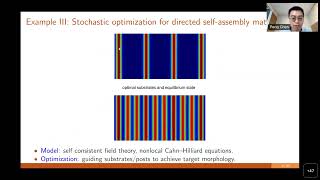
Derivative-Informed Neural Operators for Solving PDE-Governed Optimization Problems
Explore novel machine learning for solving optimization problems with PDEs, featuring derivative-informed neural operators for efficient, scalable solutions in high-dimensional parameter spaces.
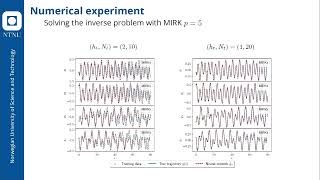
Learning Hamiltonian Systems with Mono-Implicit Runge-Kutta Methods
Explore advanced numerical methods for simulating Hamiltonian systems using Mono Implicit Runge-Kutta techniques, enhancing accuracy and efficiency in scientific computations.