Sums of Weighted Lattice Points of Polytopes
Explore connections between polytopes and algebraic combinatorics, focusing on sums of weighted lattice points and their computational implications in estimating maximal weighted lattice points.
Cracking the Riemann Hypothesis - A Computational Approach
Explore a computational approach to the Riemann Hypothesis, challenging traditional mathematical assumptions and proposing a new perspective on this famous conjecture.
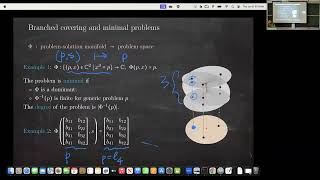
Wanted: Solutions of Square Polynomial Systems
Explore methods for solving square polynomial systems, focusing on enumerative geometry techniques and their applications in mathematical research.
Border Subrank of Tensors
Exploration of tensor subrank and border subrank, including construction of maximal border subrank tensors and lower bound computation for the dimension of maximal border subrank tensor sets.
Solving High-Dimensional Optimal Control Problems with Empirical Tensor Train Approximation
Explore innovative approaches to solve high-dimensional optimal control problems using Tensor Train approximation, with applications to destabilized viscous Burgers and diffusion equations.

A Numerical Toolkit for the Likelihood Correspondence
Explore numerical methods for analyzing likelihood correspondences in statistical models, focusing on applications in enumerative geometry and algebraic statistics.
Certified Homotopy Tracking in Enumerative Geometry
Explore certified homotopy tracking in enumerative geometry with Kisun Lee from Clemson University, focusing on advanced mathematical concepts and applications.
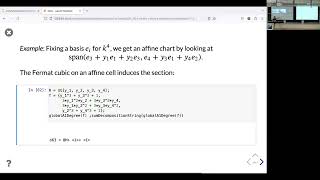
A^1-Brouwer Degrees in Macaulay2
Explore A^1-Brouwer degrees using Macaulay2 software in this Fields Institute talk by Thomas Brazelton from Harvard University, focusing on applications in enumerative geometry.
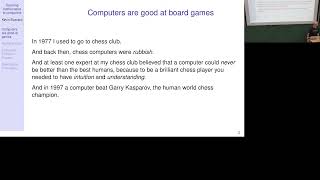
Teaching Mathematics to Computers - Advancements in Computational Theorem Proving
Explore the potential of computers in theorem-proving and advanced mathematics, from basic logic to modern research, and their future role in mathematical discovery.

Teaching Mathematics to Computers - Modern Approaches and Challenges
Explore the potential of computers in theorem-proving and advanced mathematics, from basic logic to modern research, and their future role in mathematical discovery.
The Fundamental Theorem of Algebra - Challenging Mathematical Orthodoxy
Challenging the Fundamental Theorem of Algebra: Exploring its limitations, implications for calculus and linear algebra, and the need for a more accurate formulation in rational numbers.
Finite Fields and Their Applications
Explore new Mathematica 13.3 features for finite field computations, including arithmetic, mappings, and polynomials. Learn about upcoming linear algebra and equation solving capabilities.

Integral Transforms through Mellin-Barnes Integration
Explore special functions, Mellin-Barnes integration, and integral transforms using advanced computational techniques for math and physical science applications.
Rubi: Solving Integrals, One Rule at a Time
Master symbolic integration using Rubi's rule-based approach. Explore transparent, systematic methods for finding antiderivatives and compare with traditional algorithms.
Computational Number Theory in the Modern World
Explore modern computational number theory, covering primes, factorization, divisibility, congruence, and advanced topics like analytic and additive number theory.
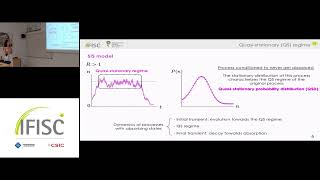
Numerical Methods for Quasi-Stationary Distributions
Explore numerical techniques for calculating quasi-stationary distributions in complex systems, enhancing understanding of long-term behavior in stochastic processes.
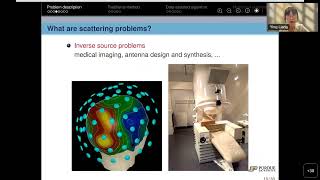
Data-assisted Algorithms for Inverse Random Source Scattering Problems - DDPS
Explore data-assisted algorithms for inverse random source scattering problems, enhancing reconstruction accuracy with fewer realizations and comparing performance of various data-driven methods.
A Family of Rational Zeta Series
Explore close formulas for computing rational zeta series, featuring unique insights not reproducible by current software.

New Algorithms: Numerical Solution of Large Systems of Nonlinear Equations Using Monodromy
Explore a novel algorithm using monodromy to solve large systems of analytic nonlinear equations, developed during a Wolfram internship.

Computational Mathematics: Dynamics, Geometry, and Algebra in Numerical Integration
Explore computational mathematics at the intersection of dynamics, geometry, and algebra, focusing on geometric numerical integration and structure-preserving discretization of differential equations.

Python ate my Homework - Using SymPy for Mathematical Problem Solving
Discover SymPy for solving complex math problems with Python. Learn to use Jupyter for assignments and contribute to computational mathematics.