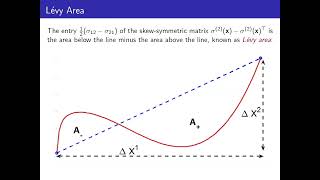
Convex Hulls of Curves, Volumes, and Signatures
Explore convex hulls of curves, volumes, and signatures in geometry, gaining insights into their mathematical properties and applications.
GeometryOps.jl - Building a Comprehensive Native Geometry Package
Unifying Julia's geometry ecosystem, GeometryOps.jl offers native, high-performance algorithms for spatial data, compatible with GeoInterface.jl and outperforming LibGEOS.jl for implemented operations.
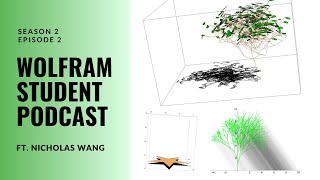
Modeling Shadows of Generated Trees
Explore 2D and 3D vector techniques for generating trees and calculating shadows through angled vector projections in this engaging podcast episode.
Automated Planar Geometry in Wolfram Language
Explore updates to Wolfram Language's automated geometric functions, including GeometricScene, RandomInstance, and FindGeometricConjectures, plus future developments.
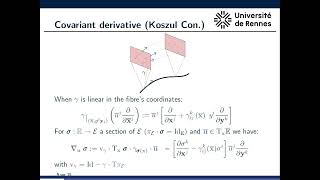
Geometric Modelling of Micro-Structured Material
Explore advanced techniques for geometric modeling of micro-structured materials, enhancing understanding of complex material properties and behaviors.
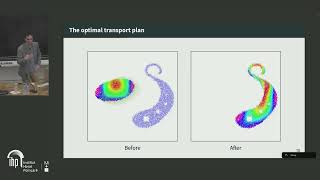
Computational Optimal Transport: Mature Tools and Open Problems
Explore computational optimal transport's advancements, applications in 3D shape analysis, and open challenges. Gain insights into state-of-the-art tools for efficient distribution analysis and geometric data processing.
Coresets and Decision Trees for Machine Learning Optimization
Discover how coresets can optimize decision tree algorithms, boost computation speed by 10x, and maintain accuracy in machine learning applications through geometric partitioning techniques.
Clustering: Clusterability, Voronoi Diagrams, and Assignment-based Clustering - Lecture 22
Explore clustering fundamentals through Voronoi diagrams and assignment-based techniques while learning to assess data clusterability and implement effective grouping strategies.
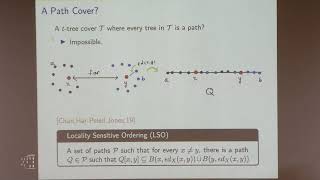
Recent Progress on Euclidean Spanners
Explore recent advancements in Euclidean spanners, including sparse, light, fault-tolerant, and dynamic variants, while discovering outstanding open problems in the field.
A Quasi-Monte Carlo Algorithm for Smooth Kernel Evaluation
Explore a novel data structure for density queries, combining discrepancy theory and LSH to build sparse coresets and enhance smooth kernel evaluation algorithms.
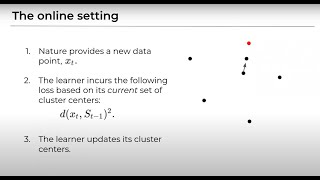
Online k-means Clustering on Arbitrary Data Streams - Lecture
Explore online k-means clustering for arbitrary data streams, focusing on a novel algorithm with polynomial space and time complexity and provable guarantees without input assumptions.

Kirk Lecture: A Recent Technology for Scientific Computing - The Virtual Element Method
Explore the Virtual Element Method, a generalization of FEM for solving PDEs using polygonal/polyhedral meshes, offering improved accuracy, efficiency, and flexibility in scientific computing.
Complexity and the Hat
Explore complexity through mathematical concepts, focusing on unique perspectives and innovative approaches in discrete mathematics and computer science.
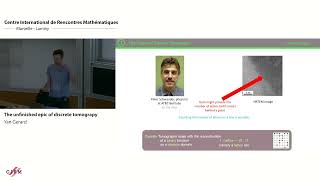
The Unfinished Epic of Discrete Tomography
Delve into the mathematical foundations of discrete tomography through an engaging exploration of its ongoing challenges and theoretical developments in modern computational geometry.
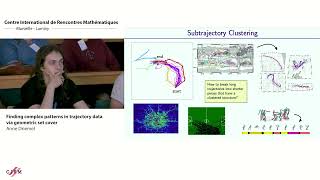
Finding Complex Patterns in Trajectory Data via Geometric Set Cover
Explore geometric set cover techniques for analyzing complex trajectory patterns, focusing on mathematical approaches to pattern recognition and data analysis in spatial movement.
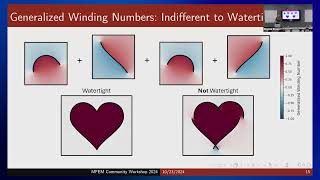
Robust Containment Queries over Collections of Parametric Curves via Generalized Winding Numbers
Discover advanced geometric containment query techniques for 2D regions using rational Bezier curves and generalized winding numbers, enabling efficient multiphysics simulations without expensive refinement processes.
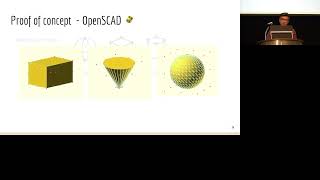
Facilitating the Parametric Definition of Geometric Properties in Programming-Based CAD
Explore innovative approaches to define geometric properties parametrically in programming-based CAD systems, enhancing design workflow automation and flexibility.
Exploring Wolfram Language 13.3 - New Features and Enhancements
Explore new features in Wolfram Language 13.3, including LLM integration, enhanced computational geometry, AR/VR publishing, generative AI for images, and improved parallel computation and external library access.