
Understanding AlphaFold - AI in Protein Structure Prediction
Explore AlphaFold's revolutionary impact on protein structure determination with Dame Janet Thornton. Discover how this AI program is transforming bioinformatics and its potential future applications.
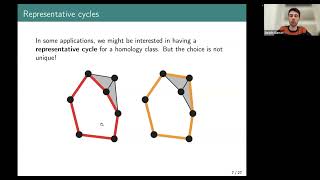
Harmonic Persistent Homology for Disentangling Multiway Interaction in Data
Explore Harmonic Persistent Homology for analyzing multi-omics data, uncovering hidden patterns in complex diseases, and identifying biomarkers associated with latent biological pathways.
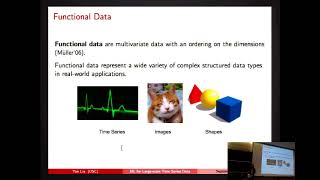
Learning and Mining in Large-Scale Time Series Data - 2015
Explore machine learning approaches for analyzing large-scale time series and spatio-temporal data, with applications in healthcare and climate modeling.
scverse: An Introduction to Single-Cell Data Analysis in Python
Explore Python's ecosystem for single-cell data analysis with scverse, a community-driven initiative coordinating omics data work.
Methods for Computational Biology and Drug Discovery
Explore fundamental computational methods in physics and chemistry, presented by their creators, with insights into their development and applications.
AI and Machine Learning in Single Cell Genomics - Day 2
Explore cutting-edge single-cell genomics research, featuring expert talks on spatial transcriptomics, multi-omics, and bioinformatics from leading institutions in Atlanta and across America.
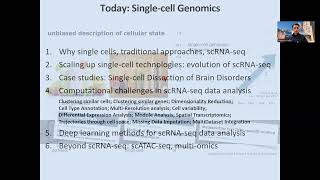
Single Cell Analysis in Computational Biology - Lecture 3
Comprehensive exploration of single-cell RNA sequencing, covering technologies, applications, and analysis techniques. Discusses advantages over bulk sequencing and addresses key biological questions in the field.

Introduction to Machine Learning in Computational Biology - Lecture 1
Comprehensive overview of computational biology, exploring GenAI, representation learning, and their applications in genomics and language models. Insights into future directions and potential impacts.
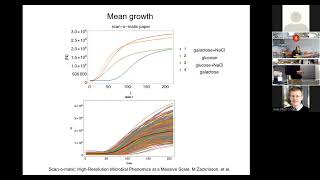
Quantifying Determinants of Microbial Growth
Explore computational approaches for quantifying microbial growth determinants, focusing on genotype-environment interactions and their implications for pathogen control and biotechnology.
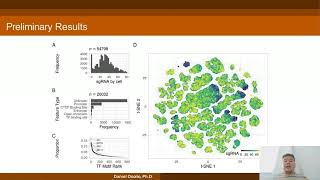
Systematic Characterization of Gene Regulatory Networks Rewiring Patterns Mediated by Non-Coding Regions
Explore gene regulatory network rewiring patterns through innovative experimental methods and computational approaches for characterizing effects of perturbations at single-cell level.
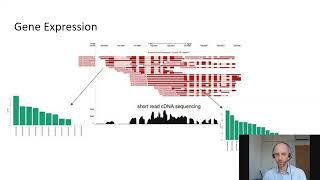
Studying Promoter and Isoform Diversity with Long-Read Transcriptome Sequencing
Explore promoter and isoform diversity in cancer transcriptomes using long-read RNA sequencing. Gain insights into alternative promoters' role in gene regulation and their impact on cancer research.
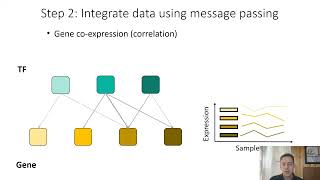
Developing Disease Insights with Genotype-Specific Regulatory Networks
Explore a new method for estimating genetic variant effects on transcription factor regulatory events, integrating diverse omics data to build interpretable regulatory networks for disease insights.
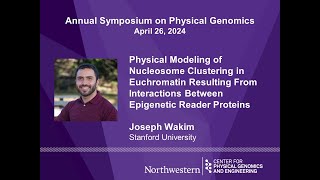
Modeling of Nucleosome Clustering in Euchromatin Resulting from Reader Protein Interactions
Explore nucleosome clustering in euchromatin through modeling interactions between reader proteins. Gain insights into chromosomal organization and dynamics from the Spakowitz lab's research.
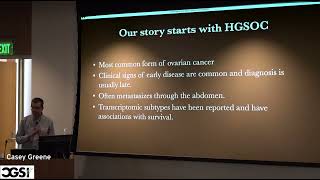
Issues with Deconvolution Using Single-Cell Profiles - CGSI 2024
Explore challenges in deconvolution using single-cell profiles, examining key issues and potential solutions in computational genomics.
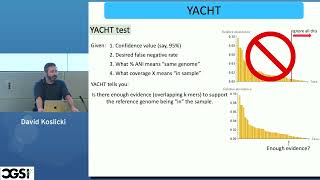
YACHT: An ANI-Based Statistical Test to Detect Microbial Presence or Absence in Metagenomes
Explore YACHT, an ANI-based statistical test for detecting microbial presence in metagenomes. Learn about its applications and implications for microbiome research.
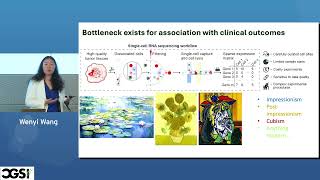
A Guide to Perform Transcriptomic Deconvolution in Cancer
Explore transcriptomic deconvolution techniques for cancer research, focusing on tumor cell mRNA expression estimation and improved analysis of cell-type ratios in complex tissue samples.
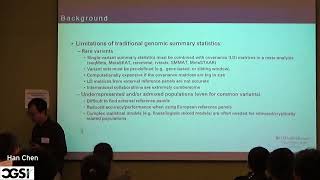
StocSum: A Reference Panel Free Summary Statistics Framework for Diverse Populations
Explore StocSum, a novel framework for analyzing summary statistics in diverse populations without reference panels. Learn its applications in genomics research and meta-analysis.
Coarse-grained Simulations of Nucleosomes
Explore coarse-grained simulations of nucleosomes to understand chromatin organization and gene regulation through interdisciplinary computational modeling techniques.
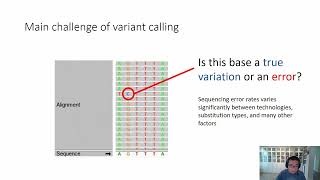
Rescuing Low Frequency Variants Within Intra-Host Viral Populations from Oxford Nanopore Sequencing Data
Explore techniques for identifying low-frequency viral variants from Oxford Nanopore sequencing data, enhancing understanding of intra-host viral populations and mutation patterns.
Why Networks Matter: Embracing Biological Complexity
Explore how genetic regulatory networks provide insights into health, disease, and potential therapies through examples from large-scale genomic datasets.
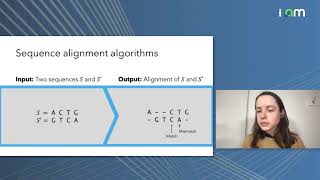
How Much Data Is Sufficient to Learn High-Performing Algorithms?
Explore data-driven algorithm design's impact on performance, focusing on generalization guarantees for combinatorial algorithms with piecewise-structured parameter functions.