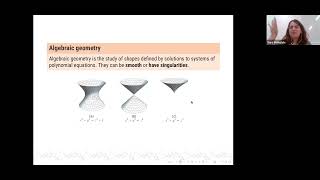
Machine Learning Detects Terminal Singularities in Q-Fano Varieties
Explore machine learning applications in algebraic geometry, focusing on Q-Fano varieties and terminal singularities detection. Gain insights into new combinatorial criteria and high-dimensional Q-Fano landscapes.
Learning Low-Degree Functions on the Discrete Hypercube
Explore computational learning theory through random query models and polynomial inequalities, improving estimates for query complexity in reconstructing hypercube functions.

Applications of Game Theory to Computational Social Science
Explore game theory applications in computational social science, focusing on algorithmic ranking, social welfare, and the monoculture paradox in digital systems.
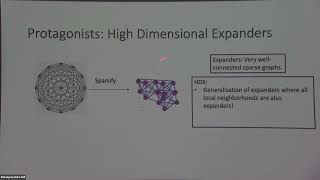
Quasi-Linear Size PCPs with Small Soundness from High-Dimensional Expanders
Delve into probabilistically checkable proofs (PCPs), exploring their encoding, verification, and applications in computer science, with focus on achieving small soundness using high-dimensional expanders.
Fault Tolerant Routing Protocols on High-Dimensional Expanders
Delve into fault-tolerant routing protocols on high-dimensional expanders, exploring efficient message transmission systems that maintain reliability even with corrupted network edges and enable advanced distributed computing applications.
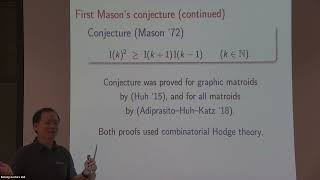
Complexity of Log-concave Inequalities in Matroids
Delve into the mathematical complexity of log-concave inequalities in matroids, exploring combinatorics, complexity theory, and geometric approaches to understanding Mason's conjecture and related mathematical concepts.
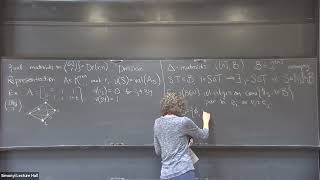
Valuated Delta Matroids and Principal Minors
Delve into advanced mathematical concepts of valuated Delta matroids, their relationship with principal minors of Hermitian matrices, and their applications in combinatorial structures.
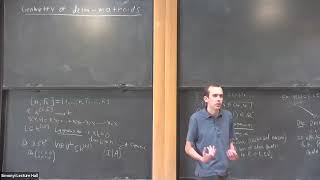
Geometry of Delta-Matroids
Explore advanced geometric constructions in delta-matroids, examining their relationship to matroids and proving ultra log-concavity of independent sets in mathematical structures.
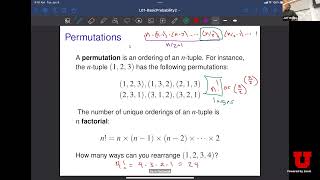
Probability and Statistics: Set Rules and Basic Probability Concepts - Lecture 2
Master fundamental probability concepts, set rules, and sample spaces through practical examples of repeated trials and permutations, building a strong foundation in statistical analysis.
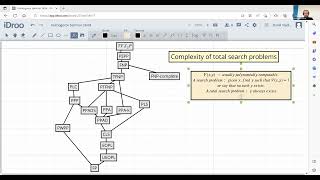
Different Classes of Search Problems in Computational Complexity - April 2023
Explore the hierarchy and classification of search problems in computational complexity, from Sperner's lemma to modern algorithmic challenges in triangulation coloring.
Generalizations of Matrix Multiplication for Solving the Light Bulb Problem
Explore a novel approach to solving the Light Bulb Problem using tensor-based algorithms, potentially outperforming traditional matrix multiplication methods for faster data analysis and pattern recognition.
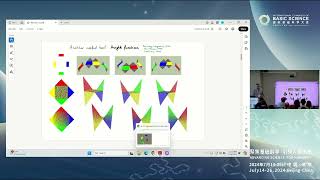
Geometry of Dimer Models - ICBS 2024
Explore asymptotic phenomena in random dimer coverings, focusing on Aztec diamonds and their connection to Riemann surface geometry.
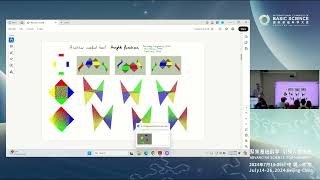
Geometry of Dimer Models - ICBS 2024
Explore asymptotic phenomena in random dimer coverings, focusing on Aztec diamonds and their connection to Riemann surface geometry.
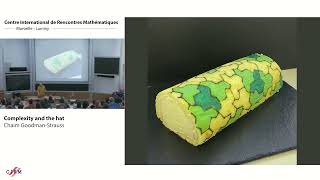
Complexity and the Hat
Explore complexity through mathematical concepts, focusing on unique perspectives and innovative approaches in discrete mathematics and computer science.
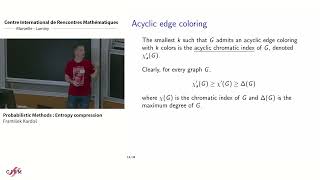
Probabilistic Methods - Entropy Compression
Explore probabilistic methods and entropy compression in mathematics through an in-depth lecture by František Kardoš at CIRM's ALEA days conference.
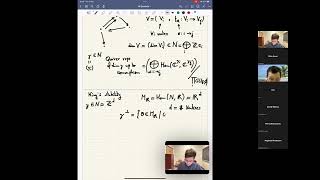
Quivers, Flow Trees, and Log Curves
Explore the connection between Donaldson-Thomas invariants, attractor flow trees, and log Gromov-Witten invariants in quiver theory and toric geometry.

Existence of Graphs with High Girth and High Chromatic Number
Delve into probabilistic methods in combinatorics, exploring Erdős's groundbreaking proof of graphs with high girth and chromatic number through elegant mathematical reasoning.

Lower Bounds to Ramsey Numbers - MIT 18.226 Probabilistic Methods in Combinatorics
Delve into probabilistic methods in combinatorics, exploring Ramsey numbers through alteration techniques and the Lovász Local Lemma for advanced mathematical problem-solving.

Threshold for a Random Graph to Contain a Triangle - MIT 18.226
Explore probabilistic methods to determine when random graphs develop triangles, using first and second moment analysis techniques in combinatorial mathematics.

Linearity of Expectations in Combinatorics - Applications to Permutations and Hamilton Paths
Master probabilistic combinatorics through practical applications, exploring random permutations and Hamilton paths in tournaments while learning key concepts of linearity of expectations.

Extremal Set Theory - Sperner's Theorem
Explore the fascinating world of Sperner's Theorem and learn how to determine the maximum number of subsets possible in an n-element set without subset containment.