High-Dimensional Expanders - Lecture 2
Explore high-dimensional expanders with Irit Dinur, delving into advanced concepts and applications in analysis and theoretical computer science.
Nearly All K-SAT Functions Are Unate
Explore the prevalence of unate functions in k-SAT, resolving a 2003 conjecture and unveiling structural insights into Boolean satisfiability problems.
PLONK - Permutations Over Lagrange-Bases for Oecumenical Noninteractive Arguments of Knowledge
Explore PLONK, a cryptographic protocol for zero-knowledge proofs, covering permutation checks, polynomial protocols, and applications in blockchain technology.
The Sensitivity Conjecture: A Proof from the Book and Connections to Physics
Explore the elegant proof of the Sensitivity Conjecture, its implications for theoretical computer science, and connections to physics concepts like Majorana fermions.
Finding Counterexamples to Conjectures via Reinforcement Learning - IPAM at UCLA
Explore reinforcement learning techniques to find counterexamples in graph theory and combinatorics, resolving open problems and improving existing solutions.
Topology of Complexes and Distributed Computing
Exploring simplicial models in distributed computing, focusing on chromatic subdivisions and Weak Symmetry Breaking, with insights into combinatorial-simplicial questions and related mathematical challenges.
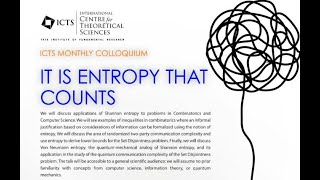
It Is Entropy That Counts by Jaikumar Radhakrishnan
Explore Shannon entropy's applications in combinatorics and computer science, including randomized two-party communication complexity and quantum communication complexity of Set Disjointness problem.
Standard and Less Standard Asymptotic Methods - Lecture 4
Explore advanced techniques for evaluating infinite sums and recognizing asymptotic patterns in numerical sequences, with practical examples and applications in various mathematical fields.
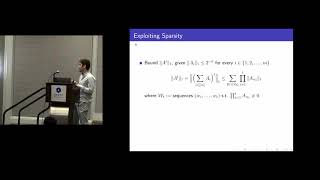
Beyond the Lovasz Local Lemma - Point to Set Correlations and Their Algorithmic Applications
Explore point-to-set correlations and their algorithmic applications, extending beyond the Lovasz Local Lemma for advanced problem-solving in computer science and mathematics.
Multiset Arithmetic via Trees - Math Foundations 230
Explore multiset arithmetic using rooted trees, offering a visual representation for counting functions and new arithmetic operations. Gain insights into this alternative approach with concrete examples and useful notations.
Differential Trail Search and Bounds in Cryptography - Session 2
Explore differential trail search and bounds in cryptography, covering basic notions, permutations, score functions, and recent advancements in the field.
Combinatorial Problems in Support Recovery for 1-bit Compressed Sensing
Explore advanced techniques in 1-bit compressed sensing, focusing on combinatorial approaches to support recovery and their applications in coding theory.
List-Decoding Random Code Ensembles - Advances in Error-Correcting Codes
Explore advanced error-correcting code theory, focusing on list-decoding techniques for random code ensembles. Gain insights into cutting-edge research in coding theory.
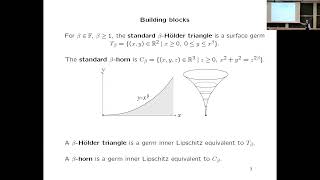
Lipschitz Geometry and Combinatorics of Abnormal Surface Germs
Explore Lipschitz geometry and combinatorics of abnormal surface germs in this advanced mathematics talk by Andrei Gabrielov from Purdue University.
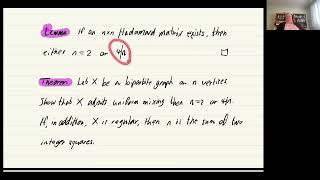
Algebraic Graph Theory and Quantum Computing - Lecture 11
Explore the intersection of algebraic graph theory and quantum computing, delving into advanced mathematical concepts and their applications in quantum information science.
Probabilistic Programming Interfaces for Random Graphs: Markov Categories, Graphons, and Nominal Sets - POPL 2024
Explore semantic models of probabilistic programming languages over graphs, connecting graphons to equational theories through Markov categories, measure-theoretic probability, and nominal sets.
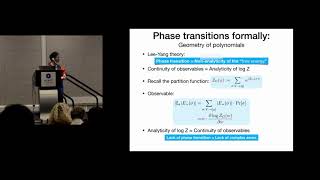
A Deterministic Algorithm for Counting Colorings with 2Δ Colors
Explore a deterministic algorithm for counting colorings, delving into phase transitions, partition functions, and entropy conditions in graph theory.
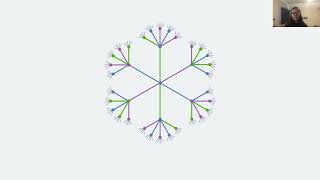
Explicit Near-Fully X-Ramanujan Graphs
Explore finite graphs resembling infinite ones, focusing on Ramanujan graphs and spectral properties. Learn about matrix-weighted polynomials and permutation-based approaches.
Indexing and Iterating Design Space Permutations
Explore mathematical techniques for indexing and iterating design space permutations, focusing on perfect hash functions for efficient game state conversion and representation.
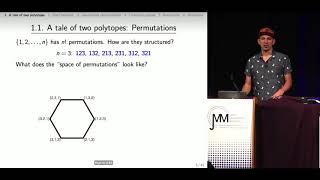
Algebraic Structures on Polytopes
Explore algebraic structures on polytopes, delving into combinatorics, Hopf monoids, and generalized permutahedra. Gain insights into mathematical applications and current research directions.
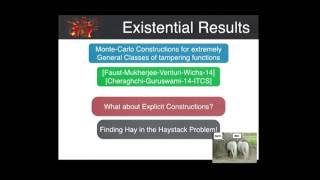
Explicit Non-Malleable Codes Against Bitwise Tampering and Permutations
Explore non-malleable codes' resistance to bit-wise tampering and permutations, covering definitions, realizability, results, and explicit constructions like Reed-Solomon and balanced unary encoding.