CAT(0) Cube Complexes - Lecture 3
Explore CAT(0) cube complexes, their properties, and applications in geometric group theory through an introductory minicourse.
Notions of Nonpositive Curvature and Groups - Lecture 3
Explore combinatorial and geometric methods in group theory, focusing on small cancellation theory, systolic complexes, and quadric complexes. Discover applications to study groups and unify nonpositively curved spaces.
CAT(0) Cube Complexes - Lecture 4
Explore advanced concepts in CAT(0) cube complexes, delving into geometric and combinatorial properties of these mathematical structures.
Notions of Nonpositive Curvature and Groups - Lecture 4
Explore advanced concepts in nonpositive curvature and group theory, focusing on combinatorial and geometric methods, small cancellation theory, and applications to systolic and quadric complexes.
Hyperbolicity from Walls - Group Actions on Hyperbolic Spaces
Explore hyperbolicity in group theory through actions on hyperbolic spaces. Learn about Sageev's construction and its applications in mathematical research.
Finitely Generated Normal Subgroups of RAAGs
Explore finitely generated normal subgroups of Right-Angled Artin Groups (RAAGs) in this mathematical deep dive into CAT(0) cube complexes.
Effective Rank-Rigidity in CAT(0) Cube Complexes
Explore CAT(0) cube complexes and rank-rigidity, examining uniform flipping and skewering techniques to determine group actions and geometric properties.
An Invitation to the Lifting Decomposition in CAT(0) Cube Complexes
Explorez la décomposition de levage dans les complexes cubiques CAT(0), ses applications et connexions avec diverses frontières, offrant de nouvelles perspectives en géométrie combinatoire.
A Combinatorial Characterization of Geometric 3-Manifolds - Lecture
Explore geometric 3-manifolds through combinatorial characterization, focusing on Thurston geometries and their local combinatorial definitions. Learn about new algorithms for geometric decomposition.
Notions of Nonpositive Curvature and Groups - Lecture 2
Explorez les théories de petite simplification et leurs liens avec les complexes systoliques et quadriques. Découvrez comment ces espaces combinatoires à courbure non positive s'appliquent à l'étude des groupes.
CAT(0) Cube Complexes - Lecture 2
Explore advanced concepts of CAT(0) cube complexes, building on fundamental principles to deepen understanding of geometric and combinatorial properties.
CAT(0) Cube Complexes - Lecture 1
Explore CAT(0) cube complexes in this introductory minicourse, delving into fundamental concepts and applications in geometric group theory.
Architectural Constraints on Recurrent Network Dynamics
Explore how network architecture influences and constrains dynamics in recurrent neural networks, focusing on threshold-linear models and their implications for understanding connectomes in neural computation.
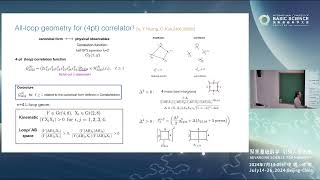
From Combinatorics to Real World Scattering - ICBS 2024
Explore combinatorial geometries in QFT and string theory, focusing on a new formulation for scattering of colored scalars, pions, and gluons.
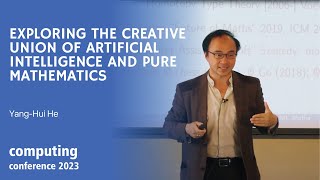
Exploring the Creative Union of Artificial Intelligence and Pure Mathematics
Explore the fusion of AI and pure mathematics, uncovering how machine learning can predict complex mathematical structures and potentially revolutionize theorem proving and scientific discovery.
Twisted (Co)homology of Matroids and Hyperplane Arrangement Complements
Delve into advanced mathematical concepts exploring twisted (co)homology, hyperplane arrangements, and matroidal pairings, with applications to scattering amplitudes in physics.