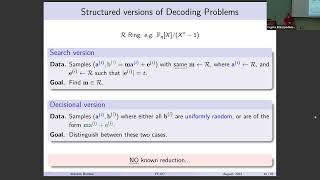
Coding Theory - Advances and Applications
Explore cutting-edge advancements in coding theory and cryptography at this Crypto 2022 session, featuring expert discussions on innovative algorithms and security protocols.
Data Deduplication for Redundant Graph Structures Files
Explore robust data deduplication techniques for sparse graph structures, connecting to classical combinatorial problems and their wide-ranging applications.
Linear Programming and Semidefinite Programming in Coding Theory - An Incomplete Overview
Explore linear programming in coding theory, including MRRW and Levenshtein bounds, spherical codes, and connections to combinatorial objects. Discover recent advances in equiangular lines and energy bounds.
The Hermitian Trace Code - Advances in Error-Correcting Codes
Explores character sum bias over high genus curves, strengthening Stepanov-Bombieri approach. Analyzes multiplicity in function fields using new 'universal derivative-fix' lemma.
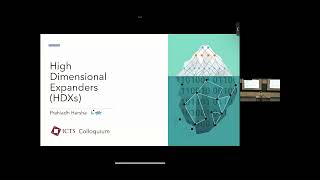
High Dimensional Expanders - HDXs
Explore high-dimensional expanders, their mathematical foundations, and recent applications in computer science, including property testing, coding theory, and approximate counting.

Expanders in Higher Dimensions: From Local to Global Properties and Applications
Explore high-dimensional expanders, their local-to-global properties, and applications in coding theory, networking, and computational complexity.
Asymptotic Distribution of Frobenius Roots for Curves and Abelian Varieties
Explore asymptotic distribution of Frobenius roots for curves and abelian varieties in this advanced mathematical lecture by Michael Tsfasman.
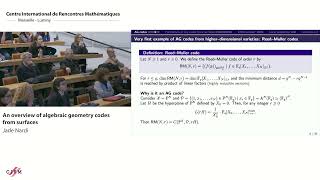
An Overview of Algebraic Geometry Codes from Surfaces
Explore algebraic geometry codes from surfaces, covering effective divisors, evaluation maps, minimum distance, and toric varieties. Gain insights into parameters, restrictions, and decoding techniques.
Sparsification: Graphs, CSPs and Codes - Sublinear Graph Simplification
Explore graph sparsification, CSP compression, and code sparsification techniques. Learn about cutting-edge research in sublinear graph simplification and its applications to various domains.
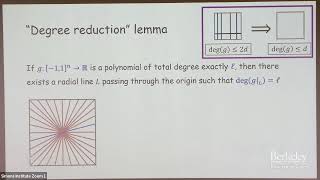
Low Degree Testing over the Reals
Explore low degree testing over real numbers, focusing on theoretical concepts and applications in local algorithms.
Statistical Physics and Statistical Inference - Lecture 2
Explore statistical physics and inference, covering Bayesian methods, error correction, spin glasses, and advanced algorithms like belief propagation. Gain insights into phase transitions and applications in machine learning.

Tradeoff Constructions for Quantum Locally Testable Codes
Explore groundbreaking constructions for quantum locally testable codes, examining weight reduction, soundness amplification, and distance amplification techniques to achieve new parameter regimes in quantum error correction.
Tight Bounds for General Computation in Noisy Broadcast Networks
Delve into the mathematical analysis of noise-resilient protocols in broadcast networks, exploring tight bounds for general computation and innovative simulation schemes with Dr. Saxena.
Codes for Unexpected and Expected Loads in Distributed Computing Systems
Explore coding theory applications in distributed computing systems, focusing on erasure coding's role in handling unpredictable data access patterns and optimizing storage efficiency.
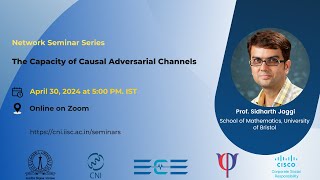
The Capacity of Causal Adversarial Channels
Explore the mathematical foundations of causal adversarial channels and their capacity constraints, focusing on discrete-time systems and state-based transitions in communication networks.
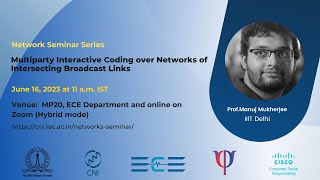
Multiparty Interactive Coding over Networks of Intersecting Broadcast Links
Delve into advanced network communication concepts, focusing on interactive coding schemes for broadcast channels with random bit-flip noise and strategies for optimizing multiparty computations.
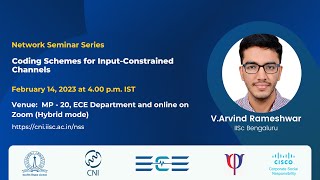
Coding Schemes for Input-Constrained Channels in Information Theory and Communication
Explore coding schemes for binary input-constrained channels, focusing on RLL constraints, Reed-Muller codes, and error resilience in both stochastic and adversarial channel models.
Innovations in Theoretical Computer Science 2020 - Session 5
Explore cutting-edge research in theoretical computer science, including secure computation, communication protocols, coding theory, and fault-tolerant algorithms presented at ITCS 2020.
Coding Theoretic Framework for Private Information Retrieval - SIAM SAGA Seminar
Explore private information retrieval in coded storage systems, focusing on algebraic-geometric codes and star product schemes for adjustable storage overhead and server collusion protection.
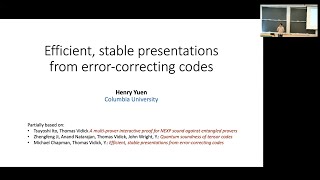
Efficient, Stable Presentations From Error-Correcting Codes
Explore error-correcting codes and their applications in efficient, stable presentations with Columbia University's Henry Yuen in this insightful talk from the Fields Institute workshop.
PCPs and Global Hyper-contractivity - Lecture 1
Explore advanced concepts in theoretical computer science, focusing on Probabilistically Checkable Proofs and global hyper-contractivity with expert Dor Minzer.